

Davis, Theodore M.
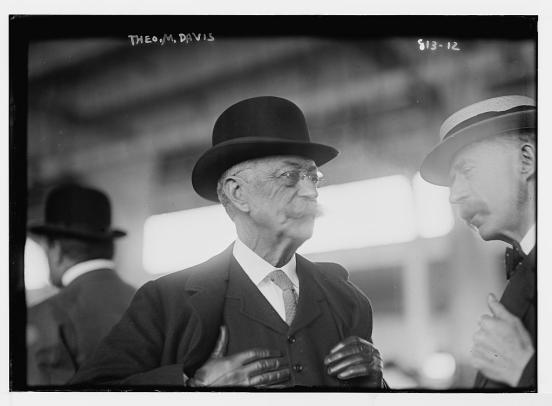
Theodore M. Davis (1837–1915) was an American businessman and financier who played a central role in the early twentieth-century exploration of the Valley of the Kings. Born in New York in 1837, Davis rose from modest beginnings and was largely self-educated. He built a successful career in law and finance in New York and Rhode Island, accumulating considerable wealth through business ventures during and after the American Civil War.
Davis first travelled to Egypt in 1887, initially as a visitor, but repeated annual stays deepened his fascination with the country’s ancient past. In 1897, he commissioned an opulent dahabiyeh, the Beduin, from which he undertook regular journeys along the Nile, visiting major archaeological sites. Influenced by conversations with European archaeologists and increasingly convinced that Thebes held the greatest potential for major discoveries, Davis began financing archaeological work by 1900, including at least one season of Percy Newberry’s excavation of private tombs in the Theban necropolis. This growing commitment laid the groundwork for his later and more ambitious involvement in the Valley of the Kings.
In 1902, Davis extended his patronage to the Valley, funding excavations under the official supervision of Howard Carter, then Chief Inspector of Antiquities for Upper Egypt. Although Davis and Carter had known one another socially since 1900, their professional collaboration began at this point, with Carter encouraging Davis’ interest in the Valley and the possibility of locating major royal tombs. Under Carter’s direction, Davis’ team achieved notable early successes, including the discovery of KV 43 (Thutmes IV) in 1903 and the clearance and publication of KV 20, the tomb of Thutmes I and Hatshepsut.
Carter’s involvement ended in 1904, when he was transferred north by the Antiquities Service. Oversight of Davis’ work subsequently passed to James Quibell and then Arthur Weigall. During this transitional period, Davis’ workmen uncovered the intact tomb of Yuya and Thuyu (KV 46) in 1905, the most lavish discovery in the Valley until the discovery of Tutankhamen’s tomb seventeen years later.
At the insistence of the Antiquities Service, Davis appointed a full-time professional archaeologist in 1906, selecting the young English archaeologist Edward Russell Ayrton. Although Ayrton personally held treasure-hunting in low regard, it was during his tenure that the bulk of Davis’s discoveries were made. Among the tombs located under Ayrton’s supervision were the tombs of Siptah (KV 47), Horemheb (KV 57), Tiye (?) or Akhenaten (?) (KV 55), the "Gold Tomb" (KV 56), and numerous unfinished and pit tombs.
Early in his employment, Ayrton proposed that the expedition would benefit from a permanent field headquarters located close to the work, equipped with facilities for cleaning, documentation, and accommodation. Davis agreed, and a rest house—later known as Davis House—was constructed at the entrance to the Western Valley of the Kings, carefully sited so as not to interfere with visitors’ first view of the Valley. The building became the operational base for the excavation team, while Davis himself continued to reside primarily aboard the Beduin with his companion Emma Andrews.
In 1908, Ayrton left the Valley to work with the British Expedition at Abydos. He was succeeded by Harold Jones, who served as Davis’ lead excavation supervisor and was joined by Lancelot Crane, an artist employed to record the reliefs of KV 57. Jones’ tenure was cut short by his death at Davis House in 1911, after which Harry Burton, then serving as photographer, assumed a senior role and remained with Davis’ operations until 1914.
Between 1902 and 1914, Davis’ crews were associated with the discovery of nearly thirty tombs, making him one of the most prolific and widely known excavators in the Valley of the Kings. He published six volumes on his discoveries, though substantial documentation remains unpublished, much of it now held by the British Museum. Artefacts recovered during his excavations are today housed primarily in the Egyptian Museum in Cairo, the British Museum, and the Metropolitan Museum of Art.
In 1914, advancing age and declining health forced Davis to abandon further excavation. Declaring the Valley of the Kings “exhausted,” he returned to the United States, where he died in 1915, seven years before Howard Carter’s discovery of Tutankhamen’s tomb (KV 62).