

KV 06
Rameses IX


Entryway A
See entire tombA divided stairway makes a shallow descent from the beginning of the entryway to gate B. The bases and lower shafts of two pilasters are partially cut into the left (northeast) and right (southwest) walls, beneath the overhang before gate B. The names and epithets of Rameses IX in long cartouches rendered in red and black paint appear on the partly cut pilasters on the left and right walls. This is one of the largest entryways in the Valley of the Kings.

Entrances to KV 6 and KV 55 ca. 1910.

Divided stairway with crowd of tourists.

Tomb entrance with modern gates.

Tourists at tomb entrance.

Tomb entrance with new and old information signs.

Rameses IX with Isis and Nephthys adoring sun disk; Rameses IX's names and epithets.


Part of modern gate


Gate B
See entire tombOn the lintel of gate B, Rameses IX adores a solar disk containing a scarab with Isis on the left and Nephthys on the right. A variation on the scene occurs here with the head and arms of Nut shown above the disk. There are two steps down from the gate to corridor B and a flat landing beyond. There are nineteenth century graffiti on the outer lintel.
Porter and Moss designation:
Tomb entrance with modern gates.
Rameses IX with Isis and Nephthys adoring sun disk; Rameses IX's names and epithets.
Part of modern gate
Corridor B
See entire tombThere are two gates each in the left (northeast) and right (southwest) walls of this corridor that lead to small side chambers. The depiction of a door leaf with a guardian serpent is placed on each side of the corridor, immediately following gate B. A ceiling recess behind the gate shows that the gate was intended to have a door.
The left wall has three scenes: Rameses IX in a kiosk consecrating offerings before Ra-Horakhty and Osiris; a portion of the Litany of Ra, but lacking the opening vignette; and the Iwnmutef priest purifying Osiris from the Opening of the Mouth ritual. The right wall shows another kiosk with Rameses IX censing and libating over a white oryx and floral offerings before Amen-Ra-Horakhty with four ram's heads and Meretseger depicted as the Western Goddess. The first division of the Book of Caverns follows on this wall, but lacks the opening vignette of the sun disk and the large figure of the ram-headed sun god. A frieze of the king's cartouches with the prenomens flanked by lion-headed uraei is located on each wall following the kiosk scenes. The ceiling is decorated with vultures alternating with winged scarabs and the king's names.
Porter and Moss designation:


Rameses IX [libating and censing before Amen-Ra-Horakhty and Meretseger] (reconstruction).

Litany of Re. Courtesy of Uni Dia Verlag; Uni Dia Image Nr. 36402.


Gate Ba
See entire tombThe names of Rameses IX appear on the lintel and reveals of the compound jambs of this gate.
Side chamber Ba
See entire tombThis small, undecorated side chamber is the first on the left (northeast) side of corridor B.
Gate Bb
See entire tombThe names of Rameses IX appear on the lintel and reveals of the compound jambs of this gate.
Side chamber Bb
See entire tombThis small, undecorated side chamber is the second on the left (northeast) side of corridor B.
Gate Bc
See entire tombThe names of Rameses IX appear on the lintel and reveals of the compound jambs of this gate.
Side chamber Bc
See entire tombThis small, undecorated side chamber is the second on the right (southwest) side of corridor B.
Gate Bd
See entire tombThe names of Rameses IX appear on the lintel and reveals of the compound jambs of this gate.
Side chamber Bd
See entire tombThis small, undecorated side chamber is the first on the right (southwest) side of corridor B. The chamber is unfinished.
Gate C
See entire tombDoor pivot holes on both sides of the gate show that large, double wooden doors once closed the gate. The lintel displays a solar disk containing a ram-headed god between a kneeling female figure and a baboon. The disk is flanked by kneeling figures of Rameses IX, who is protected by the wings of large falcons. There is a winged sun disk on the soffit and the king's names and epithets appear on the reveals and thicknesses.
Porter and Moss designation:
Corridor C
See entire tombTwo horizontal, rectangular recesses lie opposite each other high on the left (northeast) and right (southwest) walls of this corridor. On each side the initial decorative motif is a door leaf with guardian serpent. A frieze text in large hieroglyphs giving the king's names and epithets is placed above the scenes on each wall. The left wall is decorated in two registers. The first contains figures and text from the Litany of Ra, followed by a portion of the upper register of the second hour of the Imydwat and Book of the Dead spell 126. The second shows three scenes: Rameses IX followed by Hathor holding the royal names; the text of Book of the Dead spell 125; and Rameses IX adoring Khonsu-Neferhotep-Shu. Scenes on the right wall include a ram-headed god and the second to fourth divisions of the Book of Caverns, including Rameses IX offering libations to Amen-Ra. The corridor contains an astronomical ceiling with representations of constellations, a list of decans, and star tables.
Porter and Moss designation:

Circumpolar constellations.


View of Corridor C and Gate D. Courtesy of Uni Dia Verlag; Uni Dia Image Nr. 36403.

Detail of King and names, Book of Caverns. Courtesy of Uni Dia Verlag; Uni Dia Image Nr. 36404.

Detail of Litany of Re. Courtesy of Uni Dia Verlag; Uni Dia Image Nr. 36411.


Gate D
See entire tombThere are door pivot holes on both sides of the gate. On the lintel is a solar disk with a ram-headed god between a Horus-eye and a baboon, flanked on each side by Rameses IX with four gods (Shu, Geb, Osiris, and Horus) and five goddesses (Isis, Nephthys, Neit, Serqet, and Hathor). On the soffit, there is a vulture. The king's names and epithets appear on the reveals and thicknesses.
Porter and Moss designation:

Rameses IX adoring sun disk accompanied by deities.
View of Corridor C and Gate D. Courtesy of Uni Dia Verlag; Uni Dia Image Nr. 36403.

Corridor D
See entire tombAt the end of this corridor are two, low vertical recesses, opposite each other in the left (northeast) and right (southwest) walls. Immediately following gate D are representations on each wall of a door leaf with guardian serpent. The left wall contains excerpts from the second and third hours of the Imydwat in three registers. Scenes on the right wall include Rameses IX offering the image of Ma'at to Ptah and Ma'at and a recumbent mummiform figure of Rameses IX as Osiris with a disk and a scarab. This is followed by an enigmatic scene unique to this tomb: a row of inverted men in circles, depicted in the three registers. In the upper register, the circle of men is shown with female figures on mounds alternating with serpents; in the middle register the men are shown with a group of serpents and the sun bark; and in the lower register the men are with female figures standing on serpents, figures bending over backwards, a group with mummiform figures, and a disk from which two scarabs emerge. Kneeling captives are depicted at the base of both walls. On the ceiling are scenes related to the Books of Day and Night but with additional enigmatic material.
Porter and Moss designation:

Solar boat from end of middle register of "enigmatic" composition.

Bodies on beds.


Circumpolar constellations, and star clocks with kneeling "target" figures (color loss is due to cleaning).

Mummies and bodies on beds.

Enigmatic figures on beds (reconstruction).

Rameses IX offering Ma'at [to Ptah] (reconstruction).

Enigmatic compositions. Courtesy of Uni Dia Verlag; Uni Dia Image Nr. 36405.

Enigmatic compositions. Courtesy of Uni Dia Verlag; Uni Dia Image Nr. 36406.

Detail of Enigmatic compositions. Courtesy of Uni Dia Verlag; Uni Dia Image Nr. 36407.

Opening of the mouth ritual. Courtesy of Uni Dia Verlag; Uni Dia Image Nr. 36409.

Imydwat second hour, third hour (beginning). Courtesy of Uni Dia Verlag; Uni Dia Image Nr. 36413.


Gate E
See entire tombThe reveals and thicknesses of this gate are decorated with the names of Rameses IX.
Porter and Moss designation:
Chamber E
See entire tombNo well shaft has been cut in the floor of this chamber. Only the rear (southeast) wall is decorated and shows the Iwnmutef priest on either side of the gate with different ritual objects associated with the Opening of the Mouth ritual.
Porter and Moss designation:

looking into chamber F

Opening of the mouth ritual. Courtesy of Uni Dia Verlag; Uni Dia Image Nr. 36408.


Gate F
See entire tombThere are door pivot holes on both sides of this gate. They show that large, wooden double doors were to close the gate. On the lintel is a winged disk, and on the thicknesses of the gate and its right reveal are the king's names.
Porter and Moss designation:
Pillared chamber F
See entire tombThis pillared chamber contains a pair of pillars on each side of the center descent. The chamber was not decorated and the cutting of the chamber was not finished beyond the first two pillars. An outline for a door has been drawn in black paint on the right (southwest) wall near the entrance. Rows of dots on both side walls indicate wall smoothing procedures were in progress. A hieratic docket painted on the right wall was recently covered by restorers patching and filling the unfinished carving of this chamber.
Porter and Moss designation:
Descent F
See entire tombThis center descent consists slopes from the floor of chamber F to gate J. The lower end of the descent flattens out as a landing before gate J. A short, sloping ceiling extends from the rear wall of F to gate J and has a slot for a lintel beam at the bottom of the overhang. The side walls are undecorated.
Porter and Moss designation:
Burial chamber J
See entire tombThe rectangular burial pit and sarcophagus emplacement in the floor of burial chamber J are aligned on the axis of the tomb. The pit is shallow and made wider at the top by a shelf along each edge. The entire ceiling is vaulted.
The goddess Nut and a mummiform Osiris from the fifth division of the Book of Caverns flank the gate in the front (northwest) wall. The left (northeast) and right (southwest) walls contain scenes from the Book of Caverns and Book of the Earth. The rear (southeast) wall is divided into two registers. The upper shows gods before Rameses IX who is in a bark with divinities, and the lower shows Horus reviving the king as Osiris in a shrine accompanied by protective deities. The ceiling is decorated with two elongated figures of Nut bent over abbreviated versions of the Books of Day and Night, preceded by a panel showing the ram-headed sun god in a disk adored by two pair of baboons.
Chamber plan:
RectangularRelationship to main tomb axis:
ParallelChamber layout:
Flat floor, no pillarsFloor:
One levelCeiling:
Vaulted
Porter and Moss designation:

Book of Caverns, fifth division: Nut holding forms of Ra (sun disk and ram-headed man).

Gods with king's cartouches (standing in place of king) in solar bark.

Book of the Earth, part A: personification of a water clock.

Adoration of sun disk emerging from crocodile.

Ram-headed form of sun god Ra greeted by animal-headed gods; Book of the Earth, part A: dead emerging from burial mounds.

Book of the Day: Nut preparing to swallow the sun disk.

Burial chamber J with pit in floor.

Book of Caverns, sixth division: excerpt; enigmatic composition.

Book of the Night, twelfth hour: sun emerging from Nut.

Book of the Day, beginning: sun emerging from Nut.

Book of the Day, abbreviated beginning and ending.

Book of the Night, twelfth hour.


Deities adoring divine corpse.

Book of Caverns, sixth division: excerpt; Book of the Night, twelfth hour: excerpt.

Book of the Night, twelfth hour: excerpt; enigmatic composition; Book of Caverns, sixth division: excerpt.

Book of Caverns, fifth division: Osiris; Book of the Night, twelfth hour; enigmatic composition.

Book of Caverns, fifth division: Osiris.

Book of Caverns, fifth division: Nut and Osiris viewed by tourists.

Book of the Day, beginning; Book of the Earth, excerpts; enigmatic compositions.

Book of the Day: excerpts; Book of the Earth: excerpts; enigmatic composition.

Book of the Day, beginning; Book of Caverns, fifth division: excerpt; Book of the Earth: excerpts.

Book of Caverns, fifth division: Nut.

Book of the Night, twelfth hour: sun emerging from Nut.

Heads of two Nut figures.

Four baboons worshipping sun disk.

Winged sun disk; Rameses IX in solar barks of the day and night; resurrection of Osiris.

Winged sun disk; Rameses IX in day and night solar barks.

Detail of ceiling from Burial chamber J. Courtesy of Uni Dia Verlag; Uni Dia Image Nr. 36412.

Book of Caverns fifth and sixth division extracts. Courtesy of Uni Dia Verlag; Uni Dia Image Nr. 36414.

View of rear wall, burial chamber J. Courtesy of Uni Dia Verlag; Uni Dia Image Nr. 36415.

Detail of ceiling from Burial chamber J. Courtesy of Uni Dia Verlag; Uni Dia Image Nr. 36416.


Gate J
See entire tombDoor pivot holes on both sides of the gate show that wooden double doors were to be installed here. Two steps descend through the gate to chamber J. On the jambs and thicknesses of gate J are the King's names.
Porter and Moss designation:

Rameses VI's Horus name and second cartouche.

Remains of Rameses VI's titles.


About
About
The entrance to the tomb of Rameses IX, located in the main Wadi, lies on a northwest-southeast axis and is cut into the west side of a large hill that dominates the central part of the Valley. Its plan consists of an open entryway Ramp (A), three successive corridors (B, C, D), a chamber E, and an unfinished pillared chamber (F) with central descent, which leads to the burial chamber J. The first corridor B has four undecorated side chambers (Ba-Bd), one of which (Bd) was left unfinished. The first three corridors of the tomb are well cut, but no well-shaft was excavated in chamber E. A corridor following descent F was enlarged to be used as the burial chamber. A two-tiered pit to hold the missing Sarcophagus or Coffin was cut into the floor of the burial chamber.
The tomb is decorated with scenes from the Book of Gates (gate B, corridor C), Litany of Ra (corridor B, corridor C), Book of Caverns (corridor B, corridor C, burial chamber J), Imydwat (corridor C, corridor D), Book of the Dead (corridor C), Book of the Earth (burial chamber J), Book of the Night (burial chamber J), and Opening of the Mouth ritual (corridor B, well chamber E). There are also representations of the deceased with deities (corridor B, corridor C, corridor D, burial chamber J), bound enemies (corridor C, corridor D), enigmatic compositions (corridor D), and an astronomical ceiling (corridor C). Abitz observed that at the time of the death of Rameses IX, only corridors B and C had been plastered, and only the painted decoration in corridor B had been completed. After the death of the king, the remaining plastering and painting of the ceiling and walls of the tomb were hastily finished. The walls of KV 6 contain over fifty graffiti, mainly located on the upper part of the walls, indicating the tomb was partly filled with debris during antiquity.
Noteworthy features:
KV 6 has one of largest entrances in the Valley. The intention to cut pilasters at the end of the entryway A as well as the presence of side chambers off the first corridor B are reminiscent of KV 11. There is a large two-tiered pit in the floor of burial chamber J. This the last royal tomb in the Valley to have so much of its decoration completed.
Site History
KV 6 was unfinished at the time of the death of Rameses IX. It appears that only about half of the originally planned decoration was completed at the time of the Rameses IX's death. The tomb has been open since antiquity. The mummy of the king was found in the Dayr al Bahari cache (DB 320) in 1881.
Dating
This site was used during the following period(s):
Exploration
Conservation
Conservation History
The rough unfinished surfaces in chamber F have recently been smoothed over with plaster. Glass wall panels have been installed in corridors B, C and D and chamber E.
Site Condition
KV 6 has not suffered from flood damage, but the paint on the walls of the tomb is faded and flaking off. The lower registers of painted decoration on the walls of the burial chamber are lost.
Hieroglyphs
Rameses IX
 King of Upper and Lower Egypt, Beautiful is the Ka-Soul of Ra, Chosen by Ra, Son of Ra, Born of Ra Who Appears in Thebes, Beloved of Amen
niswt-bity nfr-kA-Raw stp-n-Raw sA-Raw Raw-msw-xA(w)-<im>-WAst mry-Imn
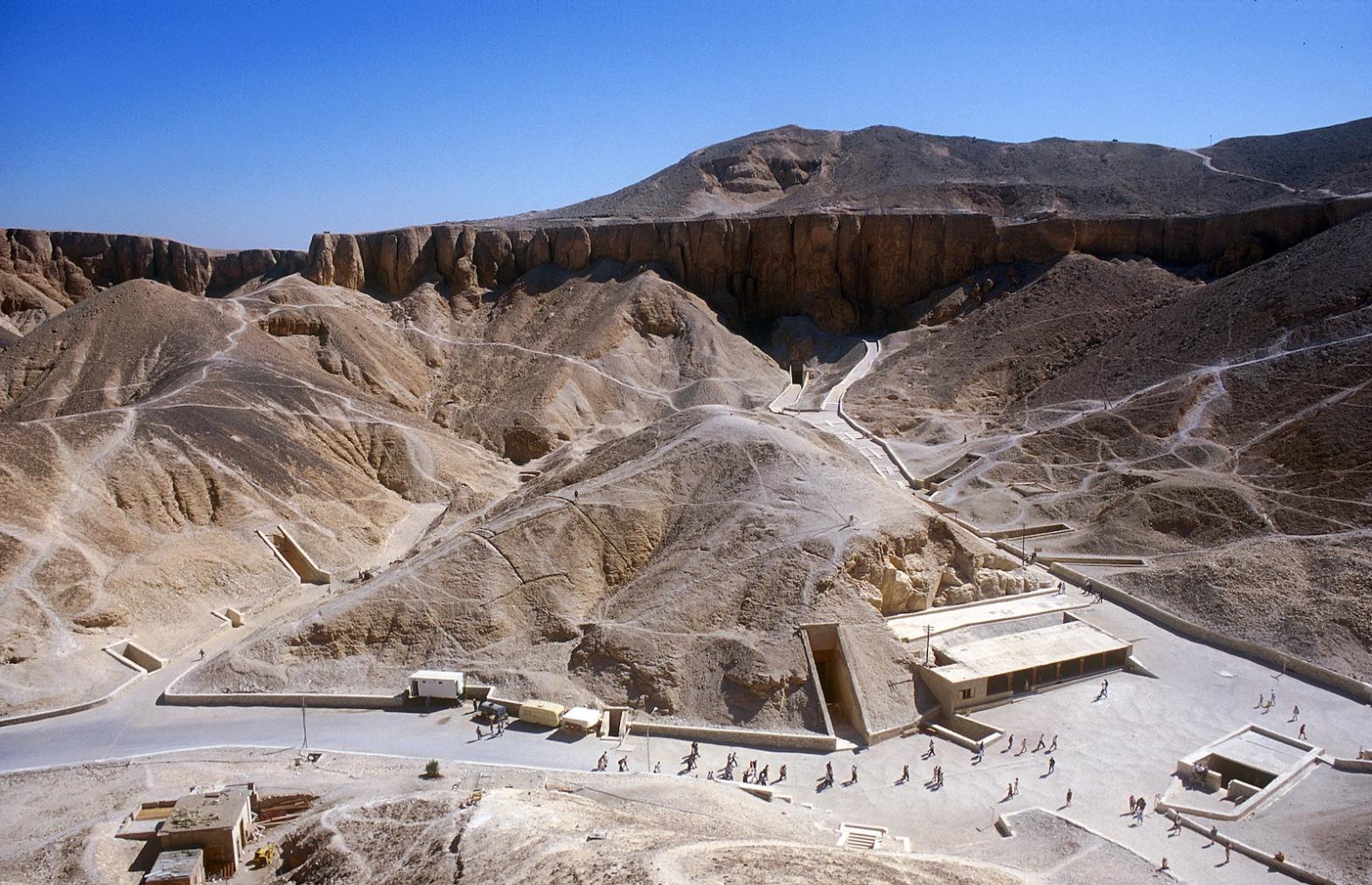
Main valley looking southeast from west cliff above KV 7, showing central hill into which KV 5., KV 6 and KV 55 were cut (left to right). Entrances to KV 3, KV 46 and KV 4 (bottom to top) are in side wadi to left of center, with entrance to KV 19 above.

Tomb entrances and inspector's office.
Book of Caverns, fifth division: Nut holding forms of Ra (sun disk and ram-headed man).
Gods with king's cartouches (standing in place of king) in solar bark.
Book of the Earth, part A: personification of a water clock.
Adoration of sun disk emerging from crocodile.
Ram-headed form of sun god Ra greeted by animal-headed gods; Book of the Earth, part A: dead emerging from burial mounds.
Book of the Day: Nut preparing to swallow the sun disk.
Rameses VI's Horus name and second cartouche.
Remains of Rameses VI's titles.
Burial chamber J with pit in floor.
Entrances to KV 6 and KV 55 ca. 1910.
Divided stairway with crowd of tourists.
Tomb entrance with modern gates.
Tourists at tomb entrance.

Tomb entrances.

Tomb entrances and tourist shelter.

Tomb entrances and tourist shelter in the central part of the Valley of the Kings.
Book of Caverns, sixth division: excerpt; enigmatic composition.
Book of the Night, twelfth hour: sun emerging from Nut.
Book of the Day, beginning: sun emerging from Nut.
Book of the Day, abbreviated beginning and ending.
Book of the Night, twelfth hour.
Solar boat from end of middle register of "enigmatic" composition.
Circumpolar constellations.
Bodies on beds.
Rameses IX adoring sun disk accompanied by deities.
Tomb entrance with new and old information signs.

Tomb entrances and a modern tourist shelter.

Tomb entrances, antiquities office and tourist shelter.

Overhang.
Rameses IX with Isis and Nephthys adoring sun disk; Rameses IX's names and epithets.
looking into chamber F
Part of modern gate

Cartouche of Rameses IX (detail)

Rameses IX [followed by Hathor].

Valley of the Kings, panoramic view from cliffs above KV 09, looking southeast. Visible are entrances to KV 03, KV 07, KV 04, KV 05, KV 06, KV 55, KV 62, KV 18, KV 17, KV 16, KV 10, KV 11, KV 57, and toursit shelter.

KV 06: Rameses IX, Burial chamber J, right wall. Book of the Earth, part A: excerpt; enigmatic composition (detail)

Tomb entrances and tourist shelter
Deities adoring divine corpse.

Tomb entrance with modern gate and tourists.

Tomb section and plan.
Book of Caverns, sixth division: excerpt; Book of the Night, twelfth hour: excerpt.
Book of the Night, twelfth hour: excerpt; enigmatic composition; Book of Caverns, sixth division: excerpt.
Book of Caverns, fifth division: Osiris; Book of the Night, twelfth hour; enigmatic composition.
Book of Caverns, fifth division: Osiris.
Book of Caverns, fifth division: Nut and Osiris viewed by tourists.
Book of the Day, beginning; Book of the Earth, excerpts; enigmatic compositions.
Book of the Day: excerpts; Book of the Earth: excerpts; enigmatic composition.
Book of the Day, beginning; Book of Caverns, fifth division: excerpt; Book of the Earth: excerpts.
Book of Caverns, fifth division: Nut.
Book of the Night, twelfth hour: sun emerging from Nut.
Heads of two Nut figures.
Four baboons worshipping sun disk.
Winged sun disk; Rameses IX in solar barks of the day and night; resurrection of Osiris.
Winged sun disk; Rameses IX in day and night solar barks.
Circumpolar constellations, and star clocks with kneeling "target" figures (color loss is due to cleaning).
Mummies and bodies on beds.

New tomb information sign.
Rameses IX [libating and censing before Amen-Ra-Horakhty and Meretseger] (reconstruction).
Enigmatic figures on beds (reconstruction).

Tomb plan.
Rameses IX offering Ma'at [to Ptah] (reconstruction).

Ostracon with plan of KV6, JE 4371 (CG 25184). Courtesy of Uni Dia Verlag; Uni Dia Image Nr. 36401.
Litany of Re. Courtesy of Uni Dia Verlag; Uni Dia Image Nr. 36402.
View of Corridor C and Gate D. Courtesy of Uni Dia Verlag; Uni Dia Image Nr. 36403.
Detail of King and names, Book of Caverns. Courtesy of Uni Dia Verlag; Uni Dia Image Nr. 36404.
Enigmatic compositions. Courtesy of Uni Dia Verlag; Uni Dia Image Nr. 36405.
Enigmatic compositions. Courtesy of Uni Dia Verlag; Uni Dia Image Nr. 36406.
Detail of Enigmatic compositions. Courtesy of Uni Dia Verlag; Uni Dia Image Nr. 36407.
Opening of the mouth ritual. Courtesy of Uni Dia Verlag; Uni Dia Image Nr. 36408.
Opening of the mouth ritual. Courtesy of Uni Dia Verlag; Uni Dia Image Nr. 36409.

Sun disk crossed by snakes, among other things, above a door. Courtesy of Uni Dia Verlag; Uni Dia Image Nr. 36410.
Detail of Litany of Re. Courtesy of Uni Dia Verlag; Uni Dia Image Nr. 36411.
Detail of ceiling from Burial chamber J. Courtesy of Uni Dia Verlag; Uni Dia Image Nr. 36412.
Imydwat second hour, third hour (beginning). Courtesy of Uni Dia Verlag; Uni Dia Image Nr. 36413.
Book of Caverns fifth and sixth division extracts. Courtesy of Uni Dia Verlag; Uni Dia Image Nr. 36414.
View of rear wall, burial chamber J. Courtesy of Uni Dia Verlag; Uni Dia Image Nr. 36415.
Detail of ceiling from Burial chamber J. Courtesy of Uni Dia Verlag; Uni Dia Image Nr. 36416.


Bibliography
Weeks, Kent R. Measurements of KV Royal Tomb Components. In: Richard H. Wilkinson and Kent R. Weeks (eds.). The Oxford Handbook of the Valley of the Kings. Oxford: Oxford University Press, 2016. Pp. 583-599.
Weeks, Kent R. (ed.). Atlas of the Valley of the Kings (= Publications of the Theban Mapping Project, 1). Cairo: American University in Cairo Press, 2000. Map sheets 16-17.
Weeks, Kent R. The Treasures of Luxor and the Valley of the Kings. Vercelli: WhiteStar, 2005; Cairo: American University in Cairo Press, 2005. Available in English, Italian, Spanish, French, German, Greek, and Chinese. Pp. 346-351.
Wilkinson, Richard H. and Carl Nicholas Reeves. The Complete Valley of the Kings. London: Thames and Hudson, 1996. Pp. 168-171.
