

KV 19
Mentuherkhepeshef
Ancient cutting of entryway to KV 19 surmounted by modern retaining walls; light rectangle in foreground is modern covering of KV 60.


Entryway A
See entire tombThe entryway to this tomb is cut into the base of a short spur projecting from the cliff face between KV 20 and KV 43, near the head of a branch wadi well above the main valley floor. The sloping entry passes over the entrance steps of KV 60, a non-royal tomb of Dynasty 18. The plastered side walls of the approach are undecorated, and a deep overhang above the first gate shelters the southeast end of the entryway.

Ancient cutting of entryway to KV 19 surmounted by modern retaining walls; light rectangle in foreground is modern covering of KV 60.

Tomb entrance ca. 1910.

Modern approach path and tomb entrance.


Gate B
See entire tombDoor pivot holes and a ceiling recess in corridor B show that the gate was intended to be closed by a pair of wooden doors. An overhang protrudes from the lintel and partially shelters the gate. A step down to a flat landing is located at the inner edge of the gate. The reveals bear dedication texts in red, and several text columns in black occur on the thicknesses, above pairs of cobras representing Isis, Nephthys, Serqet and Neit.
Porter and Moss designation:

Isis and Nephthys as fire-spitting cobras.

Hieroglyphic text columns including mention of goddesses as fire-spitting cobras.

Beginning of dedication text indicating the tomb was a royal gift.

Bottom of dedication text with evidence of change from Setherkhepeshef to Mentuherkhepeshef.

Text columns.

Text columns.

Serqet and Neit as fire-spitting cobras.

Text columns; painted image of top of door leaf with actual door pivot hole in ceiling above.

Painted image of bottom of door leaf, showing lower pivot (detail).

Detail of Nephthys and Isis as fire-spitting cobras, Gate B, left thickness. Courtesy of Uni Dia Verlag; Uni Dia Image Nr. 36481.


Corridor B
See entire tombA flat landing on the floor behind gate B leads to the sloping floor of this corridor. The plastered walls are each painted with seven scenes, showing Mentuherkhepeshef worshipping and making offerings to various deities: Osiris, Ptah Ta-Tjenen, Khonsu, Bastet, Imsety, Qebehsenuef, and Amen-Ra are shown on the left (northeast) wall; Ptah, Thoth, Banebdjed, Hapy, Duamutef, Meretseger and Sekhmet are depicted on the right (southwest) wall. At the beginning of the corridor, beneath the ceiling recess, a door leaf has been painted on both side walls. Hieratic texts on these painted doors give spells from the Book of the Dead.
Porter and Moss designation:

Mentuherkhepeshef and Imsety (scene 5).

Mentuherkhepeshef and Qebehsenuef (scene 6).

Mentuherkhepeshef and Amen-Ra (scene 7).

Meretseger and Mentuherkhepeshef (scene 6).

Mentuherkhepeshef and Bastet (scene 4).

Sekhmet and Mentuherkhepeshef: detail (scene 7).

Thoth and Mentuherkhepeshef (scene 2).

Duamutef [and Mentuherkhepeshef]: detail.

Sekhmet and Mentuherkhepeshef (scene 7)

Mentuherkhepeshef and Amen-Ra: detail (scene 7)

Mentuherkhepeshef and Osiris (scene 1).

Mentuherkhepeshef and Ptah Ta-Tjenen (scene 2).

Mentuherkhepeshef and Khonsu (scene 3).

Mentuherkhepeshef offers to the syncretic god Ptah-Tatenen (scene 2).

Ptah Ta-Tjenen [and Mentuherkhepeshef] (scene 2).

Mentuherkhepeshef and Bastet (scene 4).

Mentuherkhepeshef [and Qebehsenuef] (scene 6).

Mentuherkhepeshef offering red sash and perfumed ointment [to Bastet] (scene 4).

Ptah and Mentuherkhepeshef (scene 1).

Ptah and Mentuherkhepeshef (scene 1).

Ptah and Mentuherkhepeshef (scene 1).

Banebdjed and Mentuherkhepeshef (scene 3).

Duamutef and Mentuherkhepeshef (scene 5).

Meretseger and Mentuherkhepeshef (scene 6).

Hapy and Mentuherkhepeshef (scene 4).

Duamutef and Mentuherkhepeshef (scene 5).

Preliminary sketch of inscription behind Duamutef giving his name, changed from Hapy, written in preliminary sketch (scene 5).

Thoth [and Mentuherkhepeshef]: belt buckle on figure of Thoth inscribed with name of Rameses IX (scene 2).

Book of the Dead, spell 139, inscribed in hieratic on the painting of the door leaf (detail).

Prince Mentuherkhepeshef [with Amen-Ra] (scene 7) (reconstruction).

Mentuherkhepeshef and Qebehsenuef (reconstruction).

The prince in prayer (before Osiris), scene 1, Corridor B, left wall. Courtesy of Uni Dia Verlag; Uni Dia Image Nr. 36483.

The prince offers to Qebehsenuef, scene 6, Corridor B, left wall. Courtesy of Uni Dia Verlag; Uni Dia Image Nr. 36484.

The prince offers to the sycretic god Amun-Ra (scene 7), Corridor B, left wall. Courtesy of Uni Dia Verlag; Uni Dia Image Nr. 36485.

The prince offers to the syncretic god Amun-Ra. (scene 7), Corridor B, left wall. Courtesy of Uni Dia Verlag; Uni Dia Image Nr. 36486.

The prince libates before the goddess Sekhmet, (scene 7), Corridor B, right wall. Courtesy of Uni Dia Verlag; Uni Dia Image Nr. 36487.

The prince libates before the god Banebdjed, (scene 3), Corridor B, right wall. Courtesy of Uni Dia Verlag; Uni Dia Image Nr. 36488.


Gate C
See entire tombOnly one door pivot hole is visible in the ceiling behind the left (northeast) jamb. Since the cutting of the corridor beyond was abandoned, it is not likely that door leaves were installed.
Corridor C
See entire tombThe quarrying of the tomb was abandoned after the start of this second corridor, and workmen had only begun a four-tiered excavation of stone from the corridor beyond the two rectangular recesses flanking the interior of the gate. A rectangular pit, cut into the floor just inside the second gate, apparently was covered with stone slabs, and may have served for a burial, perhaps of Mentuherkhepeshef or a later intrusive one.
Chamber plan:
RectangularRelationship to main tomb axis:
ParallelChamber layout:
Flat floor, no pillarsFloor:
One levelCeiling:
Flat

Unfinished cutting of corridor.

Burial pit.

View of Corridor C. Courtesy of Uni Dia Verlag; Uni Dia Image Nr. 36482.


About
About
KV 19 is cut into the end of a short spur projecting from the cliffs between KV 20 and KV 43, at the head of a southeast branch of the southeast Wadi. It lies on a northwest-southeast axis. Except for the royal tombs of Rameses VII, Rameses VIII, and Rameses IX, no tombs have entrances or corridors as wide as those in KV 19. Texts on the reveals of gate B state that the owner was a prince. Representations of the deceased in front of various deities and Hieratic texts of the Book of the Dead are painted in corridor B, and enigmatic compositions occur on gate B. The quarrying of the tomb was abandoned after the start of the second corridor C. A rectangular pit just inside gate C may have served for a burial, perhaps that of Mentuherkhepeshef or a later, intrusive one.
Noteworthy features:
This tomb may have originally been intended for Rameses VIII, but was abandoned. A pit was cut in the floor at the beginning of corridor C. The well-preserved painted plaster decoration depicts the prince alone before deities.
Site History
KV 19 was originally intended for Prince Rameses Setherkhepeshef, who later became Rameses VIII. It was taken over and decorated for Prince Rameses Mentuherkhepeshef, a son of Rameses IX. When KV 19 was discovered by Belzoni in 1817, it contained an unspecified number of intrusive burials, probably dating to Dynasty 22. The mummy of the prince was never found.
Dating
This site was used during the following period(s):
Exploration
Conservation
Conservation History
The Supreme Council of Antiquities has installed glass paneling, a wooden walkway and a metal gate.
Site Condition
The painted plaster decoration is in relatively good condition, although some damage has occurred to the scenes closest to the entrance. During the 1994 floods, water entered the tomb but did not reach the level of the painted decoration.
Hieroglyphs
Mentuherkhepeshef
 Fashioned by Ra, Montu is over His Strong Arm
Raw-msw MnTw-Hr-xpS.f

Modern path leading to tomb.
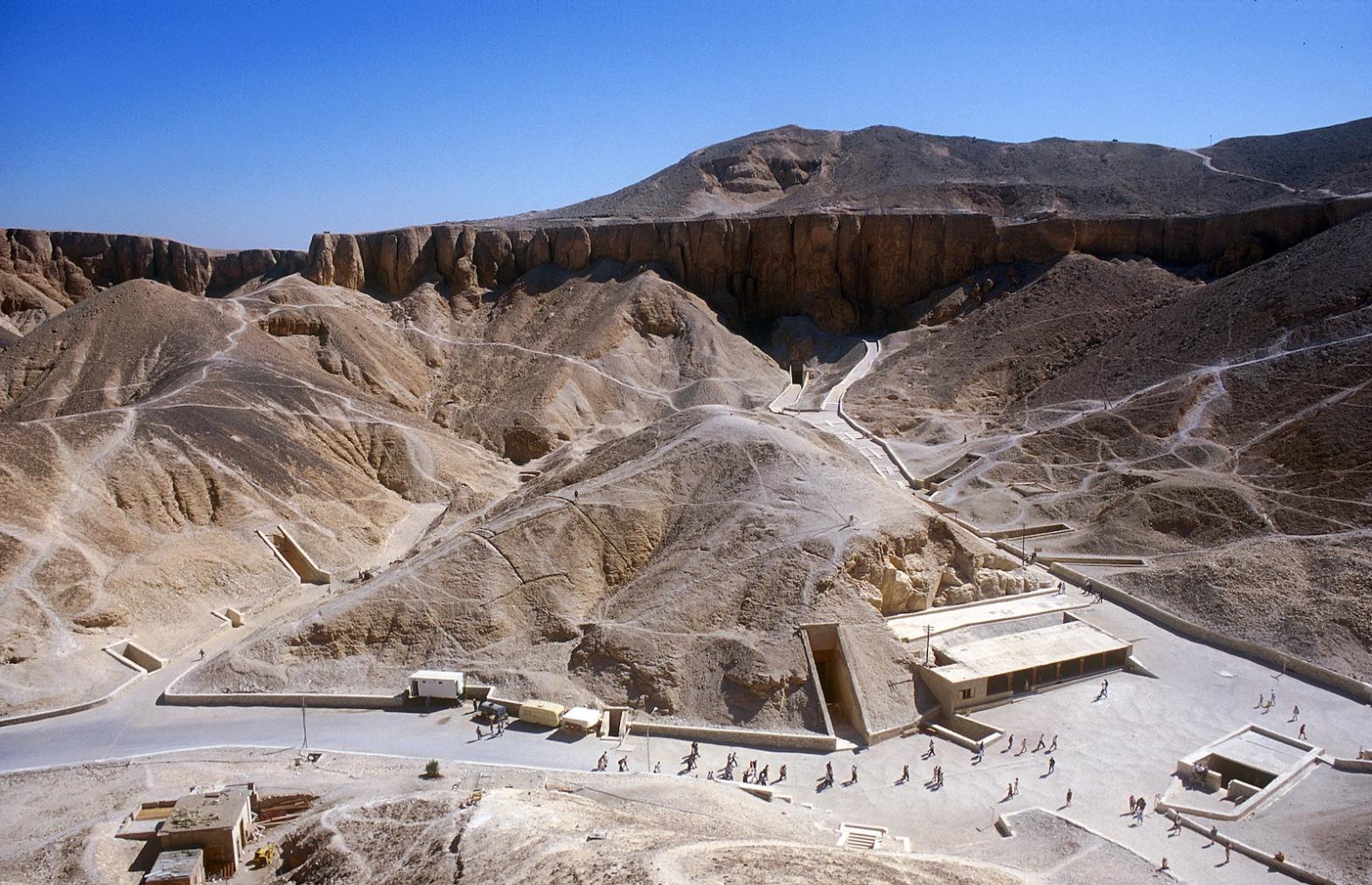
Main valley looking southeast from west cliff above KV 7, showing central hill into which KV 5., KV 6 and KV 55 were cut (left to right). Entrances to KV 3, KV 46 and KV 4 (bottom to top) are in side wadi to left of center, with entrance to KV 19 above.
Ancient cutting of entryway to KV 19 surmounted by modern retaining walls; light rectangle in foreground is modern covering of KV 60.

Tomb entrance with modern approach path.

Tomb entrances and tourist shelter.
Mentuherkhepeshef and Imsety (scene 5).
Mentuherkhepeshef and Qebehsenuef (scene 6).
Mentuherkhepeshef and Amen-Ra (scene 7).
Isis and Nephthys as fire-spitting cobras.
Hieroglyphic text columns including mention of goddesses as fire-spitting cobras.
Meretseger and Mentuherkhepeshef (scene 6).
Beginning of dedication text indicating the tomb was a royal gift.
Bottom of dedication text with evidence of change from Setherkhepeshef to Mentuherkhepeshef.
Text columns.
Text columns.
Serqet and Neit as fire-spitting cobras.
Unfinished cutting of corridor.
Burial pit.

Entrances to KV 20, KV 19 and KV 43.
Mentuherkhepeshef and Bastet (scene 4).
Sekhmet and Mentuherkhepeshef: detail (scene 7).
Thoth and Mentuherkhepeshef (scene 2).
Duamutef [and Mentuherkhepeshef]: detail.
Sekhmet and Mentuherkhepeshef (scene 7)
Mentuherkhepeshef and Amen-Ra: detail (scene 7)
Tomb entrance ca. 1910.
Modern approach path and tomb entrance.
Mentuherkhepeshef and Osiris (scene 1).
Mentuherkhepeshef and Ptah Ta-Tjenen (scene 2).
Mentuherkhepeshef and Khonsu (scene 3).
Mentuherkhepeshef offers to the syncretic god Ptah-Tatenen (scene 2).
Ptah Ta-Tjenen [and Mentuherkhepeshef] (scene 2).
Mentuherkhepeshef and Bastet (scene 4).
Mentuherkhepeshef [and Qebehsenuef] (scene 6).
Mentuherkhepeshef offering red sash and perfumed ointment [to Bastet] (scene 4).
Ptah and Mentuherkhepeshef (scene 1).
Ptah and Mentuherkhepeshef (scene 1).
Ptah and Mentuherkhepeshef (scene 1).
Banebdjed and Mentuherkhepeshef (scene 3).
Duamutef and Mentuherkhepeshef (scene 5).
Meretseger and Mentuherkhepeshef (scene 6).
Hapy and Mentuherkhepeshef (scene 4).
Duamutef and Mentuherkhepeshef (scene 5).
Preliminary sketch of inscription behind Duamutef giving his name, changed from Hapy, written in preliminary sketch (scene 5).
Thoth [and Mentuherkhepeshef]: belt buckle on figure of Thoth inscribed with name of Rameses IX (scene 2).
Book of the Dead, spell 139, inscribed in hieratic on the painting of the door leaf (detail).
Text columns; painted image of top of door leaf with actual door pivot hole in ceiling above.
Painted image of bottom of door leaf, showing lower pivot (detail).
Prince Mentuherkhepeshef [with Amen-Ra] (scene 7) (reconstruction).
Mentuherkhepeshef and Qebehsenuef (reconstruction).
Detail of Nephthys and Isis as fire-spitting cobras, Gate B, left thickness. Courtesy of Uni Dia Verlag; Uni Dia Image Nr. 36481.
View of Corridor C. Courtesy of Uni Dia Verlag; Uni Dia Image Nr. 36482.
The prince in prayer (before Osiris), scene 1, Corridor B, left wall. Courtesy of Uni Dia Verlag; Uni Dia Image Nr. 36483.
The prince offers to Qebehsenuef, scene 6, Corridor B, left wall. Courtesy of Uni Dia Verlag; Uni Dia Image Nr. 36484.
The prince offers to the sycretic god Amun-Ra (scene 7), Corridor B, left wall. Courtesy of Uni Dia Verlag; Uni Dia Image Nr. 36485.
The prince offers to the syncretic god Amun-Ra. (scene 7), Corridor B, left wall. Courtesy of Uni Dia Verlag; Uni Dia Image Nr. 36486.
The prince libates before the goddess Sekhmet, (scene 7), Corridor B, right wall. Courtesy of Uni Dia Verlag; Uni Dia Image Nr. 36487.
The prince libates before the god Banebdjed, (scene 3), Corridor B, right wall. Courtesy of Uni Dia Verlag; Uni Dia Image Nr. 36488.



Articles

History of the Valley of the Kings: Third Intermediate Period to the Byzantine Period
Anatomy of a Tomb: Ancient and Modern Designations for Chambers and Features

Foundation Deposits
Bibliography
Belzoni, Giovanni Battista. Narrative of the Operations and Recent Discoveries within the Pyramids, Temples, Tombs, and Excavations, in Egypt and Nubia. London: Murray, 1820. P. 227.
Davis, Theodore M., Gaston Maspero, Edward Ayrton, Georges Daressy and E.H. Jones. The Tomb of Siphtah (= Theodore M. Davis' Excavations, Biban el Moluk, 4). London, 1908.
Helck, Wolfgang. Königsgräbertal. Wolfgang Helck, Eberhart Otto and Wolfhart Westendorf (eds.). Lexikon der Ägyptologie. 7 vols. Wiesbaden, 1972-1992. 3: 519.
Jenni, Hanna (ed.). Das Grab Ramses’ X (KV 18) (= Aegyptiaca Helvetica, 16). Basal: Schwabe Verlag, 2000.
Lefebure, Eugène. Les hypogées royaux de Thèbes, seconde division: Notices des hypogées (= Mémoires publiés par les members de la mission archéologie française au Caire 3, 1). Paris, 1889. P. 164-167, pls. 69-74.
Porter, Bertha and Rosalind Moss. Topographical Bibliography of Ancient Egyptian Hieroglyphic Text, Reliefs, and Paintings. I, 2. The Theban Necropolis: Royal Tombs and Smaller Cemeteries. Oxford: Clarendon Press, 1964. Pp. 546.
Reeves, Carl Nicholas. Excavations in the Valley of the Kings, 1905/6: A Photographic Record. Mitteilungen des Deutschen Archäologischen Instituts: Abteilung Kairo, 40 (1984): 233-234.
Reeves, Carl Nicholas. Valley of the Kings: The Decline of a Royal Necropolis (= Studies in Egyptology). London: KPI, 1990. Pp. 134-135.
Thomas, Elizabeth. The Royal Necropoleis of Thebes. Princeton: privately printed, 1966. P. 151.
