KV 16
Rameses I

Entryway A
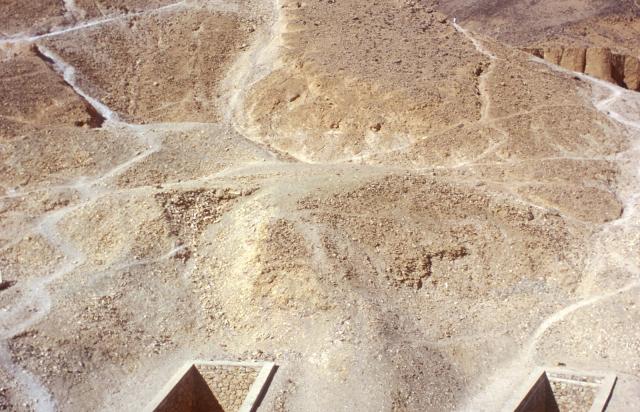
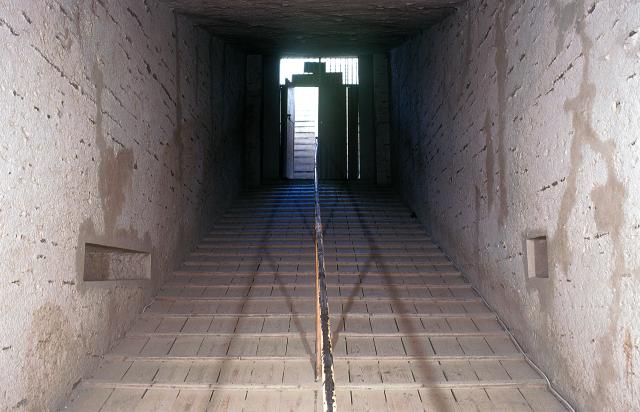
See entire tombModern steps lead down from the present wadi surface to the ancient steps. The ancient undecorated entrance stairs that follow are now covered by a modern wooden stairway. The entryway is surrounded by modern walls.
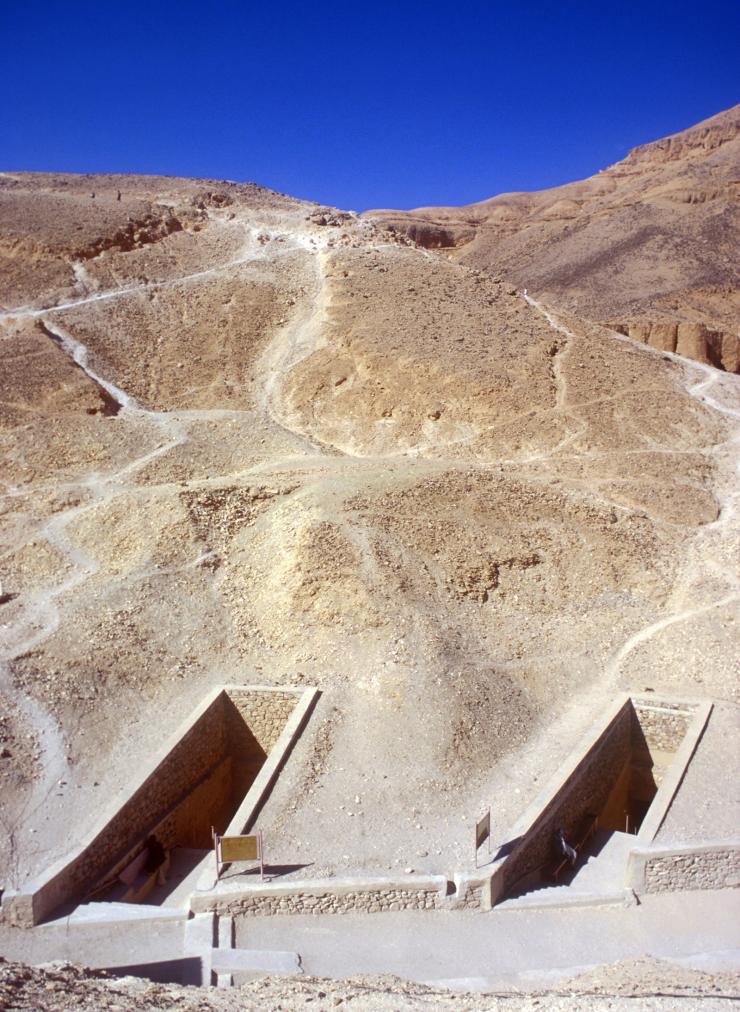
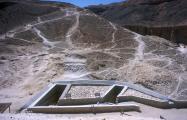
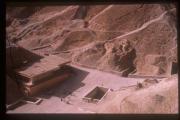
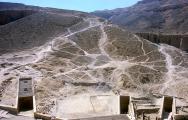
Tomb entrances before construction of flood diversion walls.
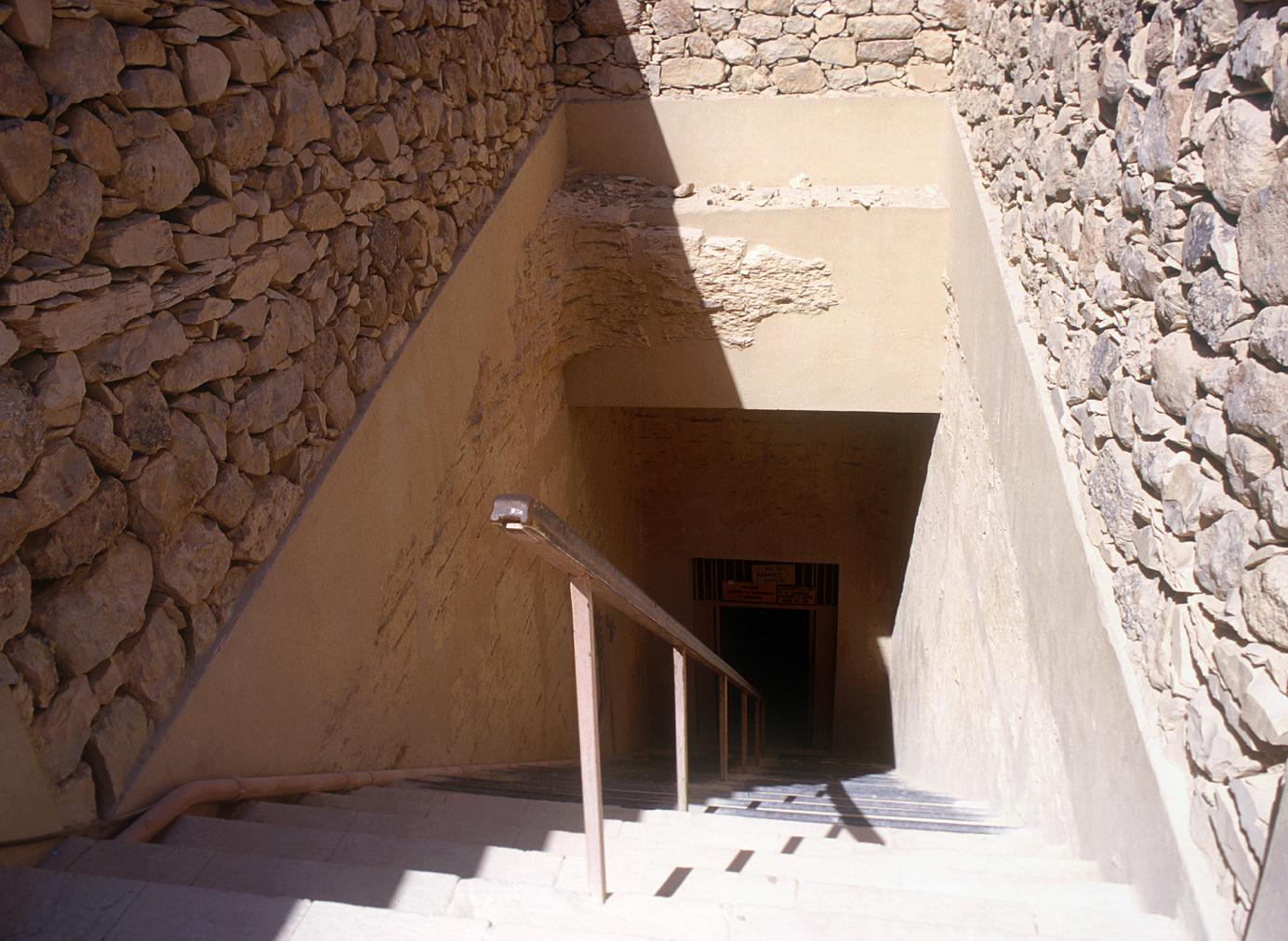
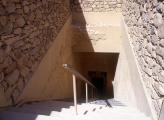
Modern stairs leading to first gate.
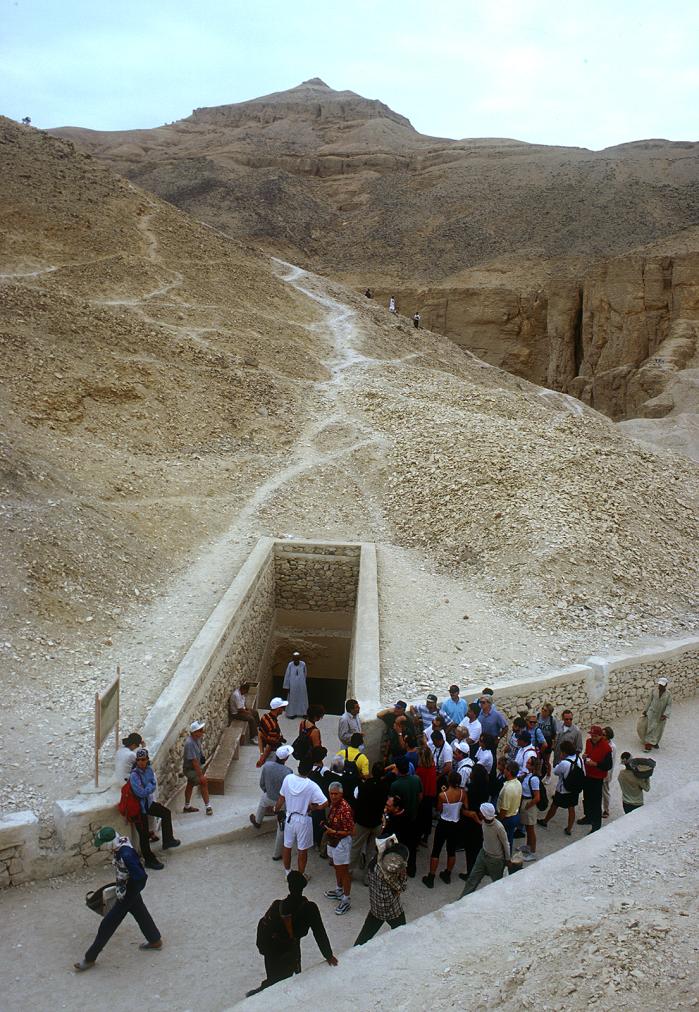
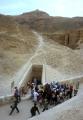
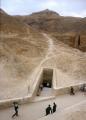
Tourists in front of tomb entrance.
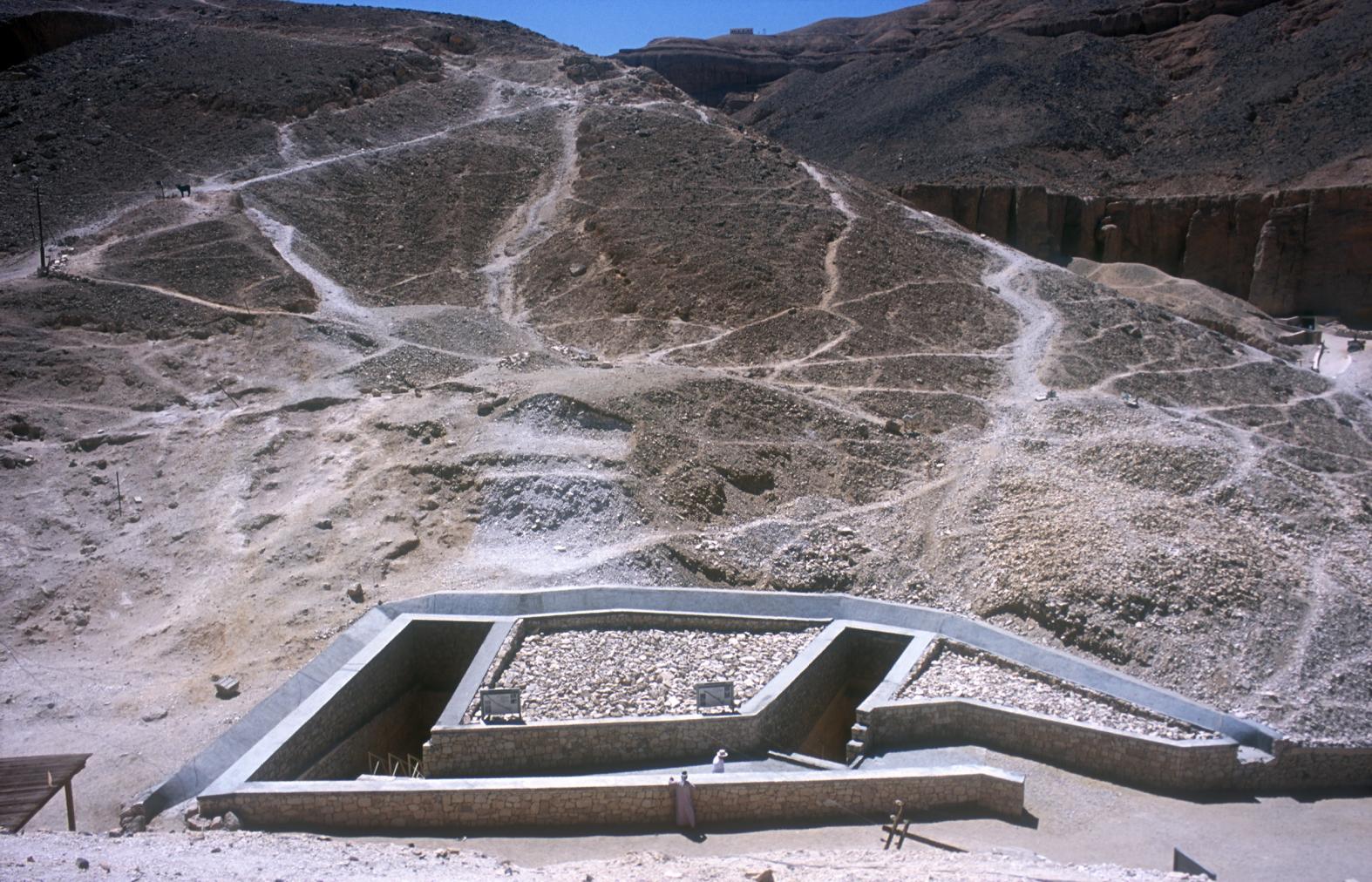
KV16 and KV17 tomb entrances.
Gate B
See entire tombFollowing the overhang of the cliff face is the undecorated first gate of the tomb, which contains four steps. A pair of modern brick jambs have been set against the thicknesses of the original jambs to support the gate.
Porter and Moss designation:
Corridor B
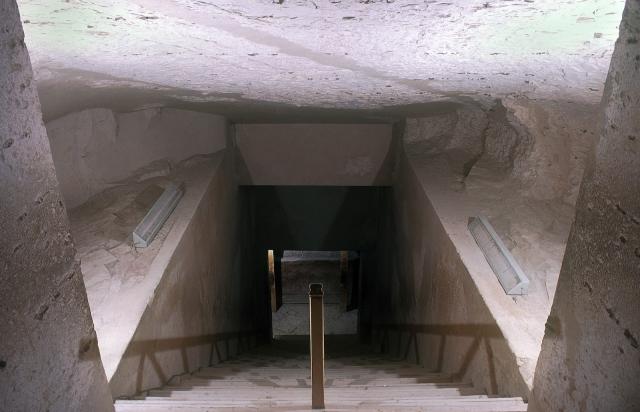
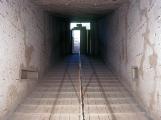
See entire tombA pair of beam holes for lowering the sarcophagus with the aid of ropes were cut in the side walls two-thirds of the way down the sloping corridor B. The passage is well carved, but undecorated.
Porter and Moss designation:
Gate C
See entire tombThe gate was undecorated. The slope of the floor in corridor B continues through this gate and the slope of the soffit beneath the lintel is continued in the ceiling of corridor C. Both Burton and Lane reported traces of plastering and remains of blocking in this gate.
Porter and Moss designation:
Stairwell C
See entire tombThis stairwell was well carved, but undecorated. The unfinished trapezoidal recesses in the left (southeast) and right (northwest) walls are wider than usual for royal tombs of this period. There is an overhang above the lower part of the stairs.
Porter and Moss designation:
Gate J
See entire tombThere is a sloping soffit beneath the high lintel. The threshold slopes slightly downward from front (northeast) to back (southwest).
Porter and Moss designation:
Burial chamber J
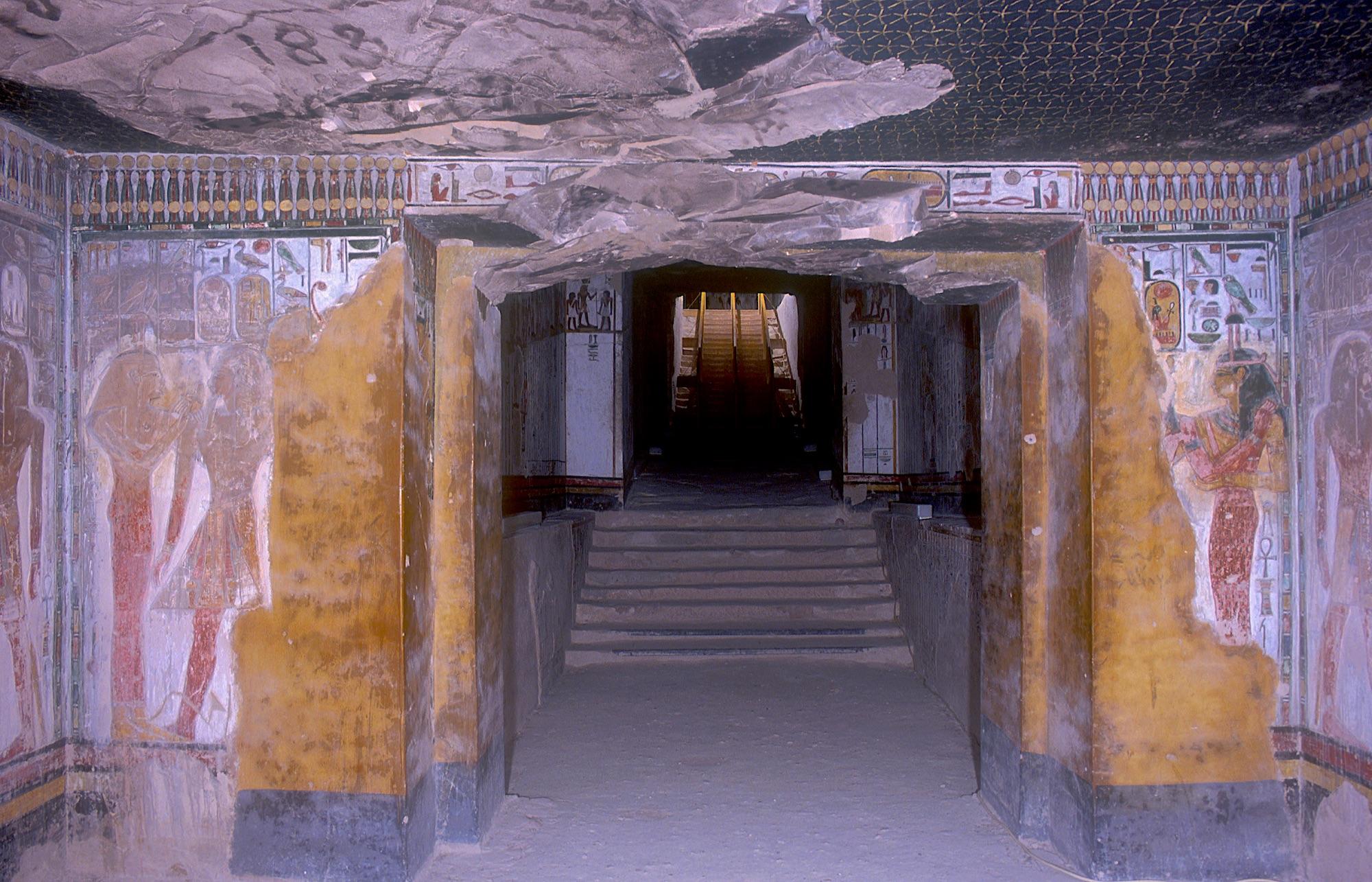
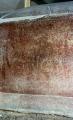
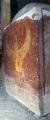
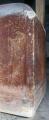
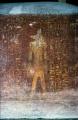
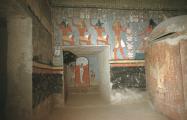
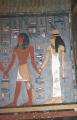
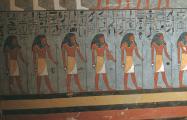
See entire tombThis rectangular chamber with a flat floor and ceiling has side chambers off the right (northwest), rear (southwest) and left (southeast) walls. Pairs of magical brick niches are placed high in the left and right walls, opposite the foot and head ends of the sarcophagus. The painted decoration on a thick coat of plaster shows the king accompanied by deities on the front (northeast) and rear walls and on the left wall, east of gate Ja. Excerpts from the Book of Gates are found on the right and left walls.
Chamber plan:
RectangularRelationship to main tomb axis:
PerpendicularChamber layout:
Flat floor, no pillarsFloor:
One levelCeiling:
Flat
Porter and Moss designation:
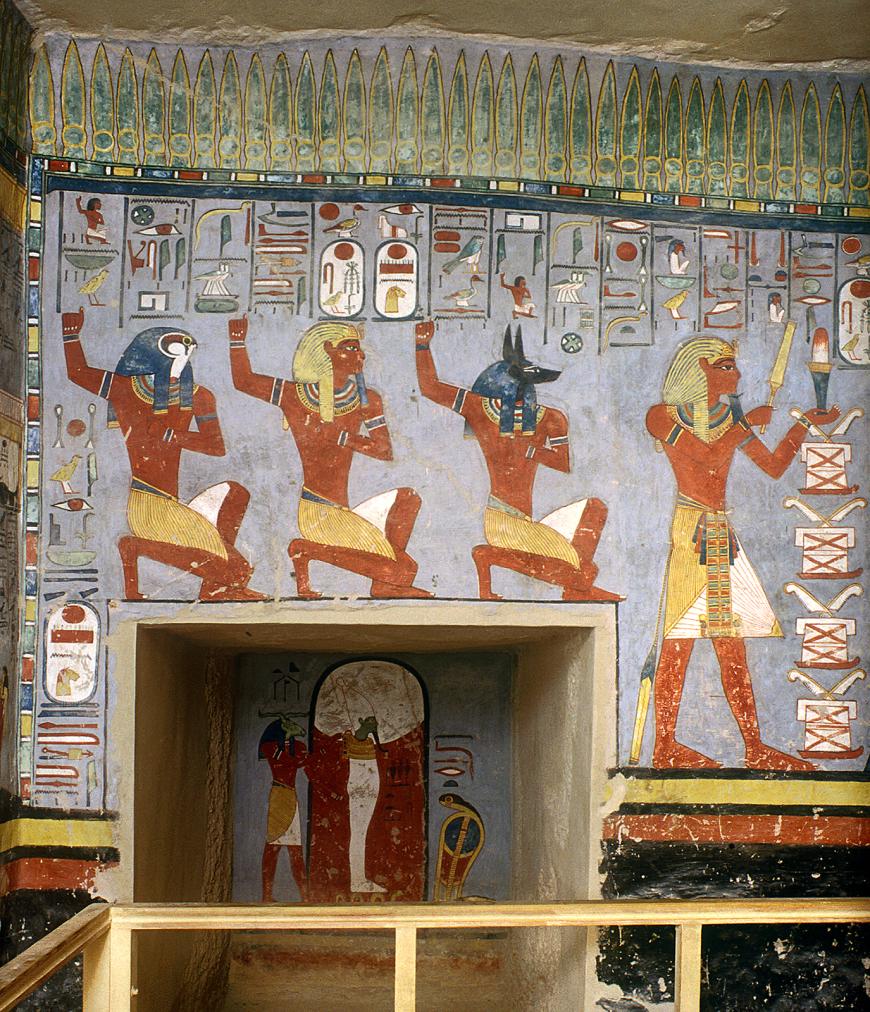
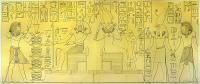
Kheker frieze; Rameses I with souls of Nekhen and Pe; consecrating meret chests [before Atum-Ra-Kheperi].
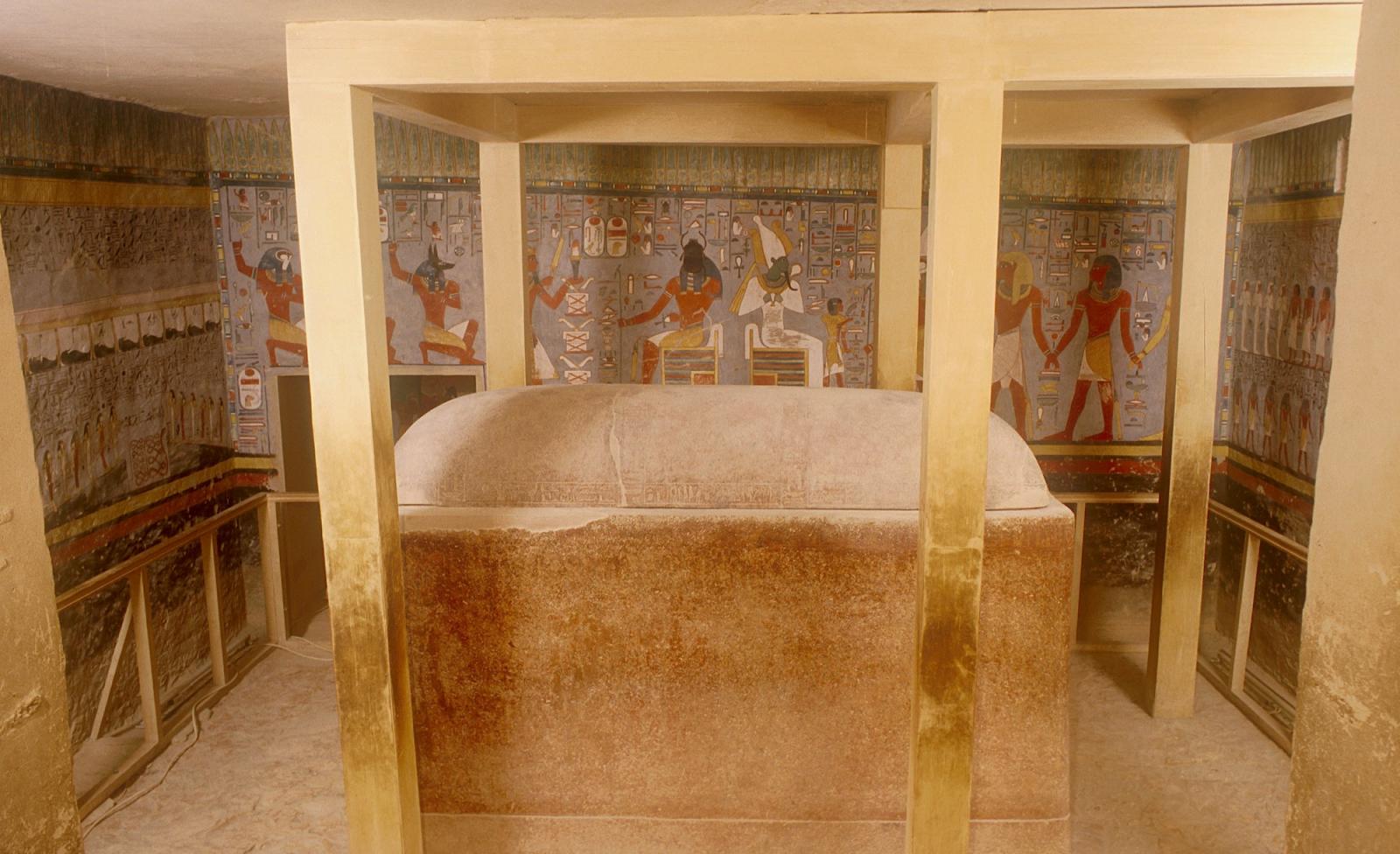
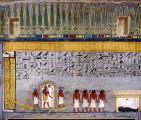
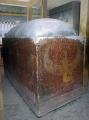
Book of Gates on walls; sarcophagus in center.
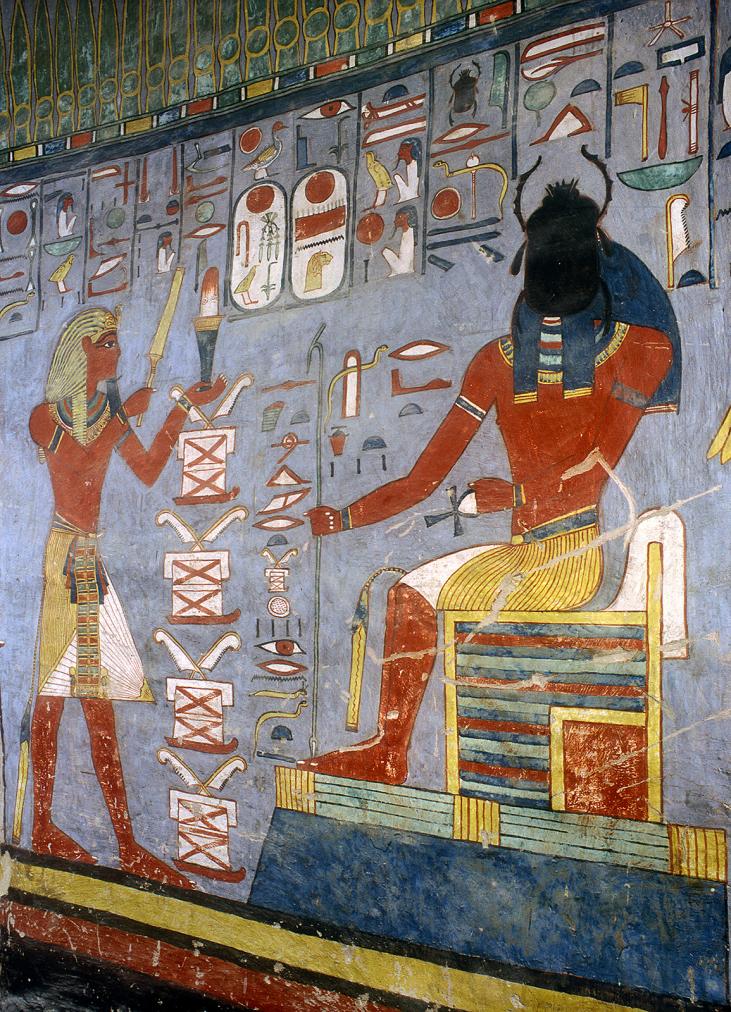
Rameses I offering unguent and four meret chests to Atum-Ra-Kheperi.
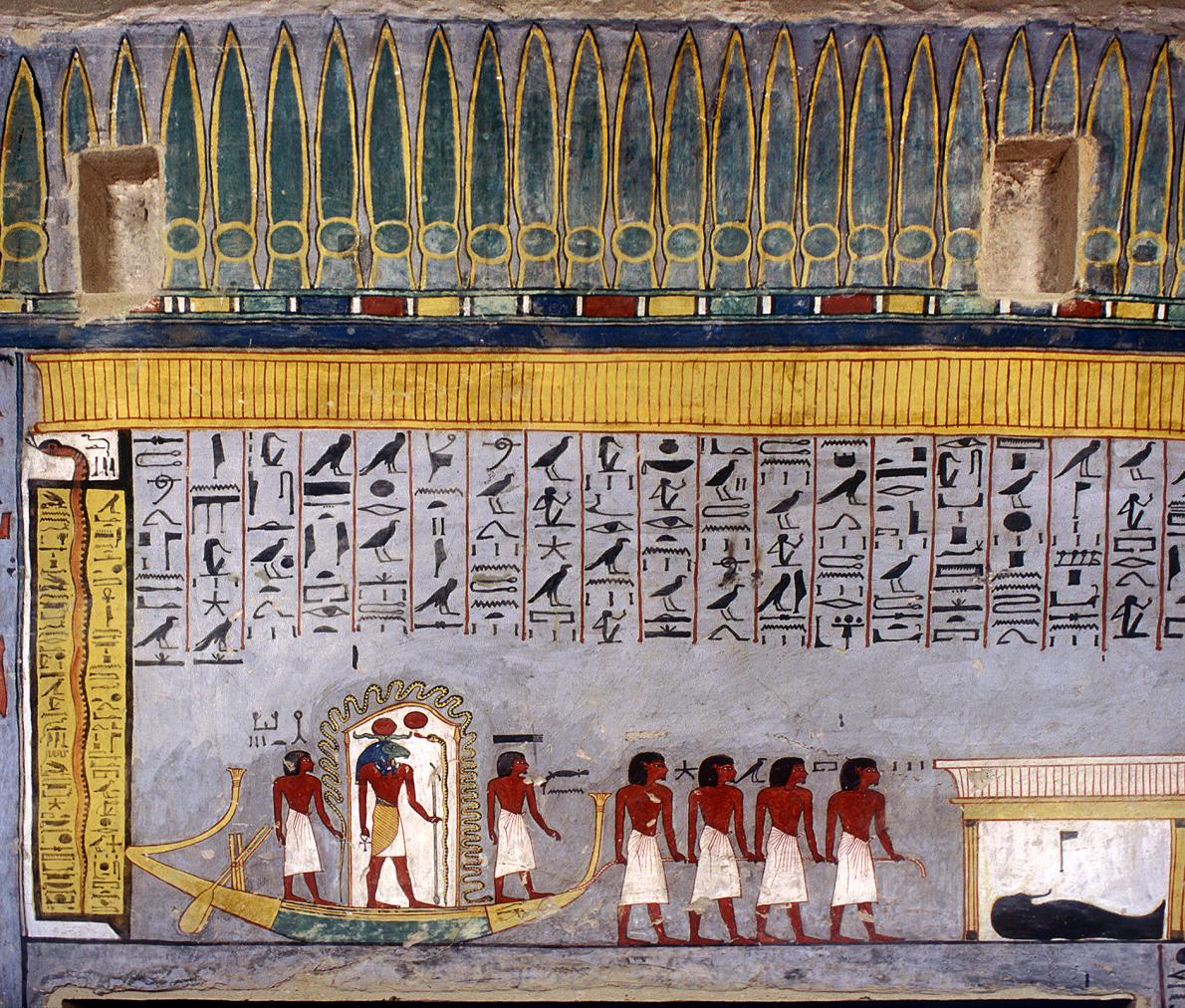
Kheker frieze; magical brick niches; Book of Gates, third division (P)/fourth hour (H), middle register, scenes 18 and 19.
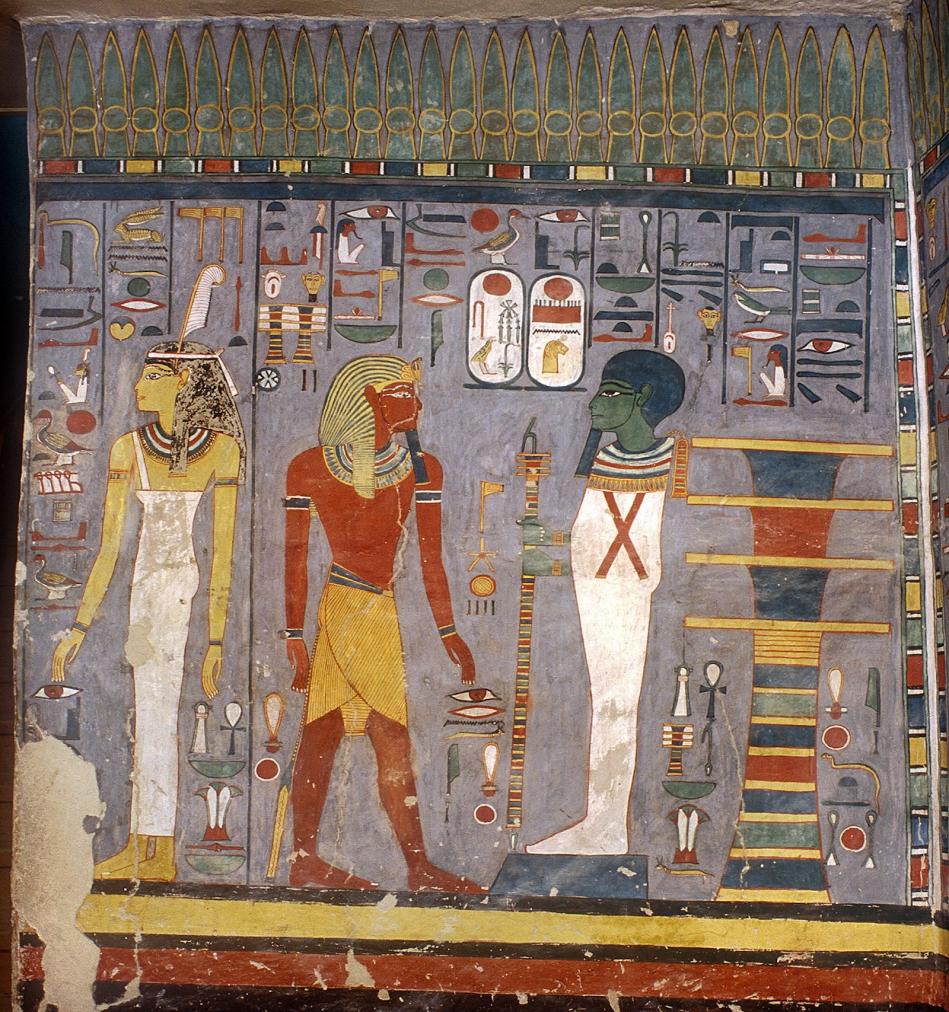
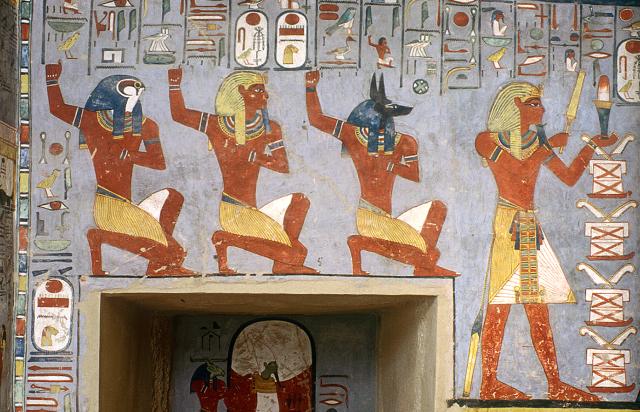
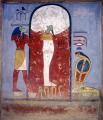
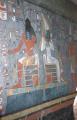
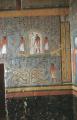
Kheker frieze; Ma'at; Rameses I before Ptah; djed-pillar.
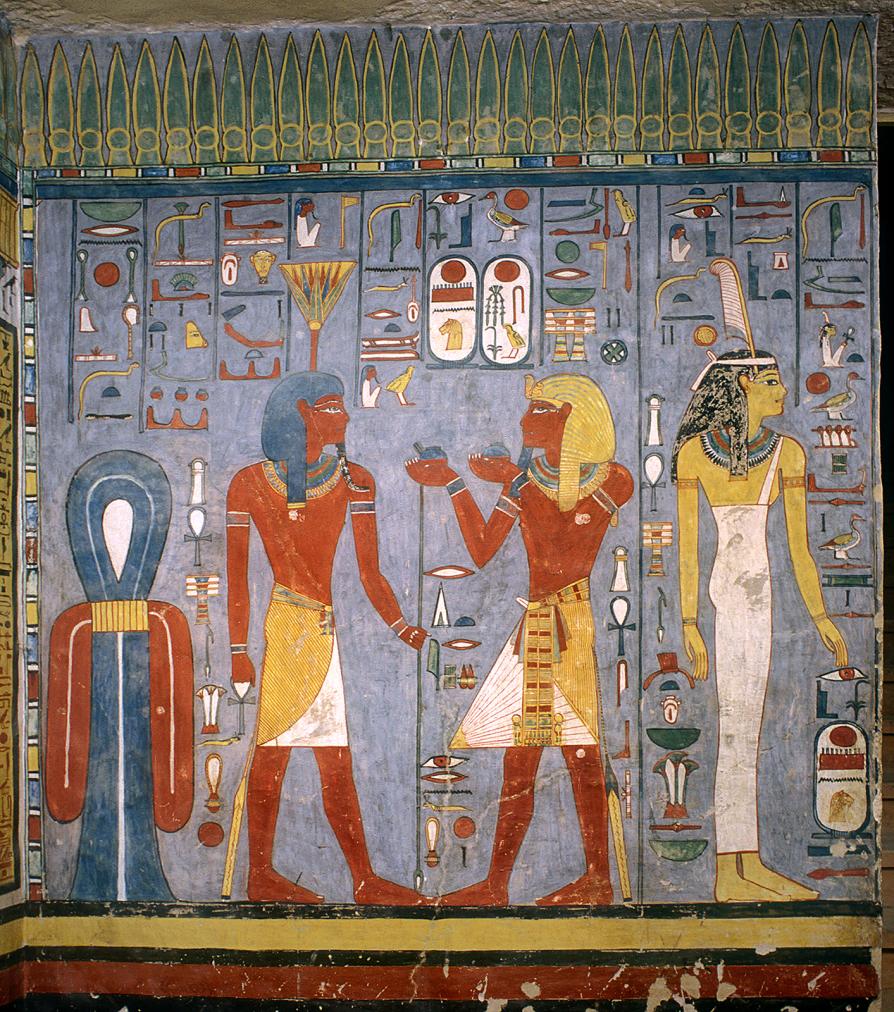
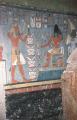
Kheker frieze; tyet-knot; Nefertem receiving offering from Rameses I; Ma'at.
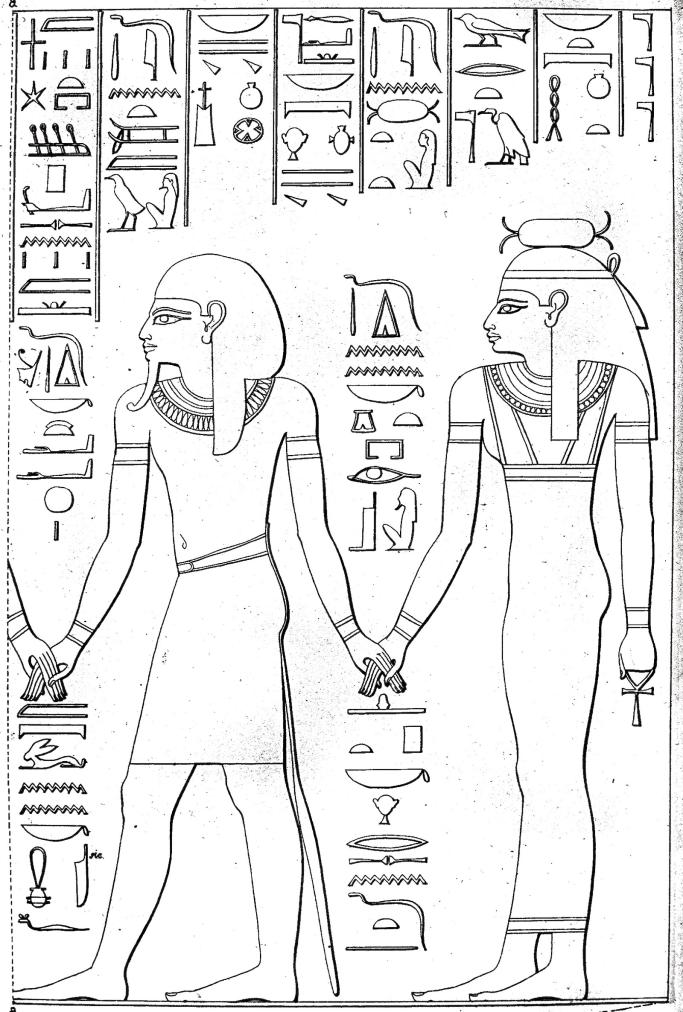
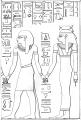
Atum and Neit escorting [Rameses I] (reconstruction)
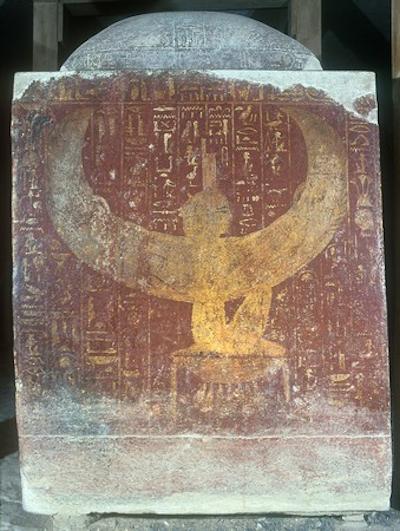
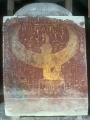
Kneeling winged Isis on head of sarcophagus.
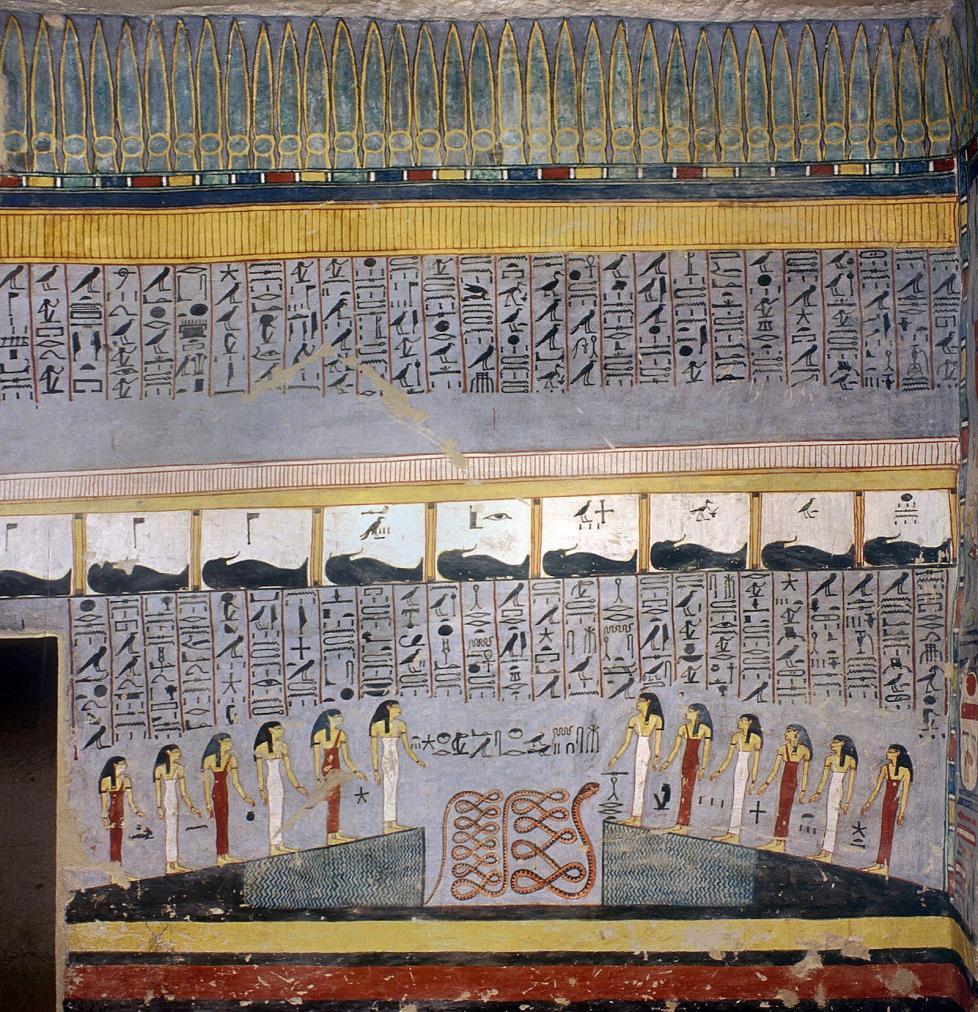
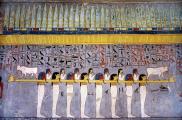
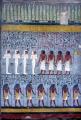
Book of Gates, third division (P)/fourth hour (H), middle and lower registers, scenes 19 and 20.
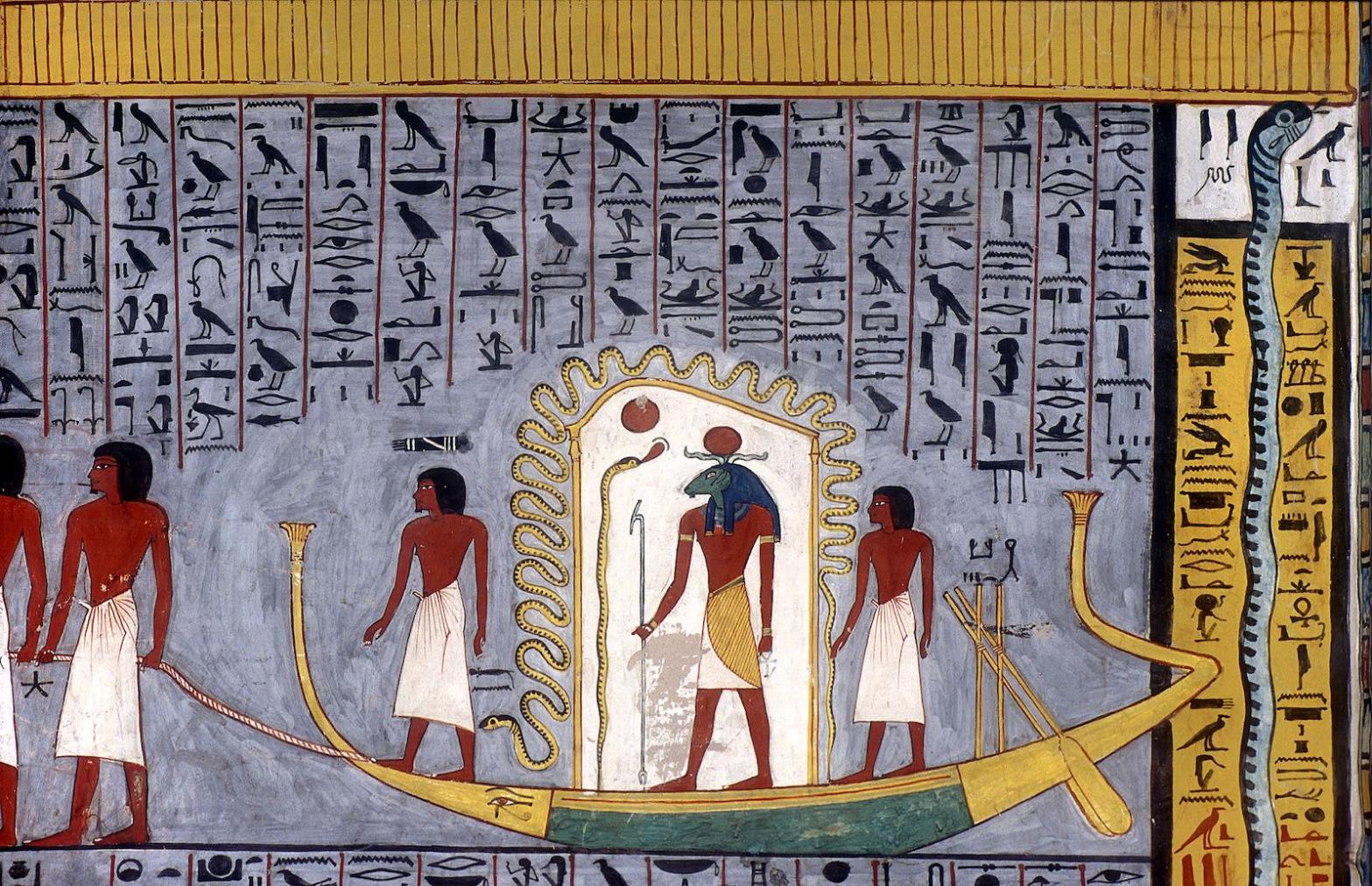
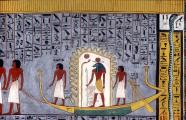
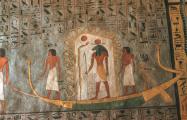
Book of Gates, second division (P)/third hour (H), middle register: Bark of Ra.
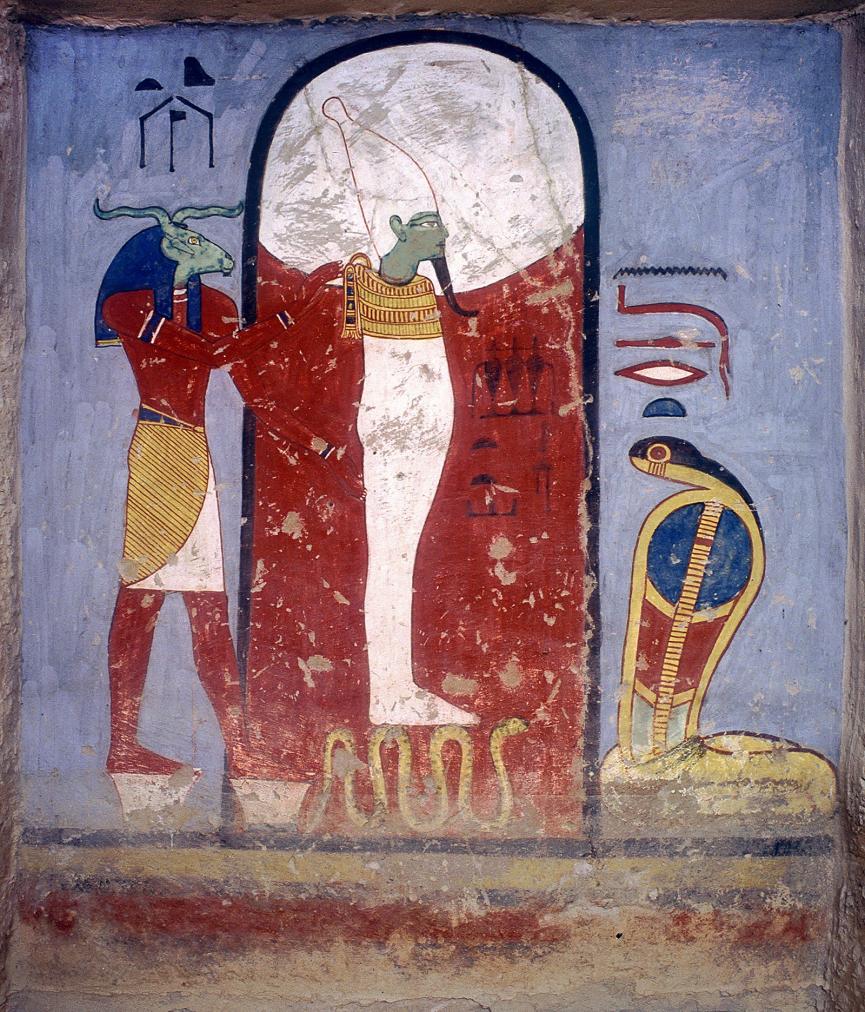
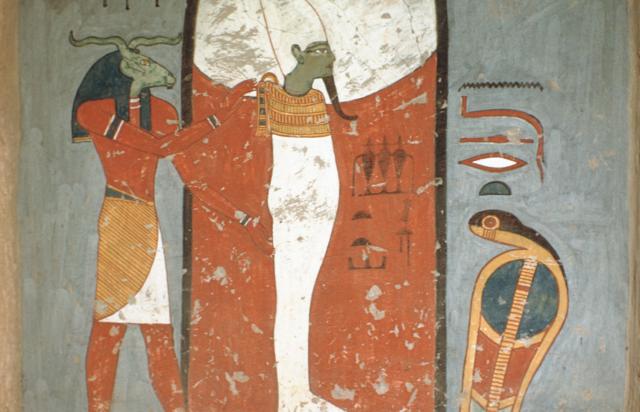
Book of Gates, third division (P)/fourth hour (H), middle register: Osiris in shrine attended by ram-headed Anubis and uraeus (KV16)
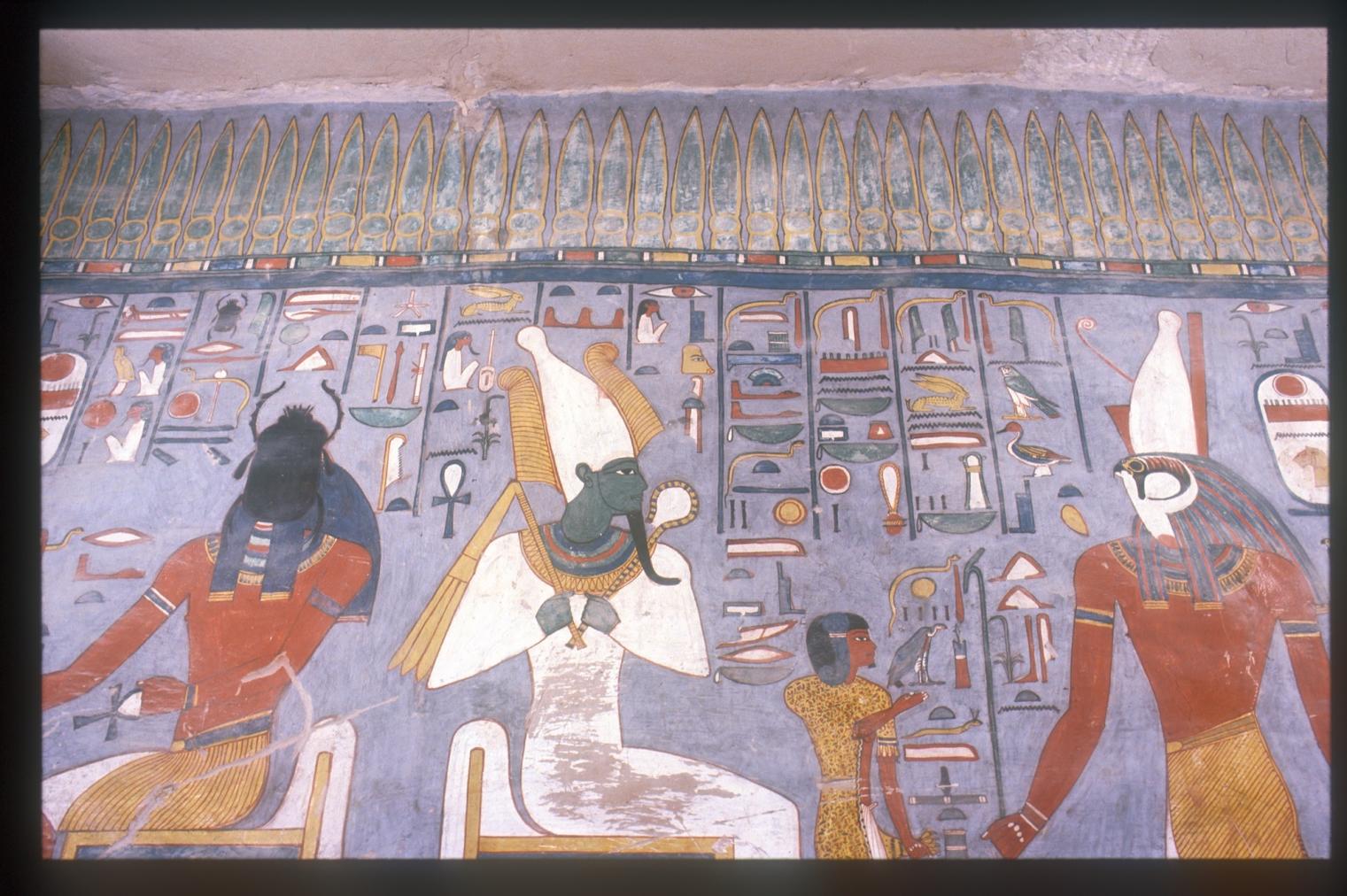
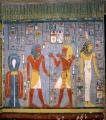
Kheker frieze; Osiris with Iwnmutef priest with Horus [leading Rameses I].
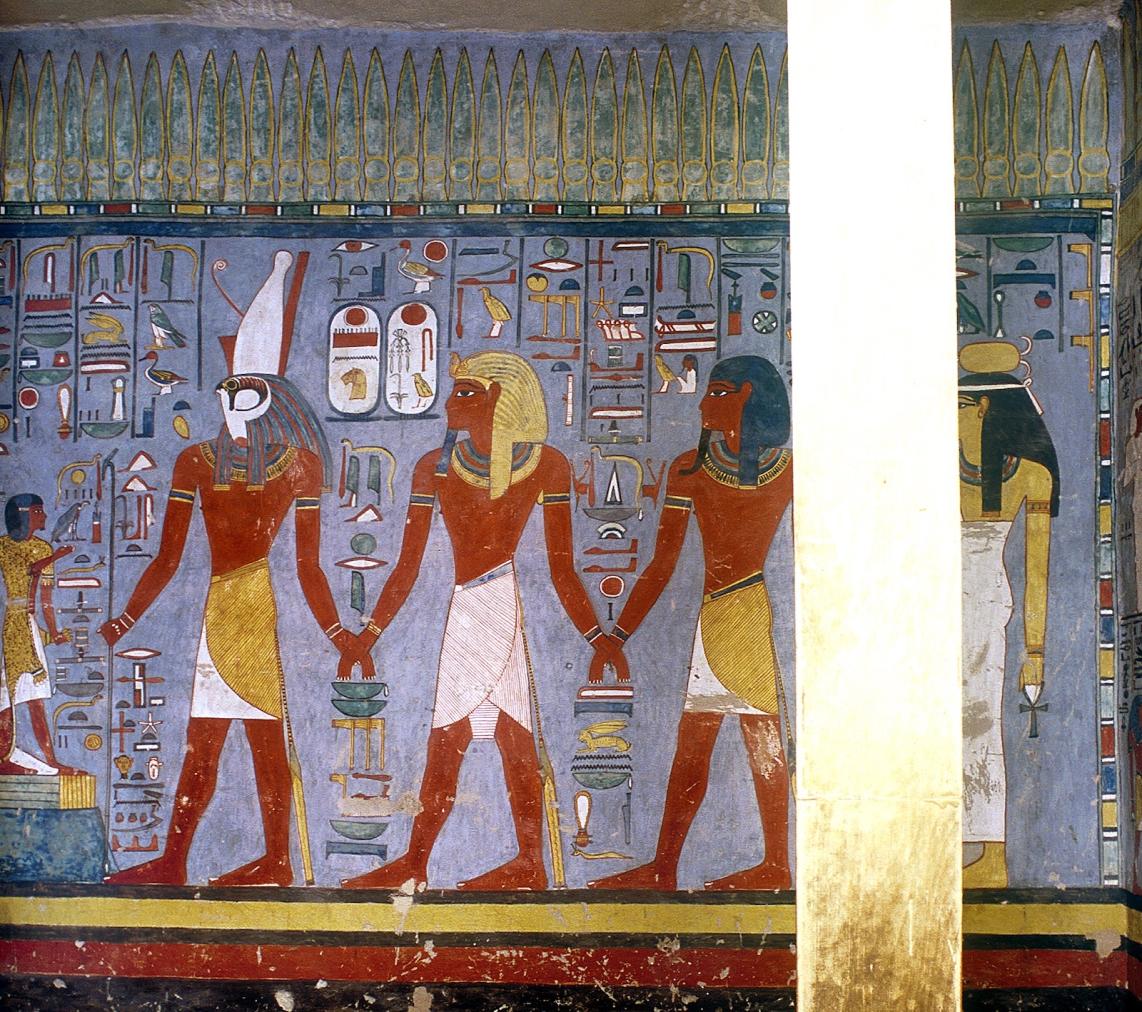
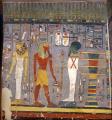
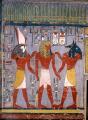
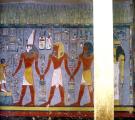
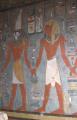
Rameses I escorted by Horus, Atum and Neith [before Osiris].
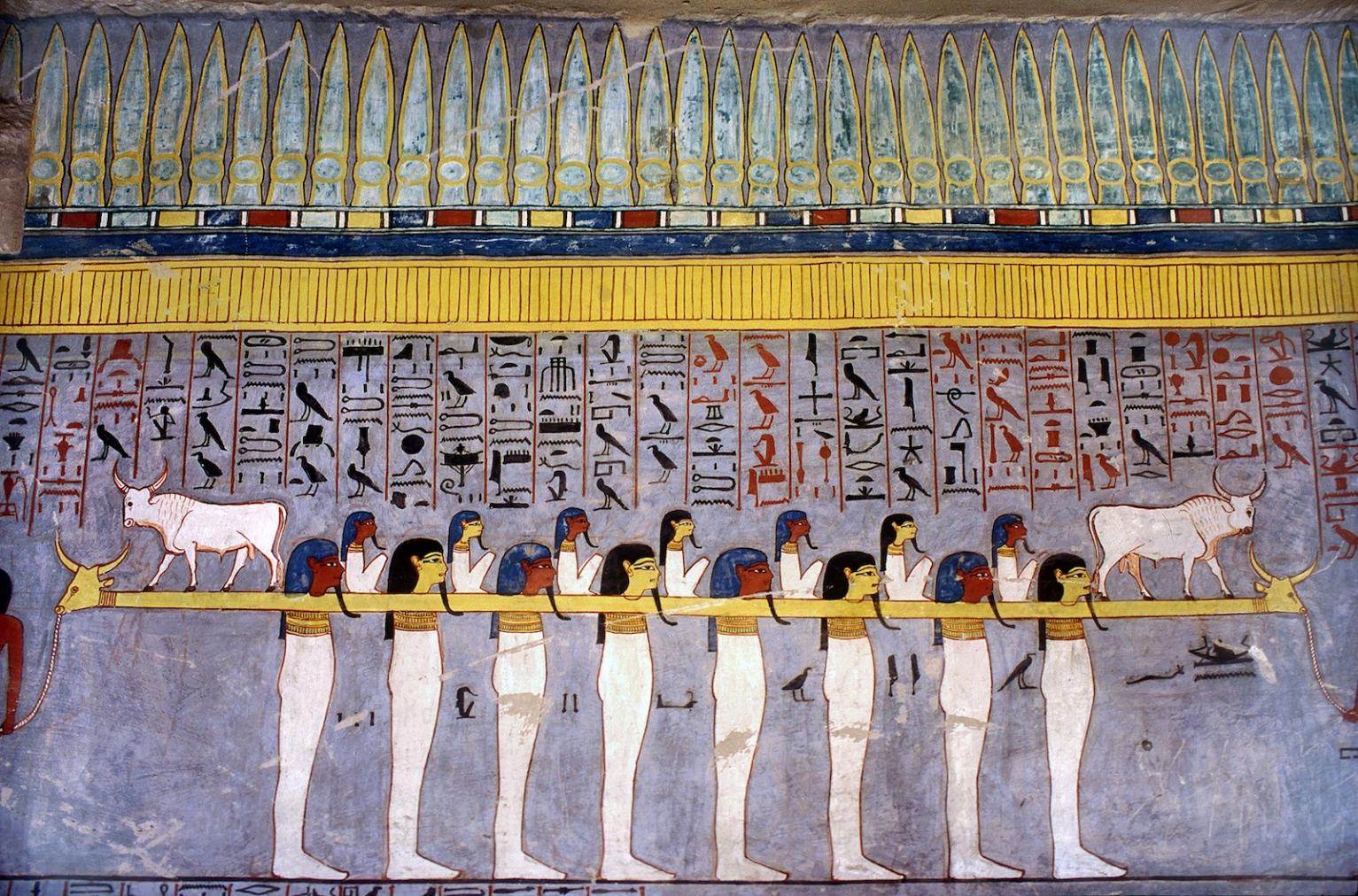
Kheker frieze; Book of Gates, second division (P)/third hour (H), middle register, scene 11: Bark of the Earth.
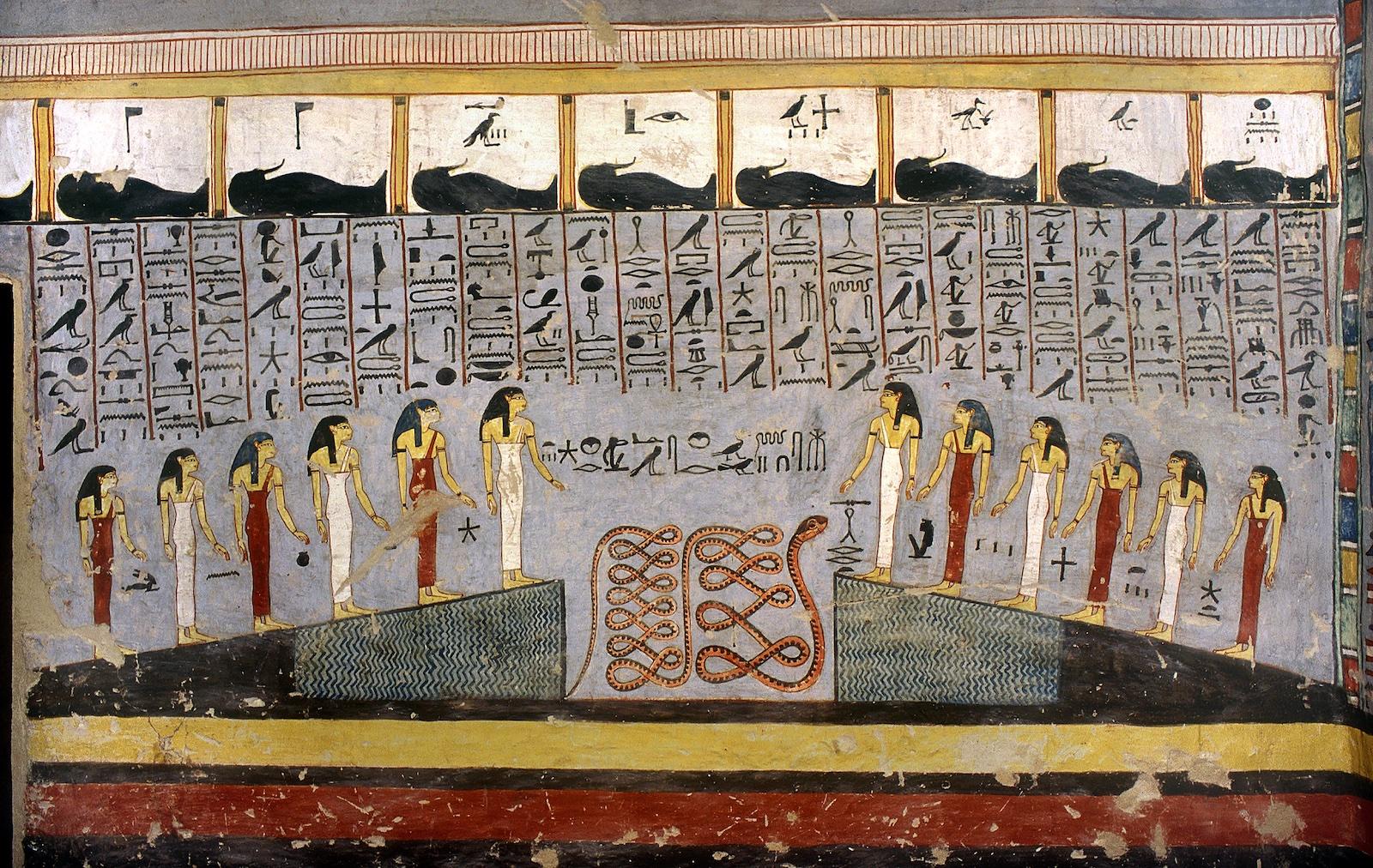
Book of Gates, third division (P)/fourth hour (H), middle and lower registers, scenes 19 and 20.
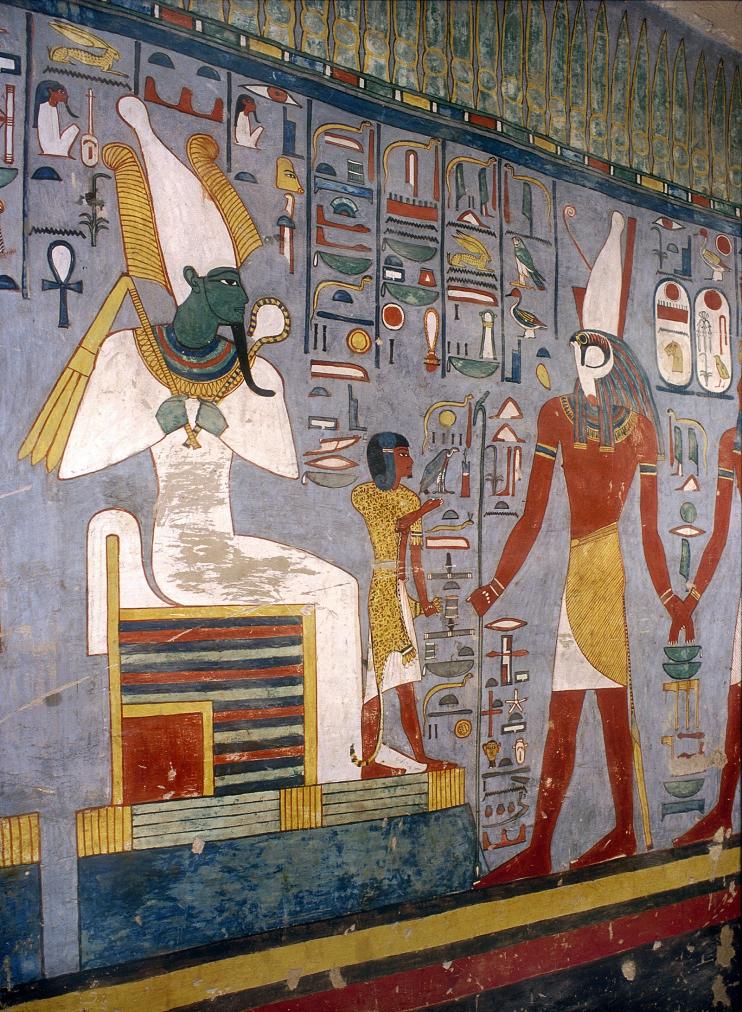
Osiris and Iwnmutef priest approached by Horus leading Rameses I.
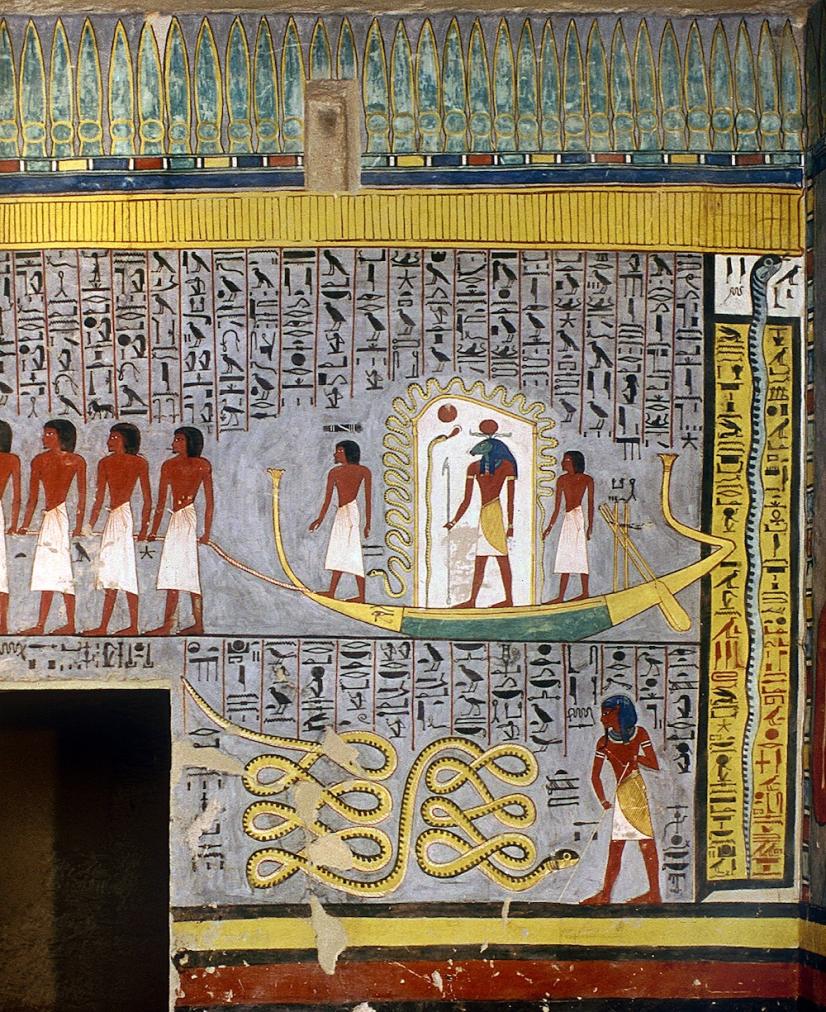
Book of Gates, second division (P)/third hour (H), middle and lower registers.
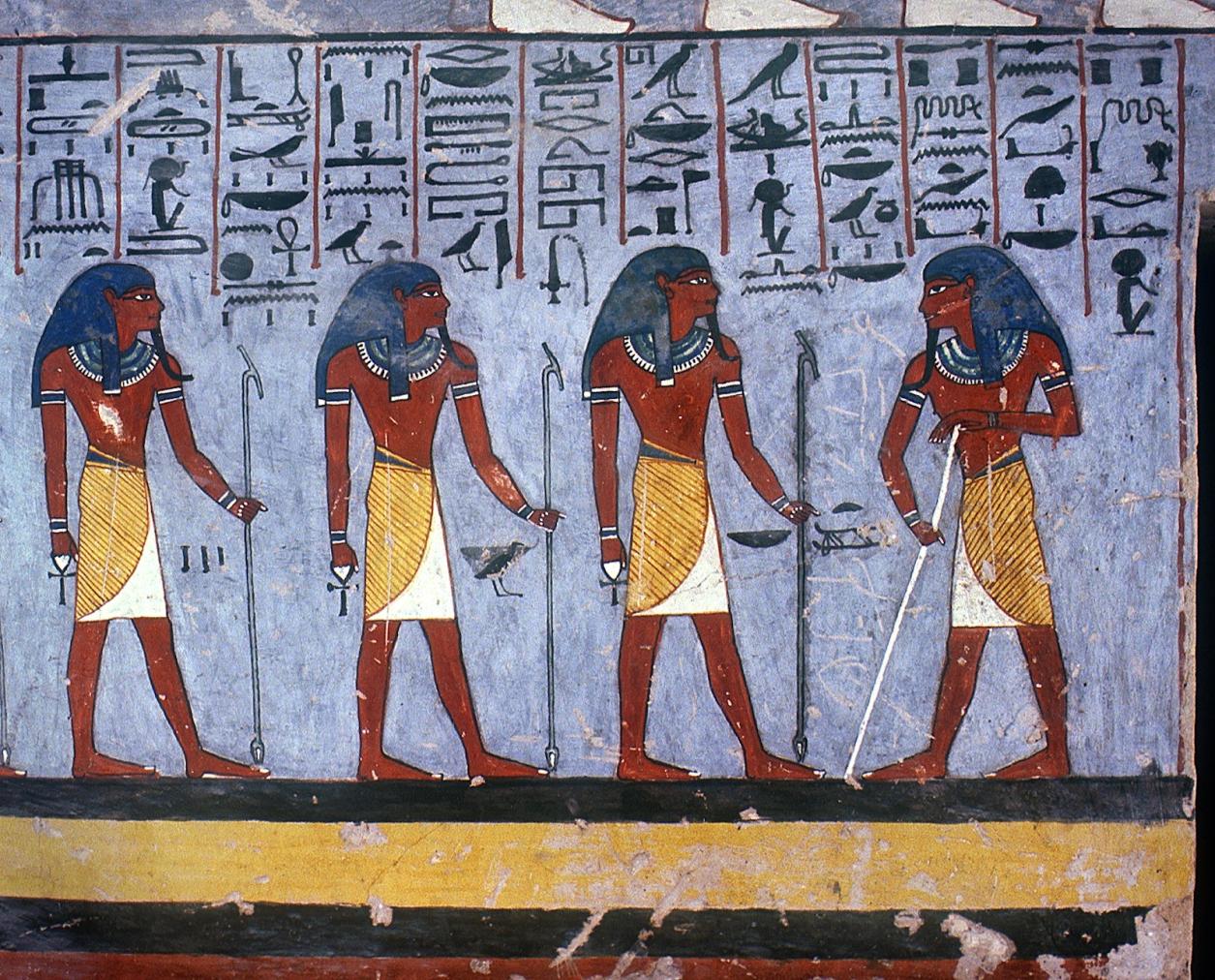
Book of Gates, second division (P)/third hour (H), lower register, scene 14.
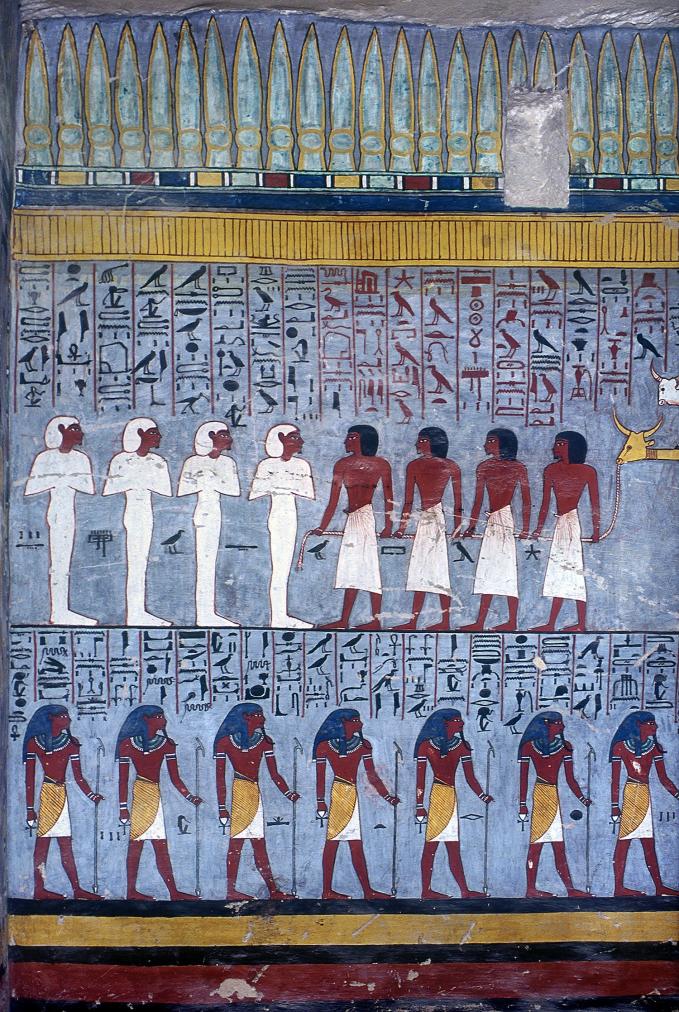
Kheker frieze; Book of Gates, second division(P)/third hour (H), middle and lower registers, scenes 12 and 14.
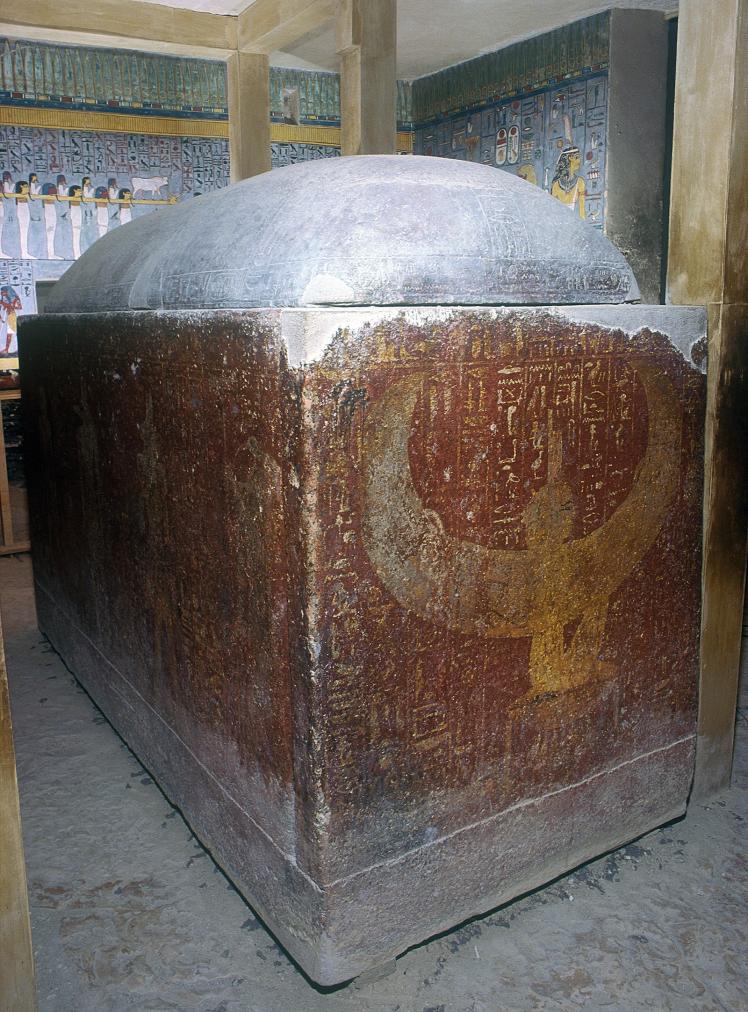
Imsety, Anubis, Duamutef, Thoth, winged Isis on the sarcophagus of Rameses I.
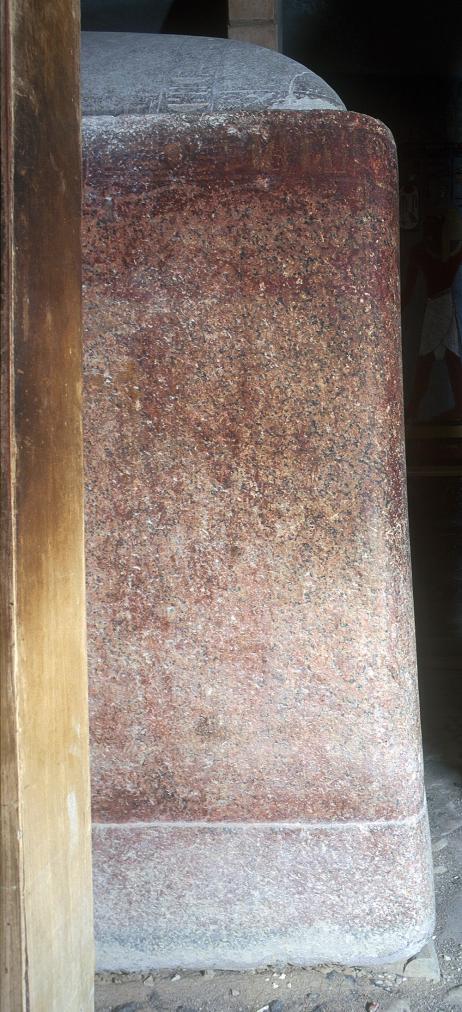
Trace of eye panel, but other painted decoration lost.
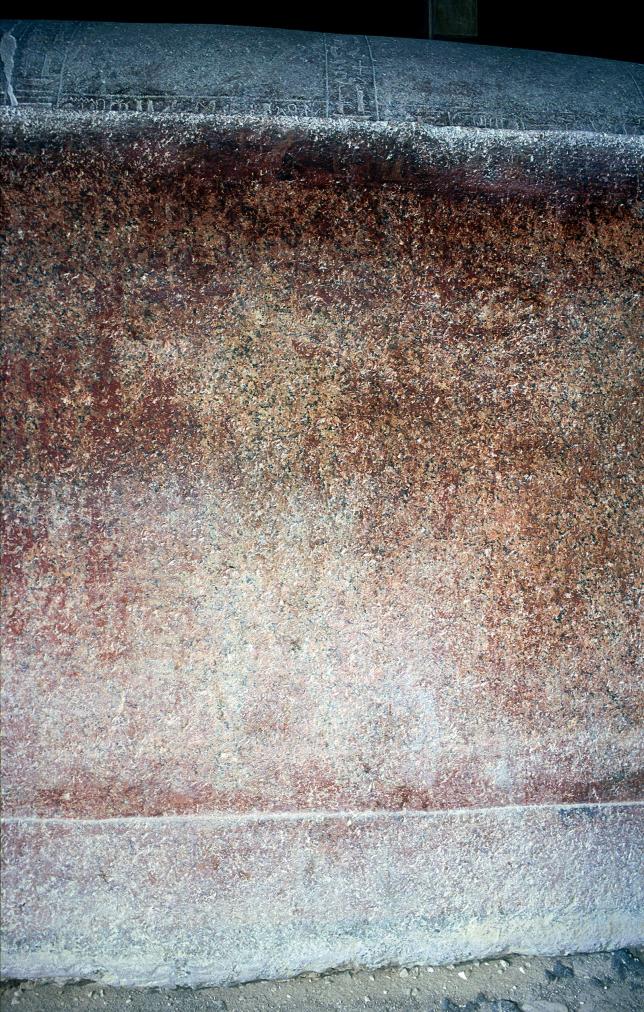
Painted decoration lost.
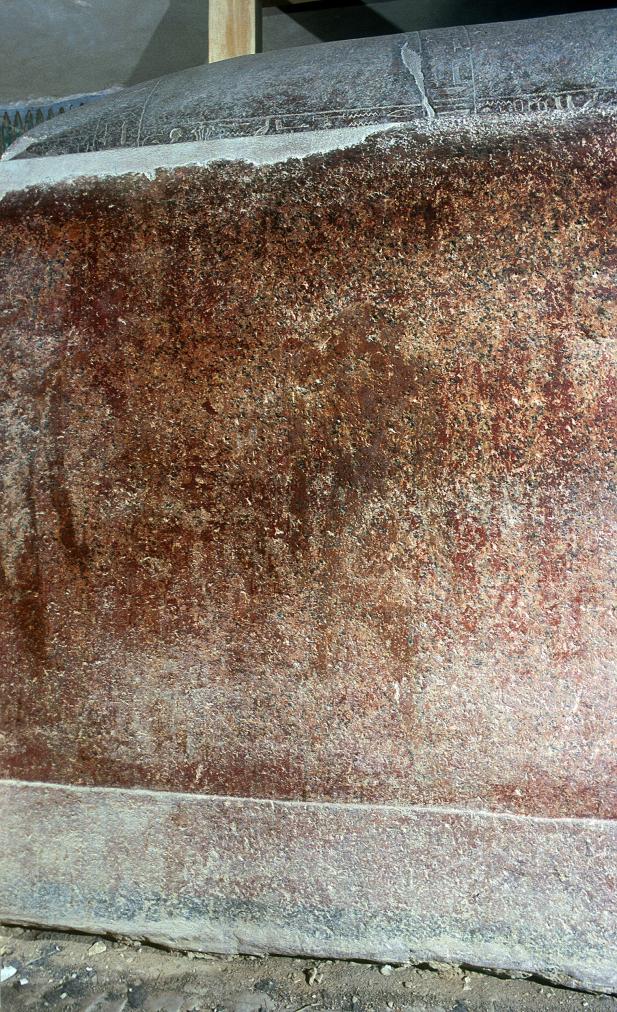
Painted decoration mostly lost, but with traces of Thoth and Qebehsenuef, one of the four sons of Horus.
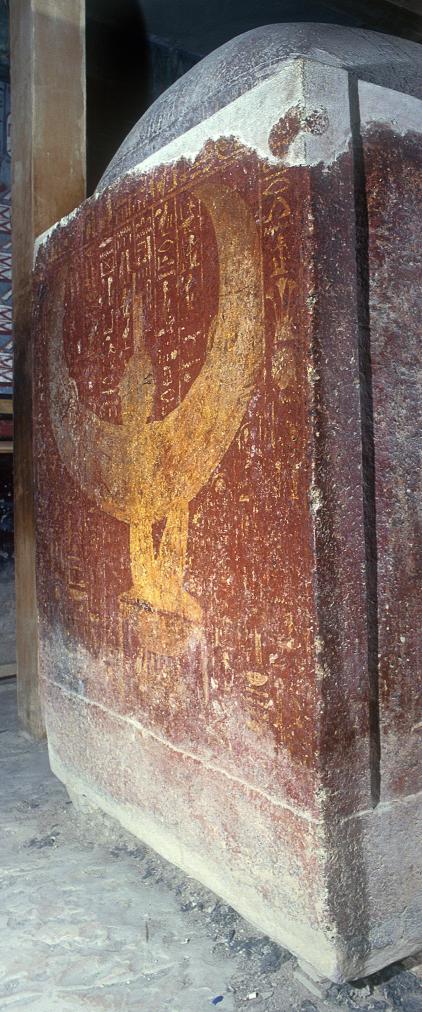
Kneeling winged Isis.
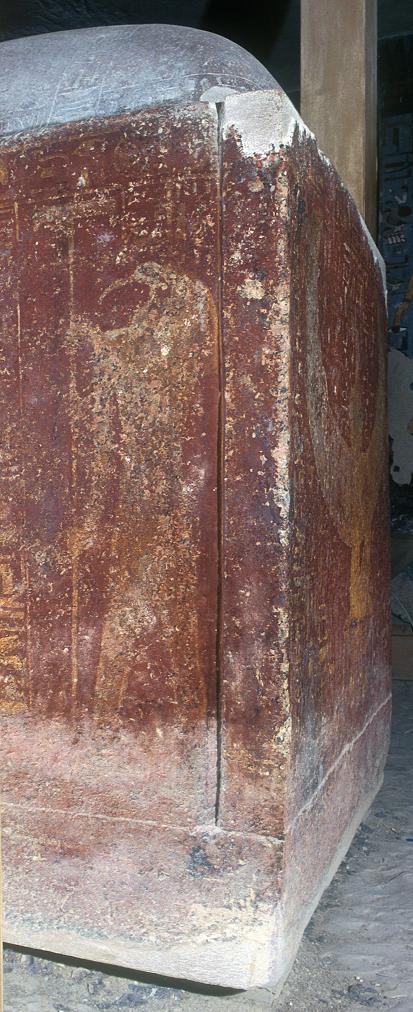
Thoth holding up pillar of heaven.
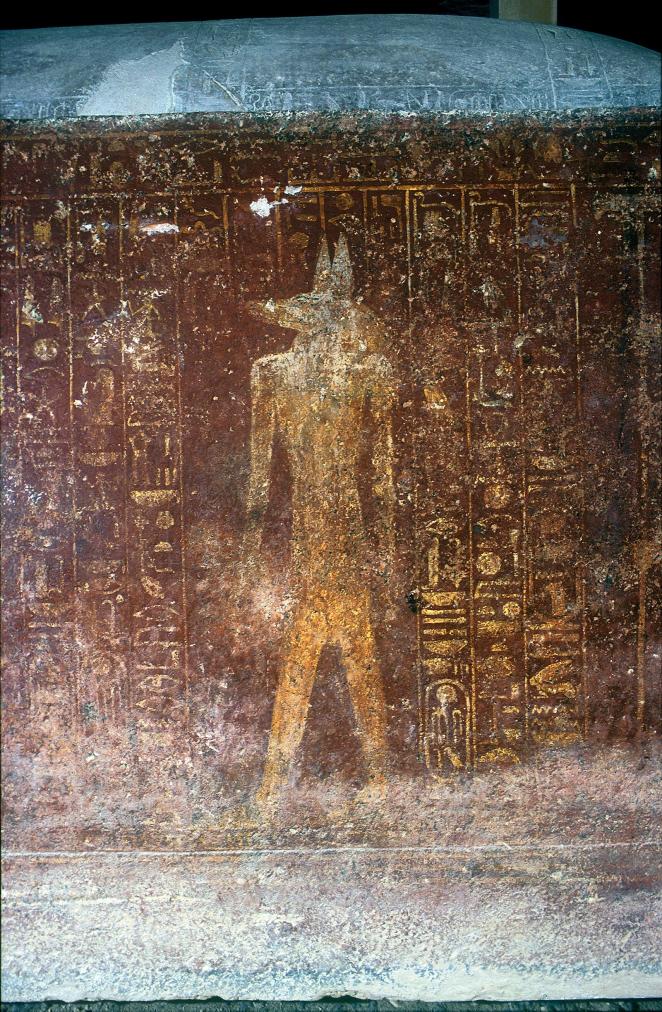
Duamutef, one of the four sons of Horus.
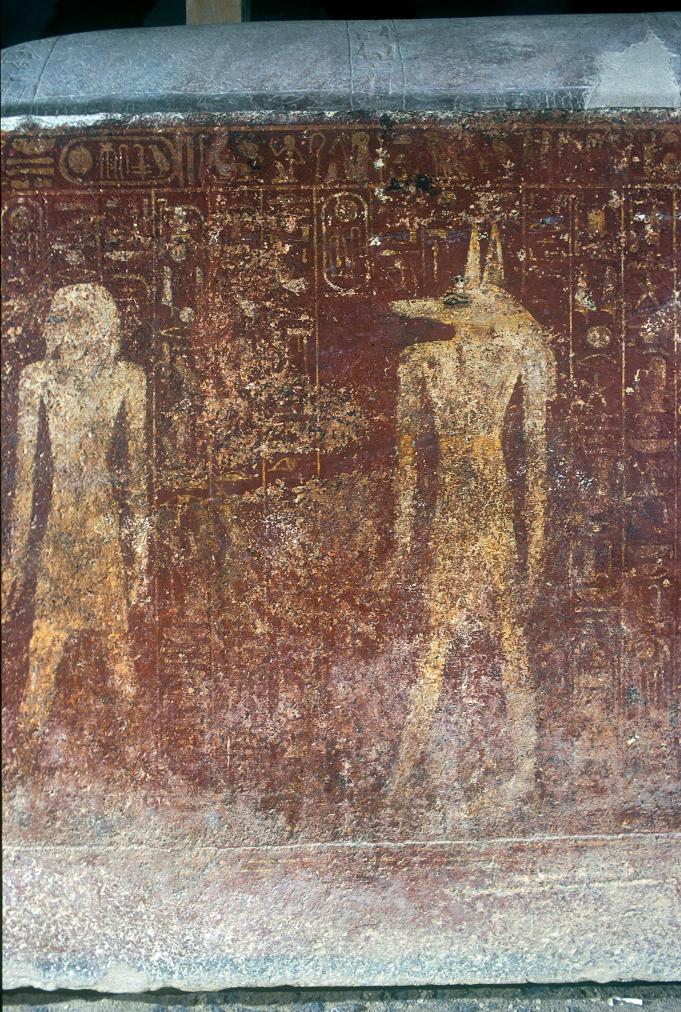
Imsety, one of the four sons of Horus, and Anubis.
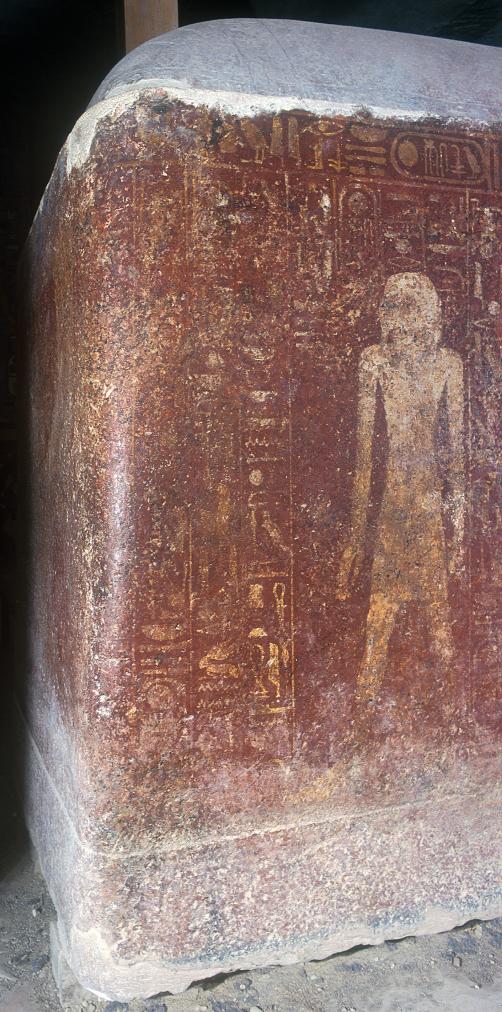
Imsety, one of the four sons of Horus.
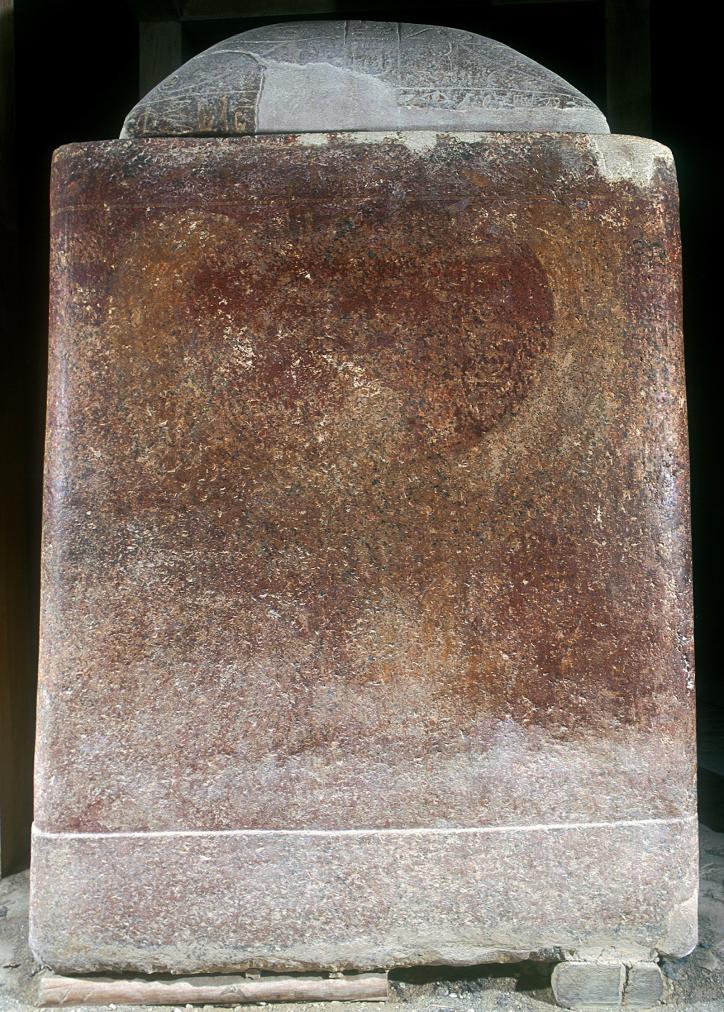
Kneeling winged Nephthys.
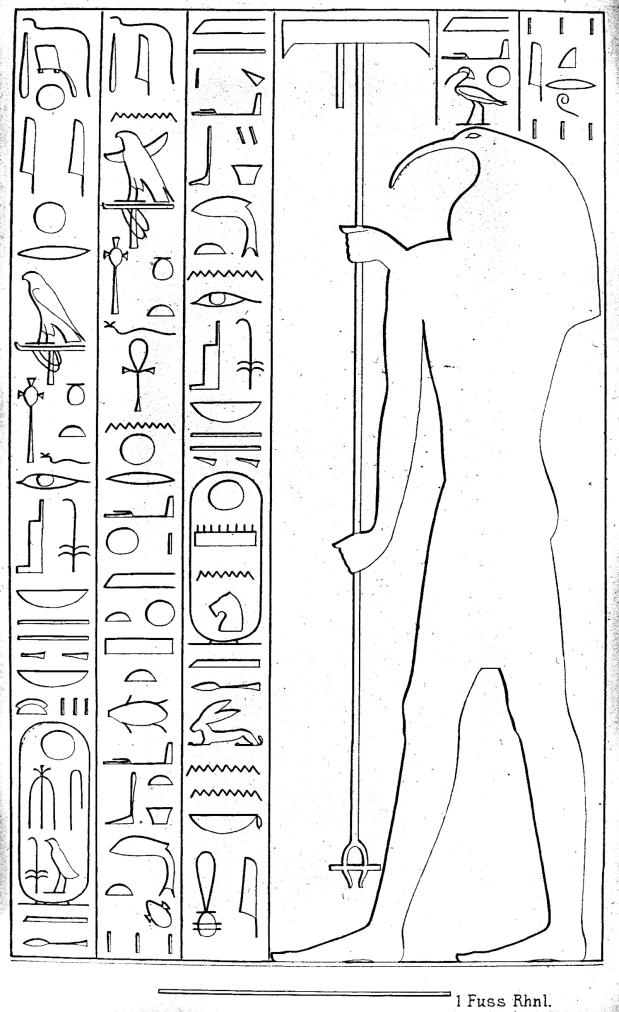
Thoth holding pillar of heaven (reconstruction).
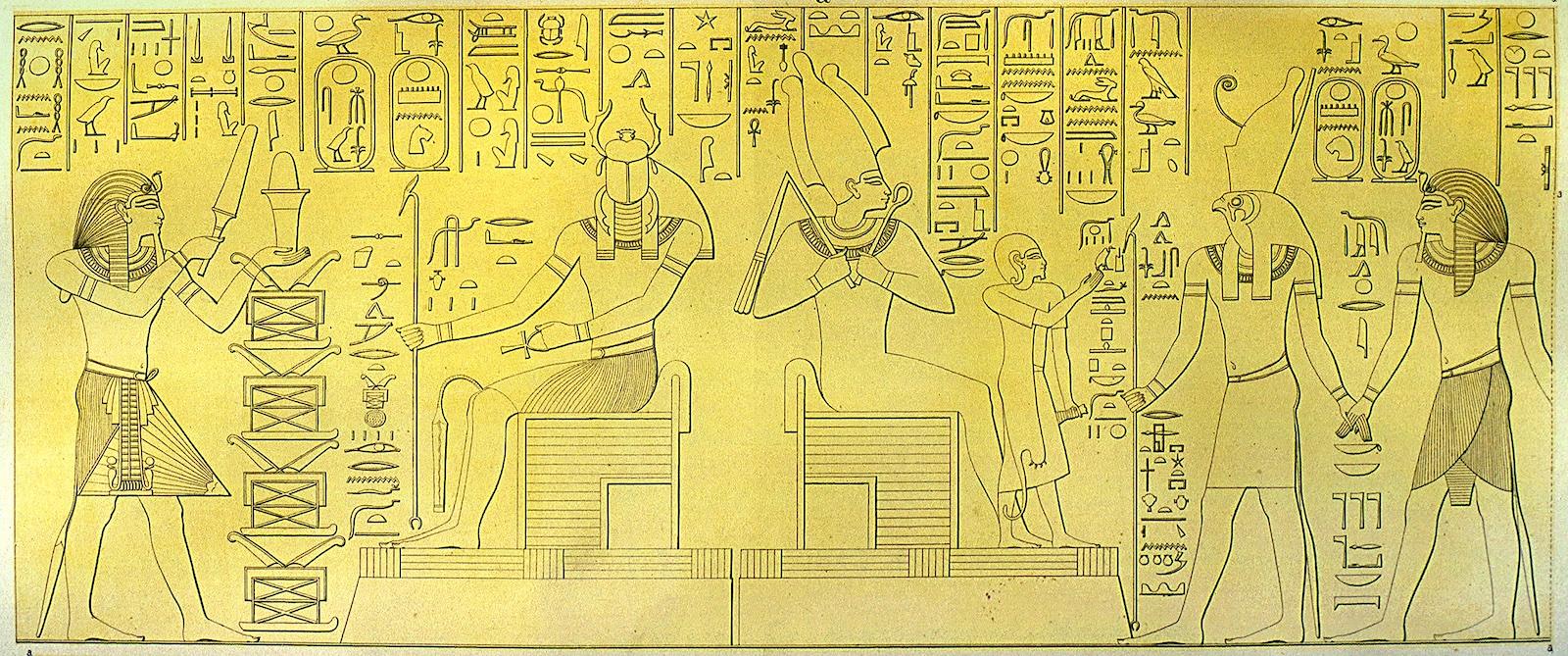
Rameses I offering meret chests to Atum-Ra-Kheperi and led before Osiris by Horus (reconstruction).
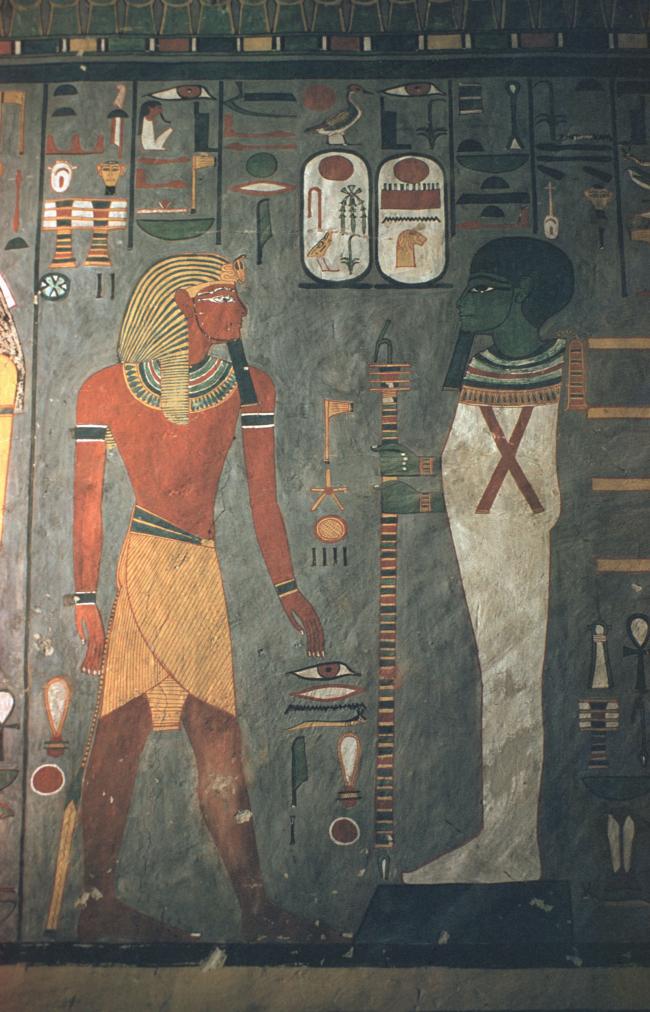
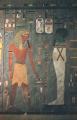
Rameses I before the god Ptah and a djed-pillar (Burial chamber J, front wall, right part). Courtesy of Uni Dia Verlag; Uni Dia Image Nr. 35651.
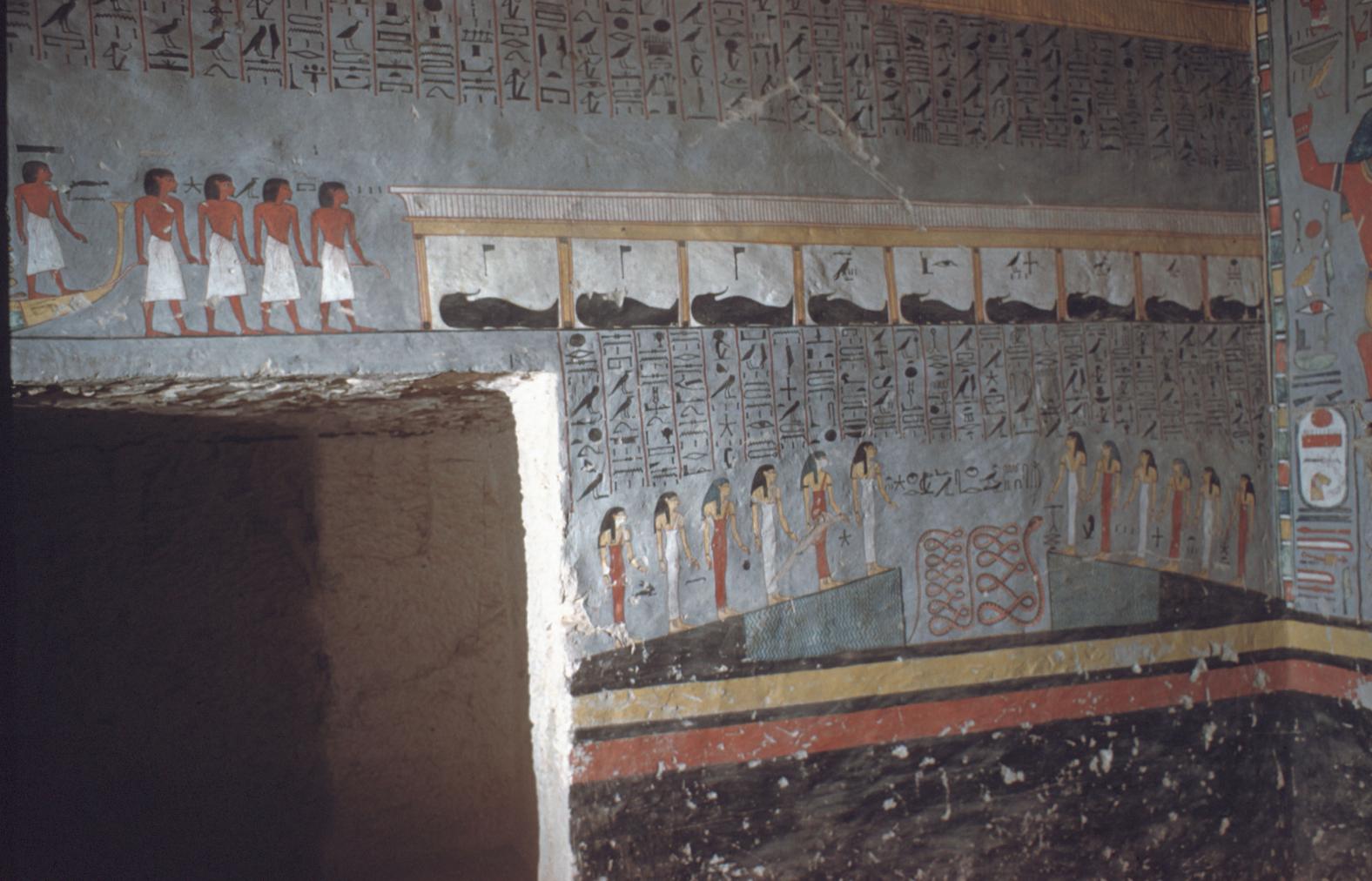
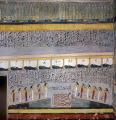
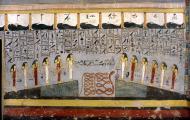
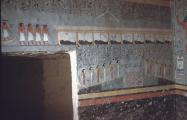
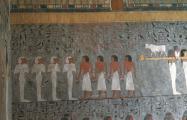
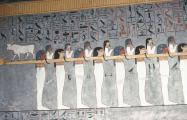
Book of Gates, third division (P)/fourth hour (H), middle and lower registers, scenes 19 and 20 - Burial chamber J, left wall. Courtesy of Uni Dia Verlag; Uni Dia Image Nr. 35653.
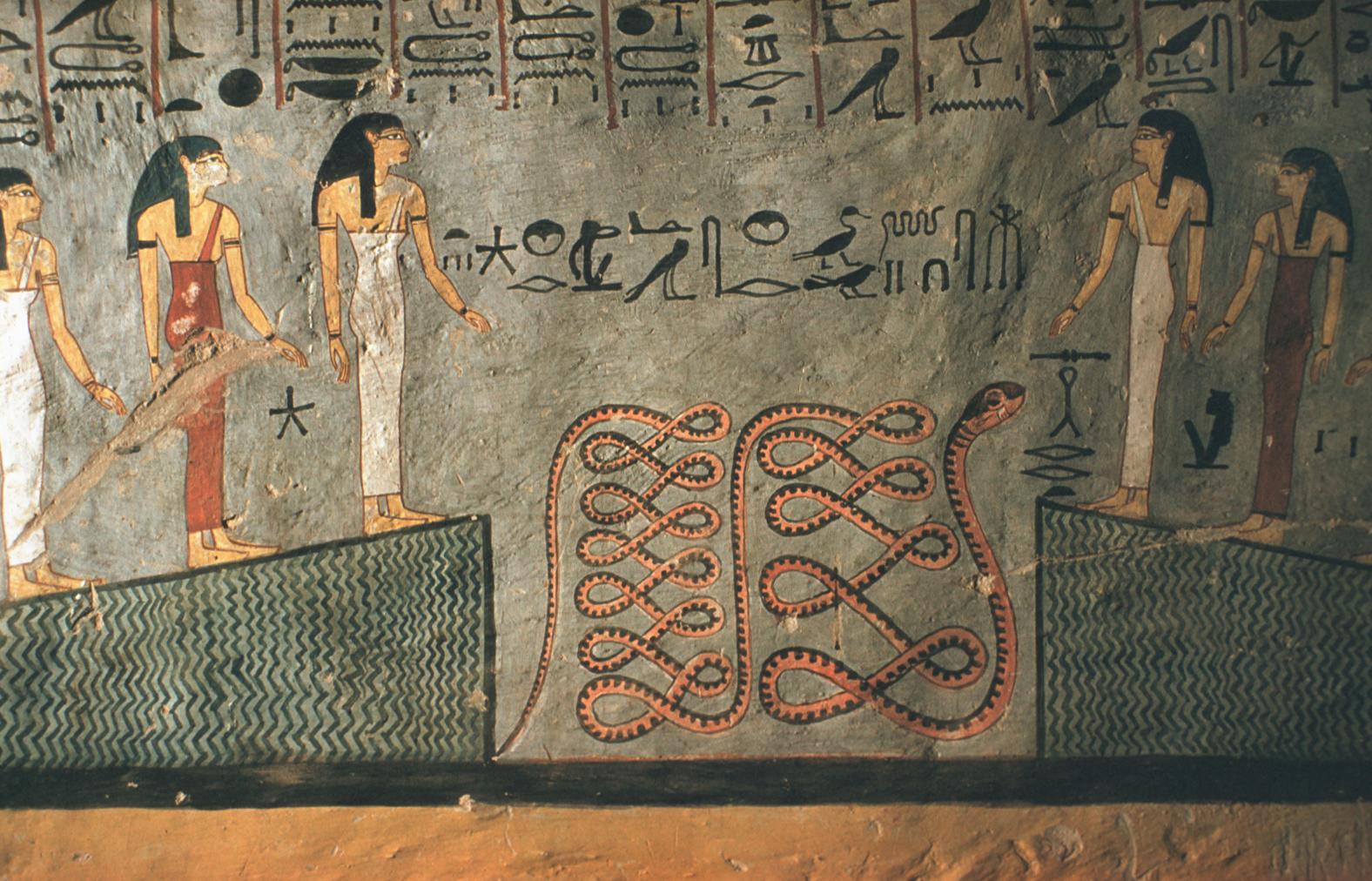
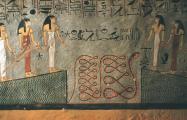
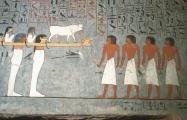
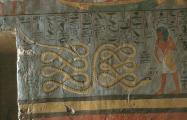
Detail of snake guarding river crossing in the hereafter; Book of Gates, third division (P)/fourth hour (H), middle and lower registers, scenes 19 and 20 - Burial chamber J, left wall. Courtesy of Uni Dia Verlag; Uni Dia Image Nr. 35654.
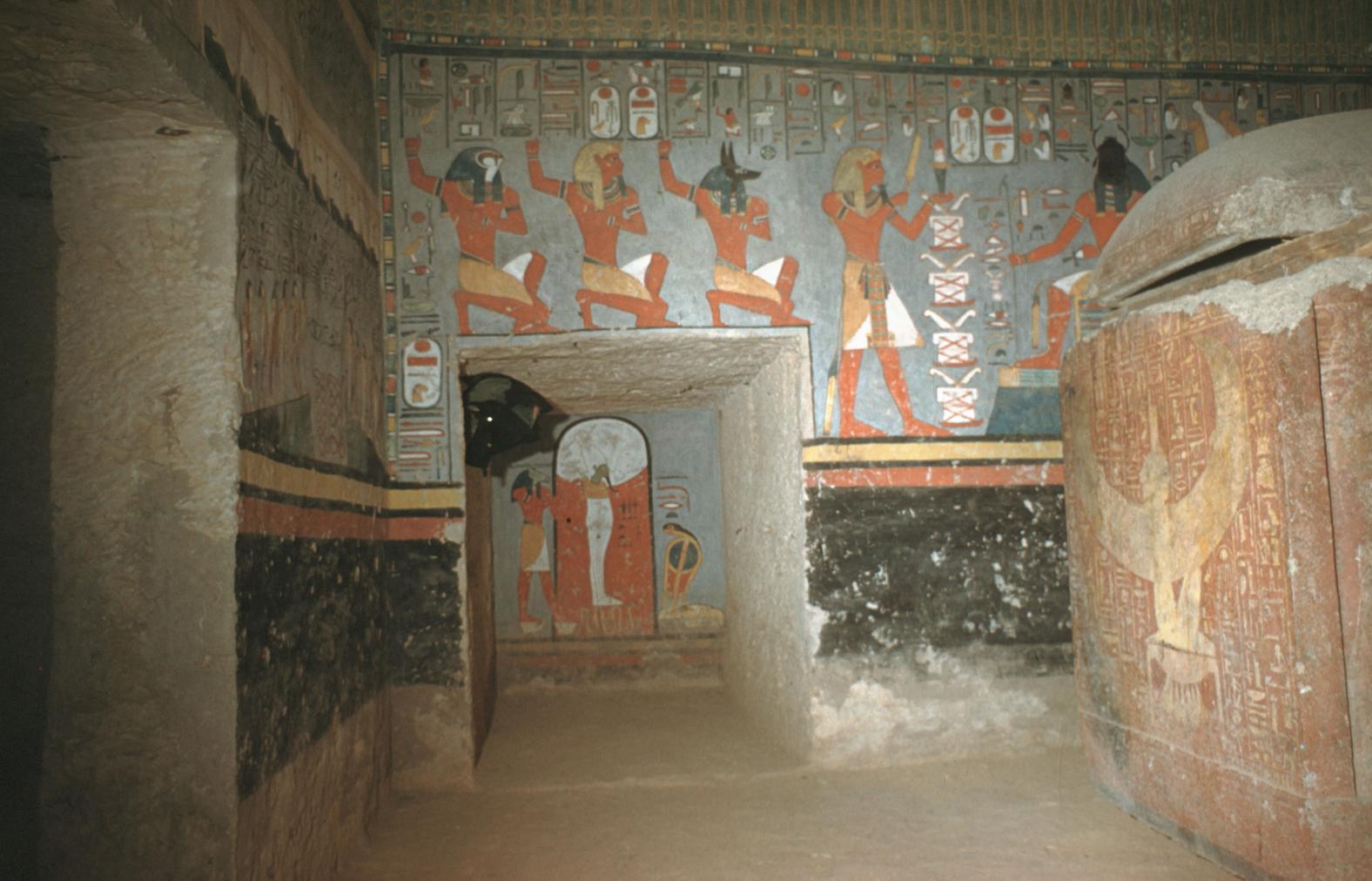
Rameses I with souls of Nekhen and Pe; consecrating meret-chests [before Atum-Ra-Kheperi] (Burial chamber J, rear wall (left part)) and side chamber Jb - Book of Gates third division (P)/fourth hour (H) rear (Southwest) wall. Courtesy of Uni Dia Verlag; Uni Dia Image Nr. 35655.
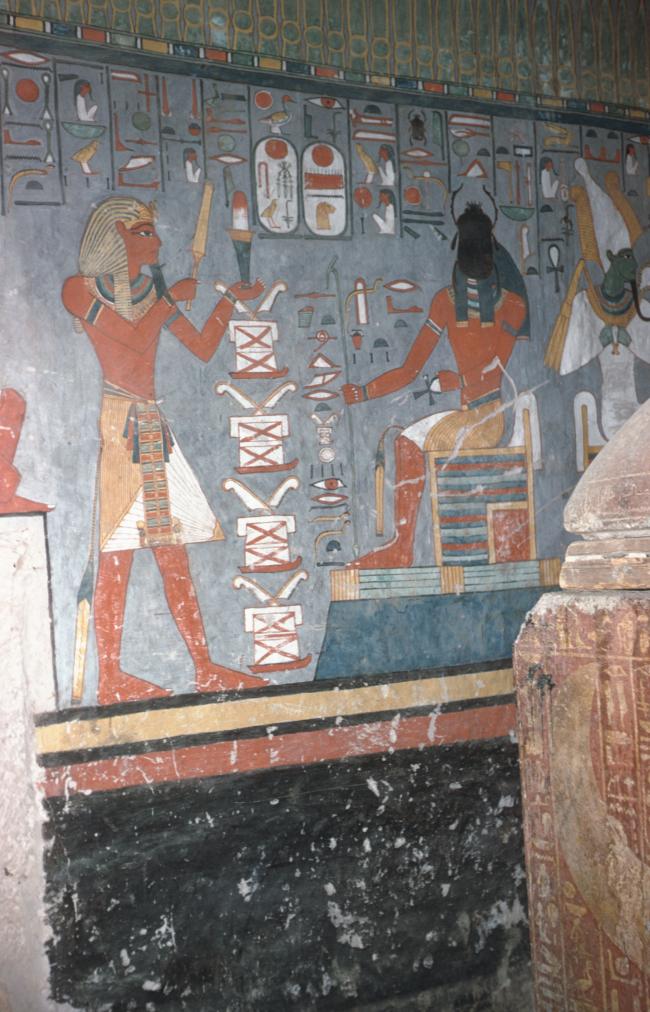
Rameses I (with the souls of Nekhen and Pe) and consecrating meret-chests before the syncretic god Atum-Ra-Kheperi, Burial chamber J, rear wall (left part). Courtesy of Uni Dia Verlag; Uni Dia Image Nr. 35657.
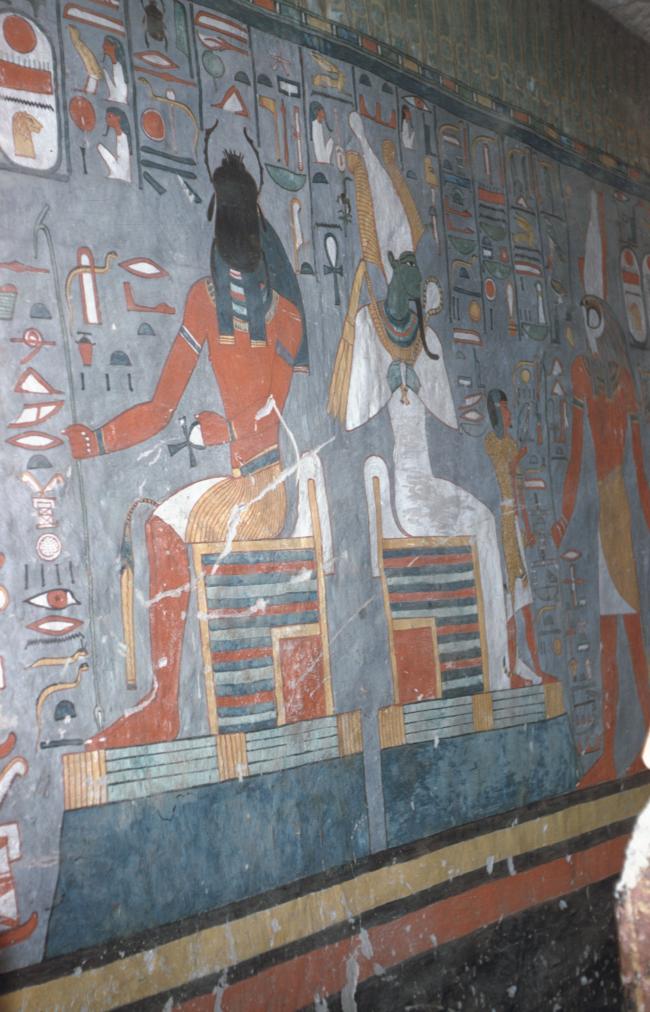
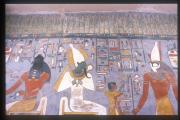
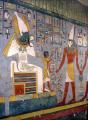
The gods Atum-Ra-Kheperi and Osiris seated back to back (not visible here) with an Iwnmutef priest before the god Horus [leading Rameses I], Burial chamber J, rear wall (center part). Courtesy of Uni Dia Verlag; Uni Dia Image Nr. 35659.
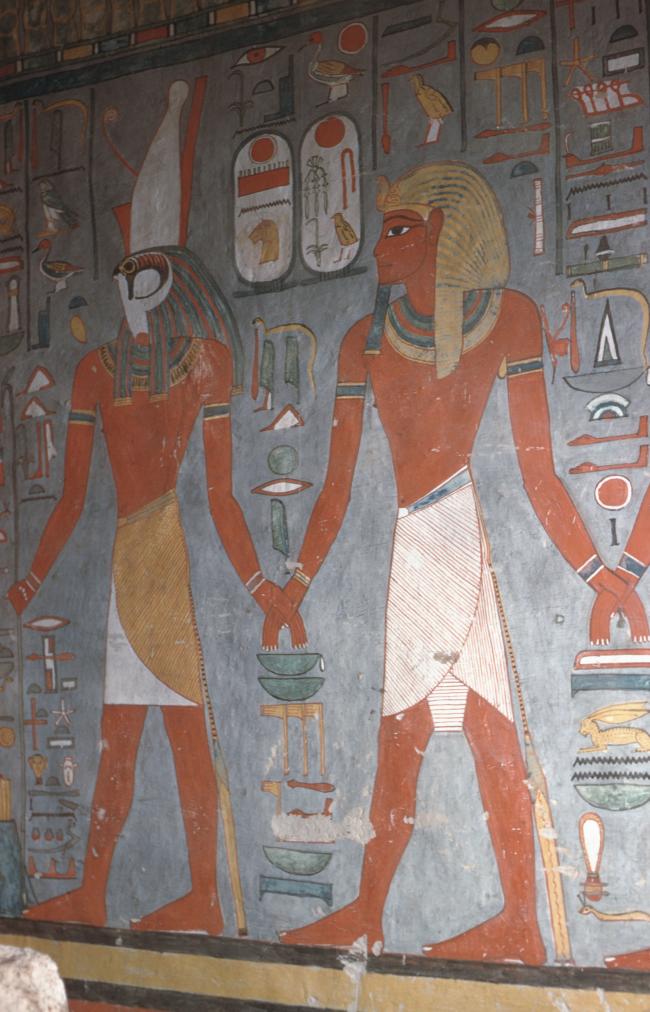
Horus [leading Rameses I], Burial chamber J, rear wall (center part). Courtesy of Uni Dia Verlag; Uni Dia Image Nr. 35660.
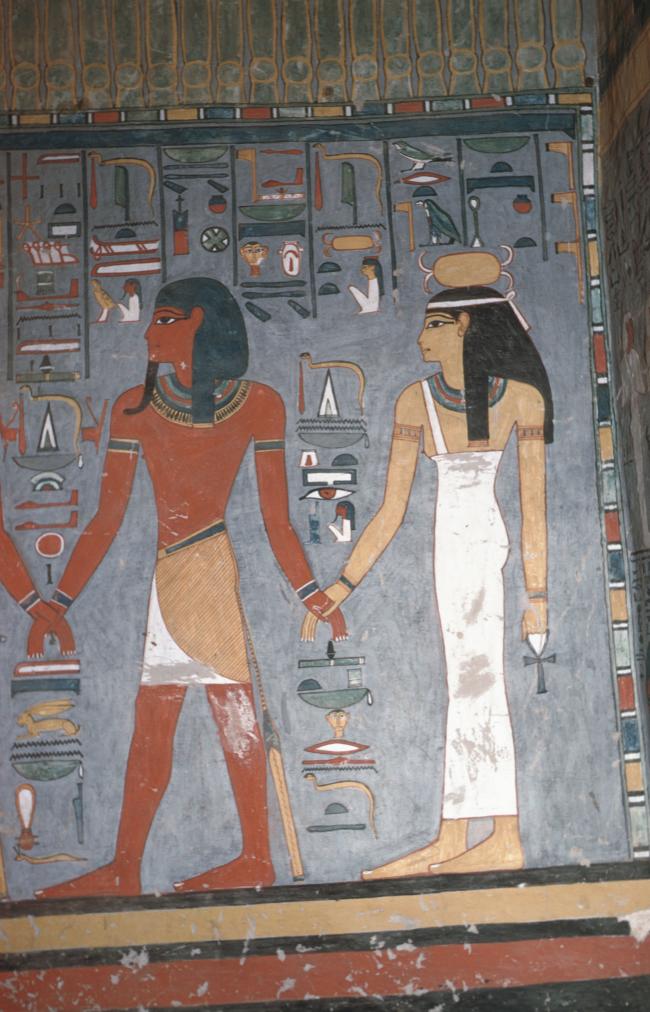
Ramses I led by the goddess Neith in front of the god Osiris, Burial chamber J, rear wall (right part). Courtesy of Uni Dia Verlag; Uni Dia Image Nr. 35661.
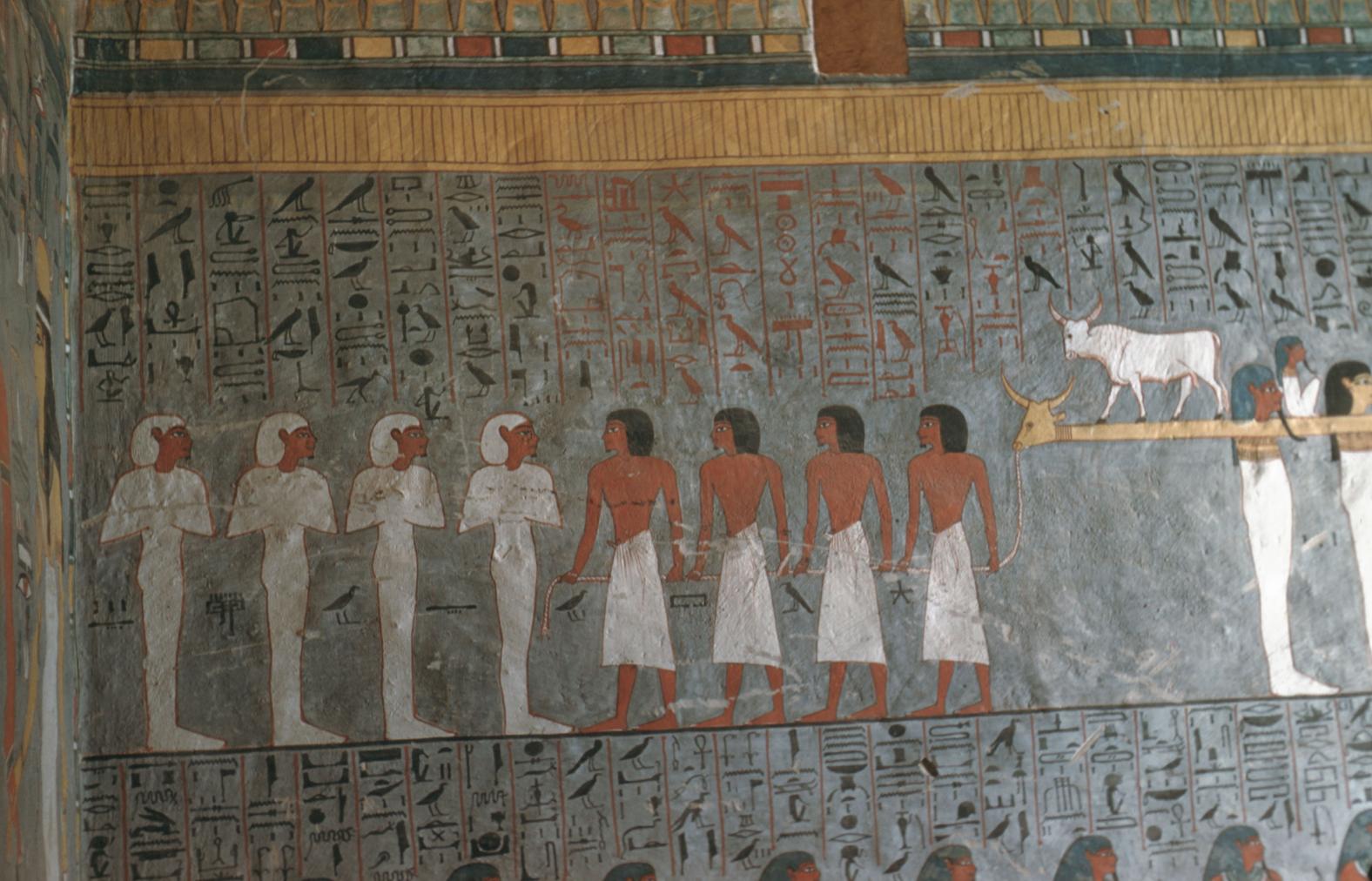
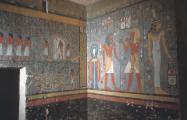
View of the western corner of Burial chamber J. Courtesy of Uni Dia Verlag; Uni Dia Image Nr. 35662.
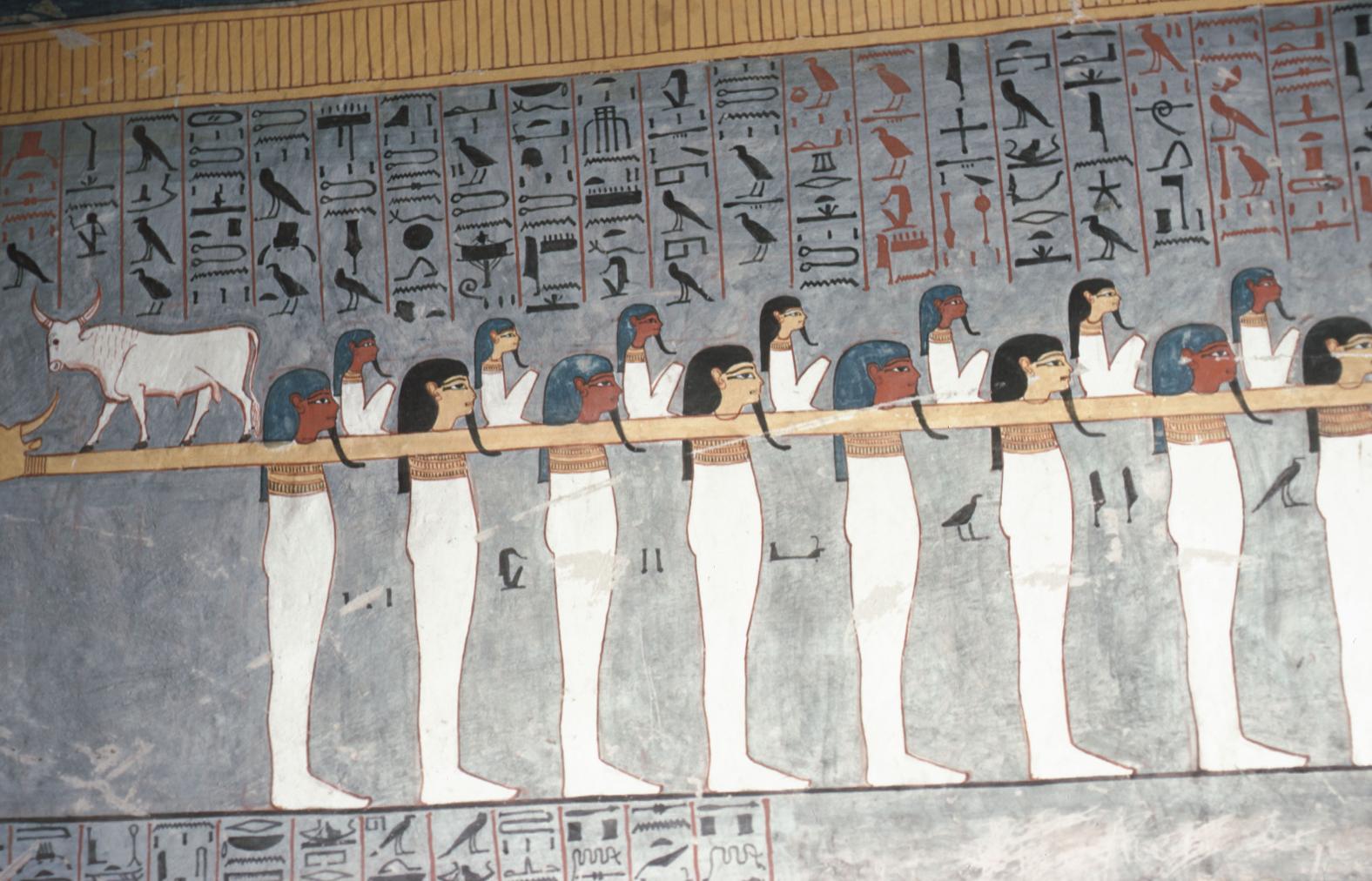
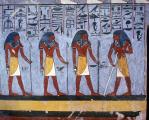
Book of Gates second division (P)/third hour (H), middle and lower registers, Burial chamber J, right (northwest) wall (left part). Courtesy of Uni Dia Verlag; Uni Dia Image Nr. 35663.
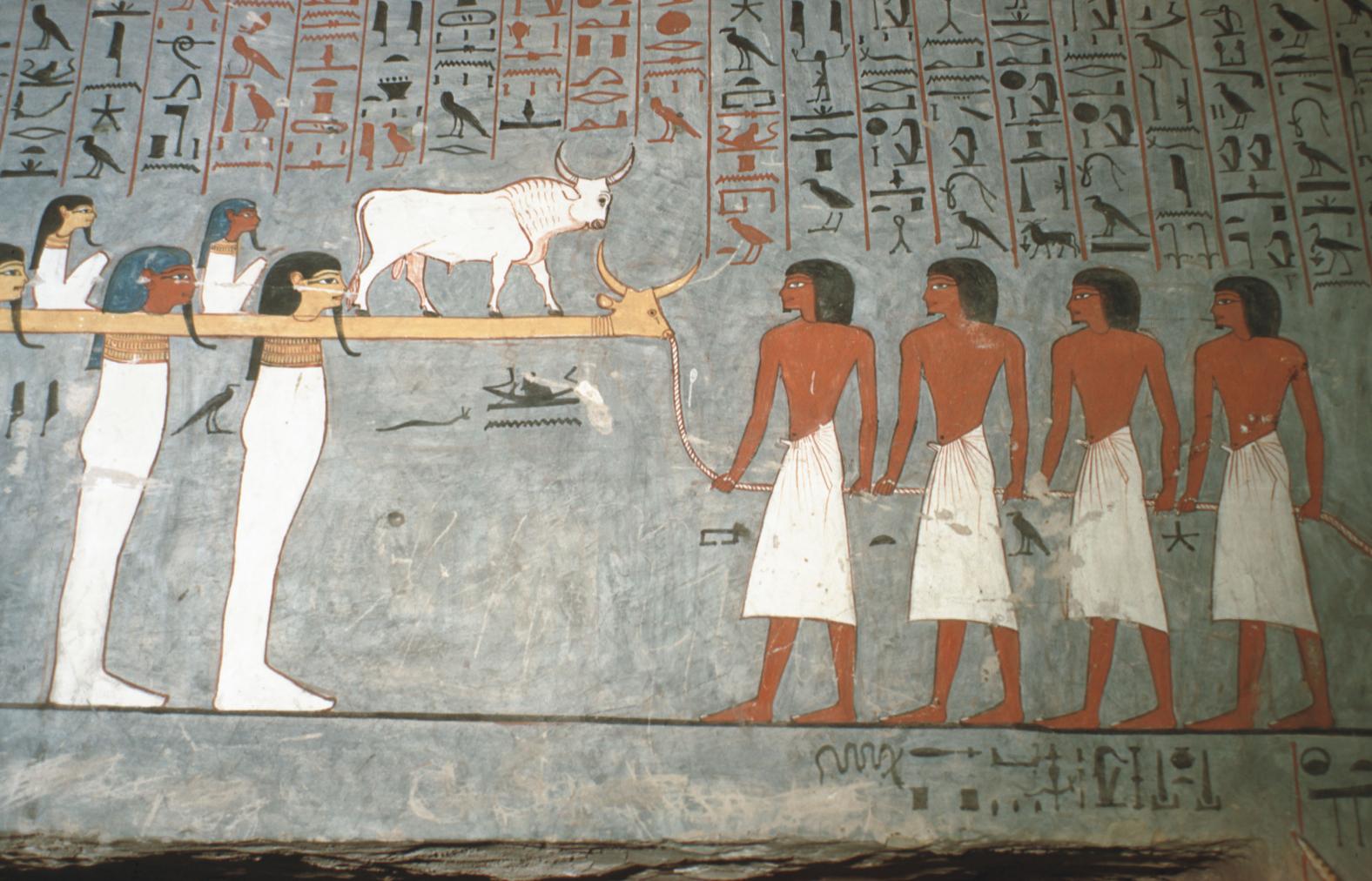
Book of Gates second division (P)/third hour (H), middle and lower registers, Burial chamber J, right (northwest) wall (center part). Courtesy of Uni Dia Verlag; Uni Dia Image Nr. 35664.
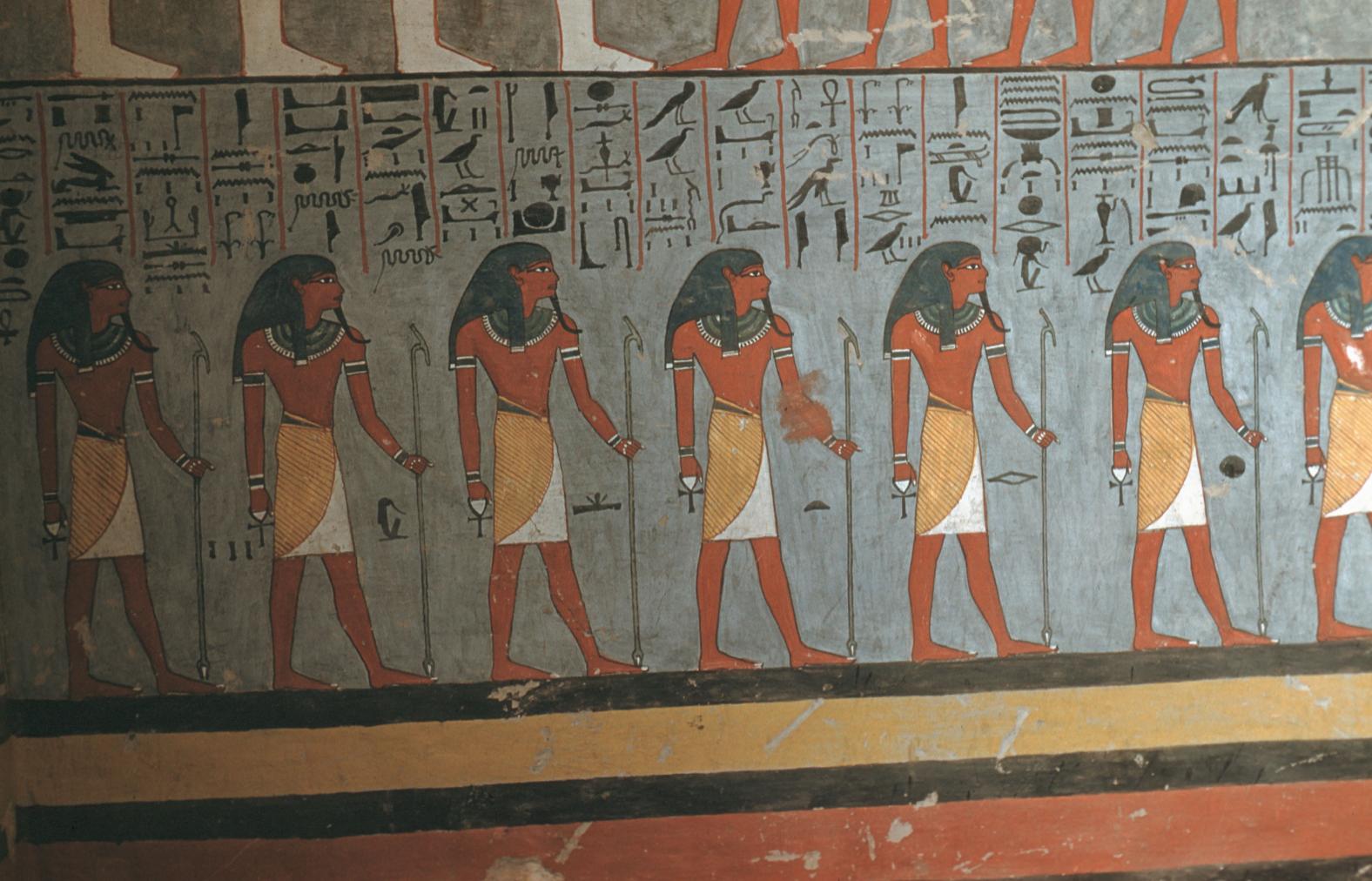
Book of Gates second division (P)/third hour (H), middle and lower registers, Burial chamber J, right (northwest) wall (center part). Courtesy of Uni Dia Verlag; Uni Dia Image Nr. 35665.
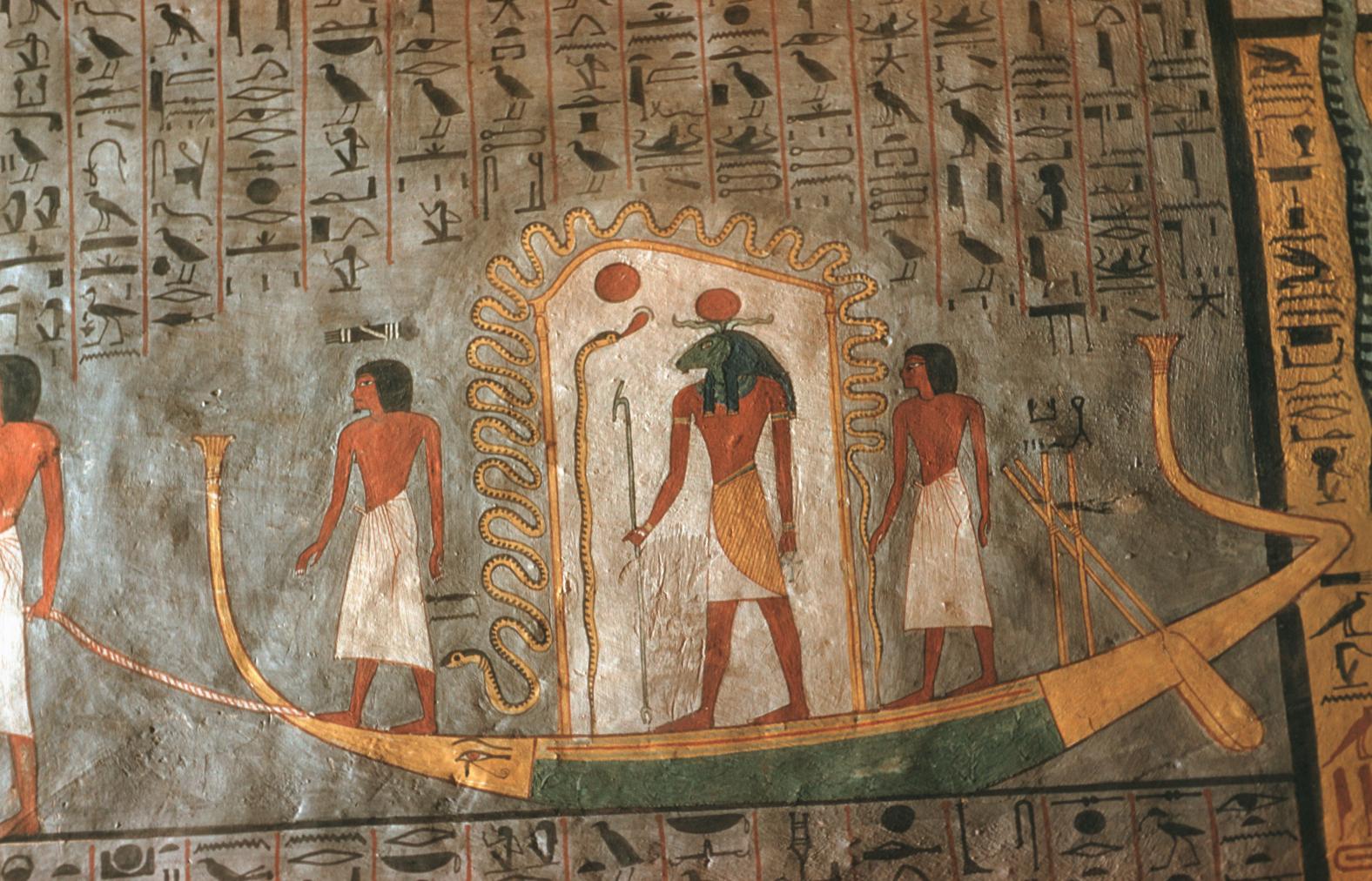
Detail of the god Amun-Ra in the Book of Gates second division (P)/third hour (H), middle and lower registers, Burial chamber J, right (northwest) wall (right part) Courtesy of Uni Dia Verlag; Uni Dia Image Nr. 35668.
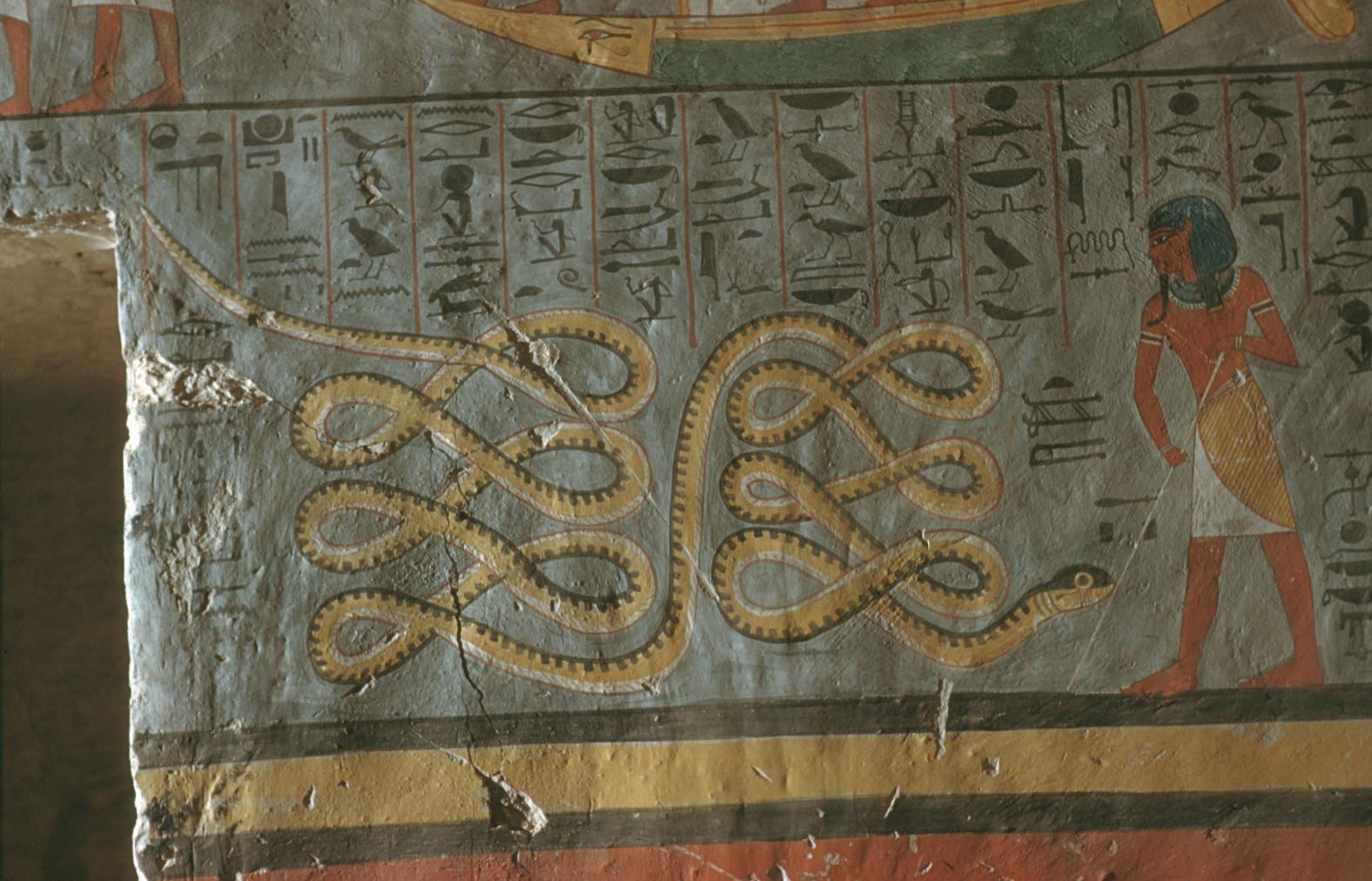
Detail of the god Atum defeating Apophis - Book of Gates second division (P)/third hour (H), middle and lower registers, Burial chamber J, right (northwest) wall (right part). Courtesy of Uni Dia Verlag; Uni Dia Image Nr. 35669.
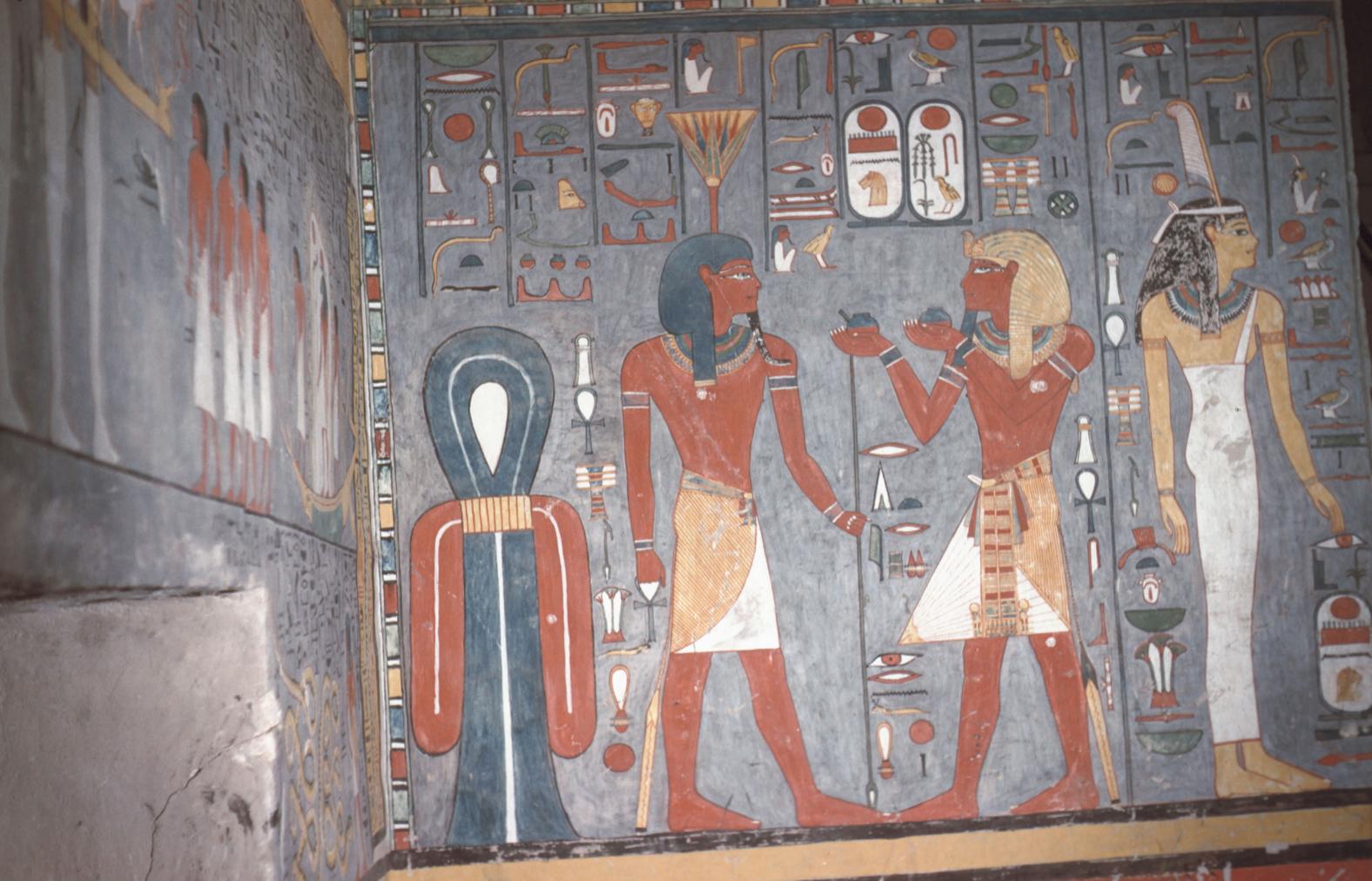
The king offers to the god Nefertem beside a tyet-knot; the goddess Ma'at to the right (Burial Chamber J, front wall, left part). Courtesy of Uni Dia Verlag; Uni Dia Image Nr. 35671.
Side chamber Ja
See entire tombThe walls of this side chamber, off burial chamber J, were smoothed, but not plastered or decorated.
Gate Ja
See entire tombThe gate leads from burial chamber J to side chamber Ja.
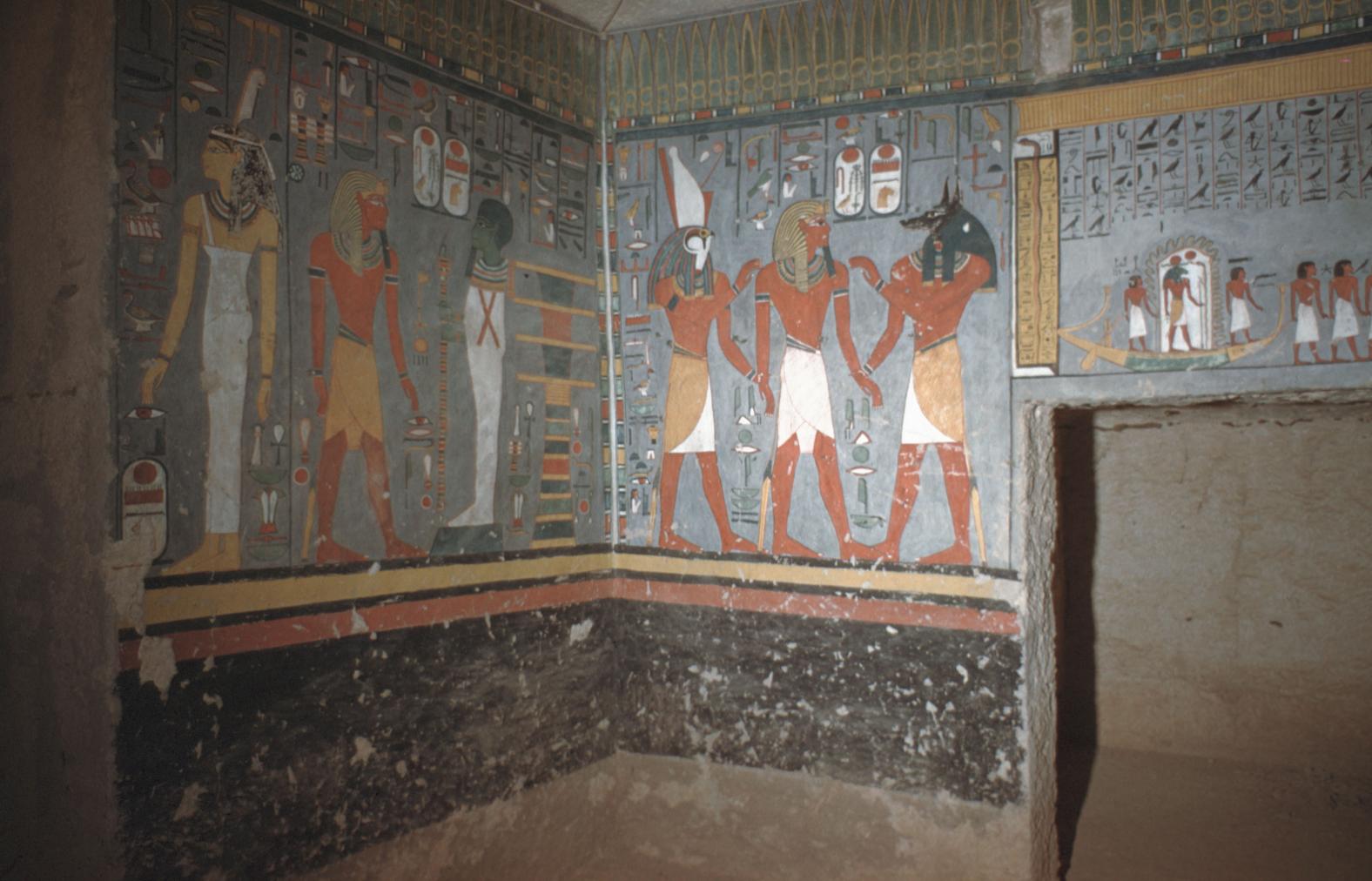
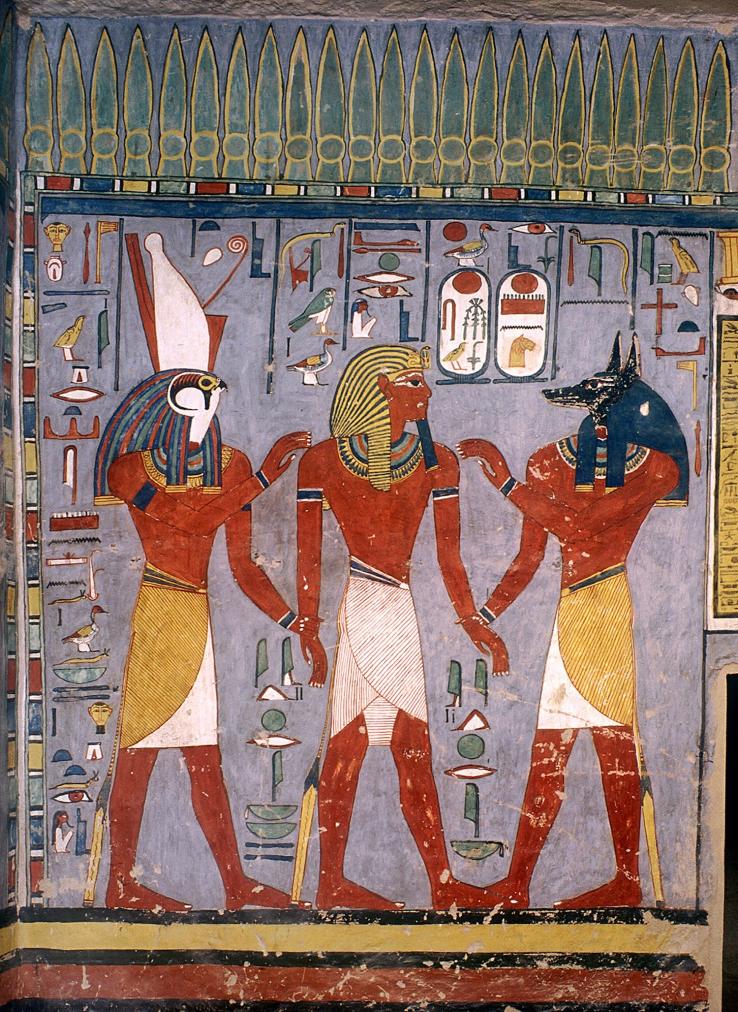
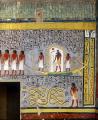
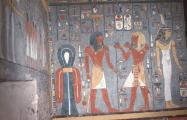
View of the southern corner and Gate Ja - the king before the god Ptah and djed-pillar (front wall, right part). The king flanked by the gods Horus and Anubis (left wall, right part), Book of Gates, third division (P)/fourth hour (H), middle register, scenes 18 and 19 (left wall above Gate Ja). Courtesy of Uni Dia Verlag; Uni Dia Image Nr. 35652.
Side chamber Jb
See entire tombThis small side chamber at the rear (southwest) end of burial chamber J with an upward sloping floor and downward sloping ceiling, may represent an abandoned cutting originally intended to extend the burial chamber to the southwest. A scene from the third division (P)/fourth hour (H) from the Book of Gates decorates the rear wall. In it, the ram-headed form of Anubis embraces an enshrined Osiris before the serpent-goddess Nesert. The right (northwest) and left (southeast) walls are undecorated.
Porter and Moss designation:
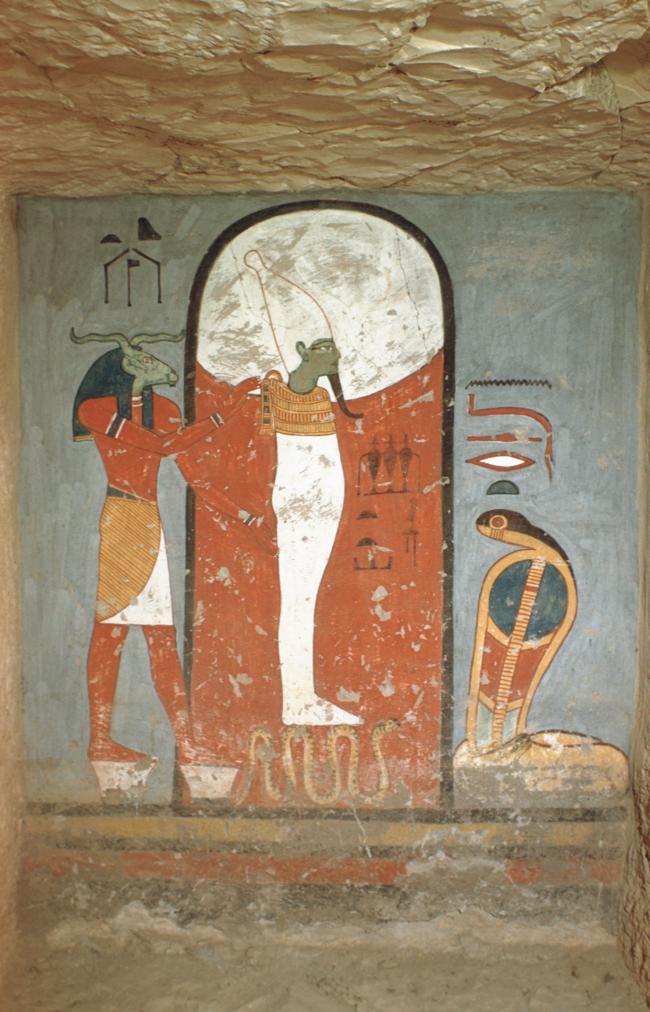
Book of Gates third division (P)/fourth hour (H), Side chamber Jb, rear (southwest) wall. Courtesy of Uni Dia Verlag; Uni Dia Image Nr. 35656.
Gate Jc
See entire tombThe gate leads from burial chamber J to side chamber Jc.
Side chamber Jc
See entire tombThe walls of this side chamber were smoothed but never plastered or decorated. Belzoni found a wooden ka statue here.
About
About
KV 16, located in the southeast Wadi, was unfinished at the time of Rameses I's death. Its axis is oriented roughly to the southwest. The tomb is of a simple plan, and has a stepped entryway (A), a sloping corridor (B) and a stairwell (C), followed by the burial chamber J with three side chambers (Ja-c). A pair of holes in the walls of corridor B served to hold a beam for lowering the Sarcophagus with the aid of ropes. The unfinished trapezoidal recesses in corridor C are unusually wide.
The burial chamber J may have been intended to be larger if side chamber Jb is an abandoned cutting. Two pairs of Magical brick niches are set high up on the side walls of burial chamber J, and side chamber Jb may have served as the emplacement for the now-missing Canopic chest. The tomb is decorated with scenes from the Book of Gates (burial chamber J, side chamber Jb) and scenes of the deceased with deities (burial chamber J). KV 16 has suffered from flood damage.
Noteworthy features:
Burial chamber J comes immediately after the second corridor B.
Site History
Only the entryway and the first two corridors of KV 16 had been cut when Rameses I died. The broken condition of the Sarcophagus lid and the upper edge of the box show that the tomb was plundered, perhaps at the end of Dynasty 20 or in Dynasty 21. The mummy was eventually cached in TT 320 in the tenth regnal year of Saamen after previously being hidden in KV 17. The tomb entrance subsequently was covered over, as the absence of any Greek or Latin graffiti attests.
Dating
This site was used during the following period(s):
Exploration
Conservation
Conservation History
The Supreme Council of Antiquities has installed four ceiling supports in the burial room around the Sarcophagus, the sarcophagus lid has been placed on the box with repairs in tinted plaster made to breaks in both box and lid. Wooden walkways, stairs and fluorescent lighting have been added.
Site Condition
The stone in the tomb is fractured and has suffered from flood damage. Rain water entered the tomb through joints and faults in the surface limestone. The painted decoration has also suffered from the floods: paint has flaked off and the walls have cracked because of rock movement.
Hieroglyphs
Rameses I
 King of Upper and Lower Egypt, Eternal is the Strength of Ra; Son of Ra, Ra has Fashioned Him
niswt-bity mn-pHty-Raw sA-Raw Raw-msw
Tomb entrances before construction of flood diversion walls.
Modern stairs leading to first gate.
Kheker frieze; Rameses I with souls of Nekhen and Pe; consecrating meret chests [before Atum-Ra-Kheperi].
Book of Gates on walls; sarcophagus in center.
Rameses I offering unguent and four meret chests to Atum-Ra-Kheperi.
Kheker frieze; magical brick niches; Book of Gates, third division (P)/fourth hour (H), middle register, scenes 18 and 19.
Kheker frieze; Ma'at; Rameses I before Ptah; djed-pillar.
Kheker frieze; tyet-knot; Nefertem receiving offering from Rameses I; Ma'at.
Tourists in front of tomb entrance.
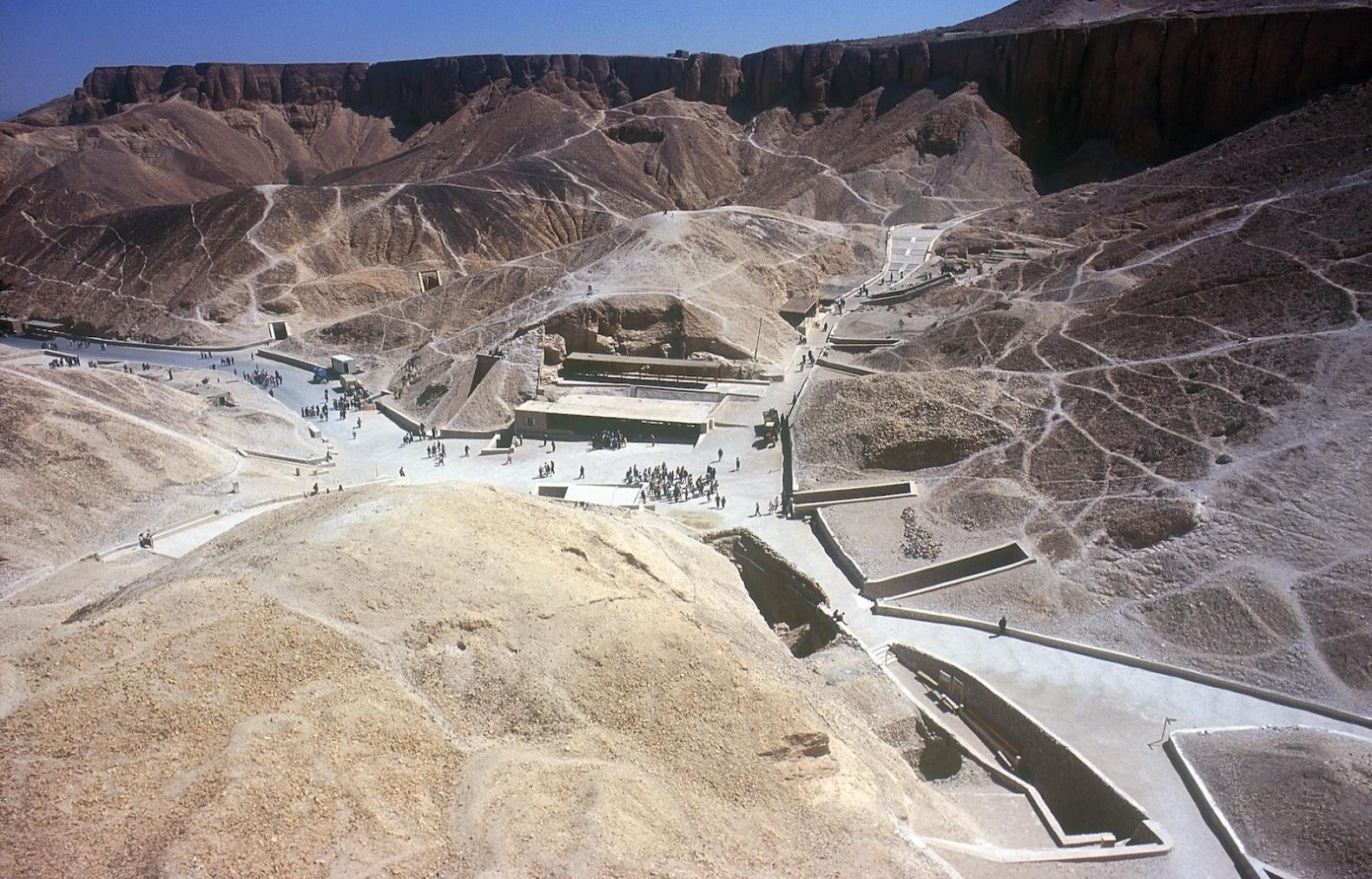
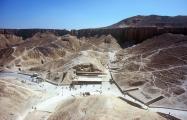
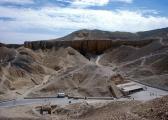
Tomb entrances and tourist shelter in the central part of the Valley of the Kings.
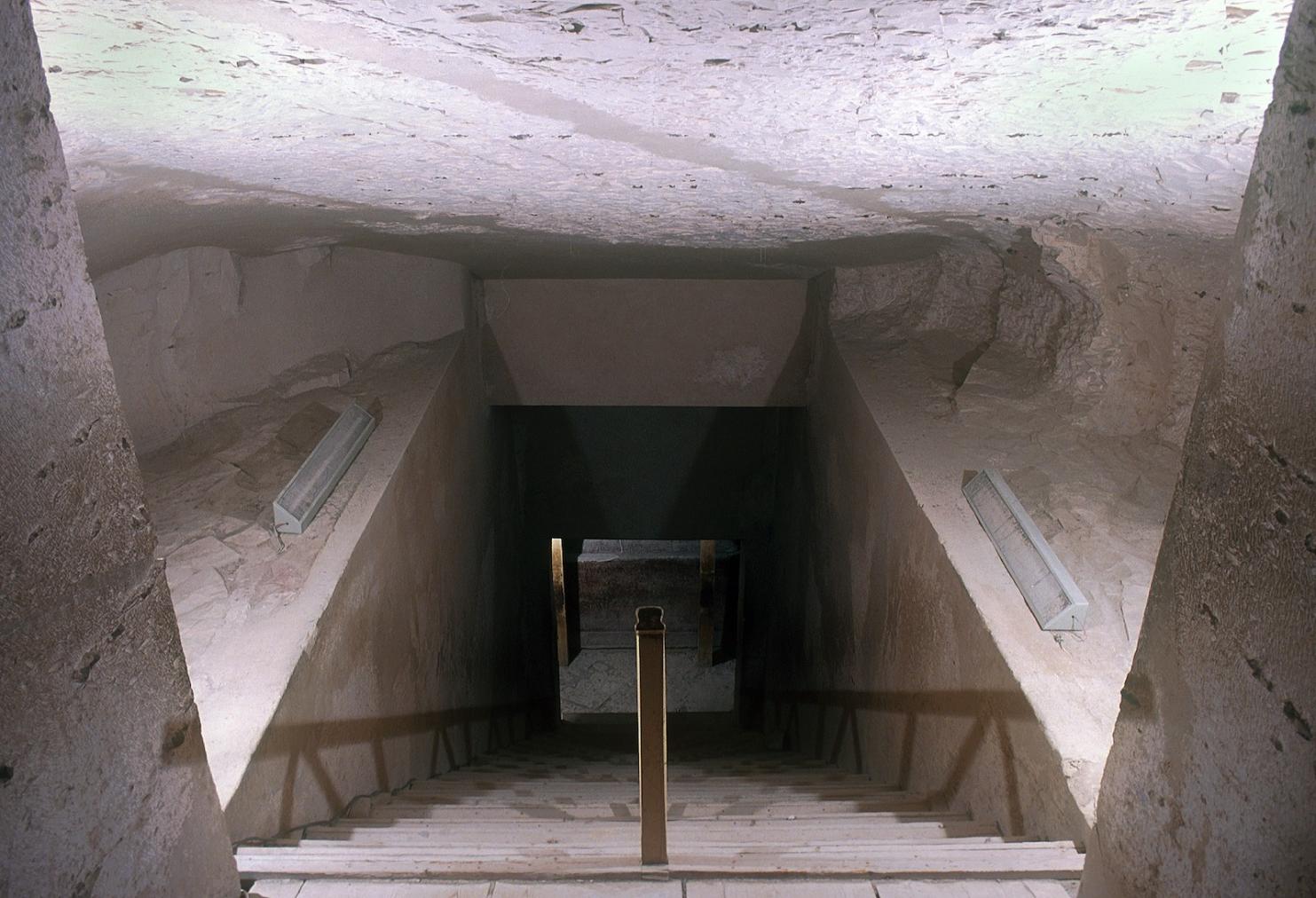
Unfinished cutting of recesses.
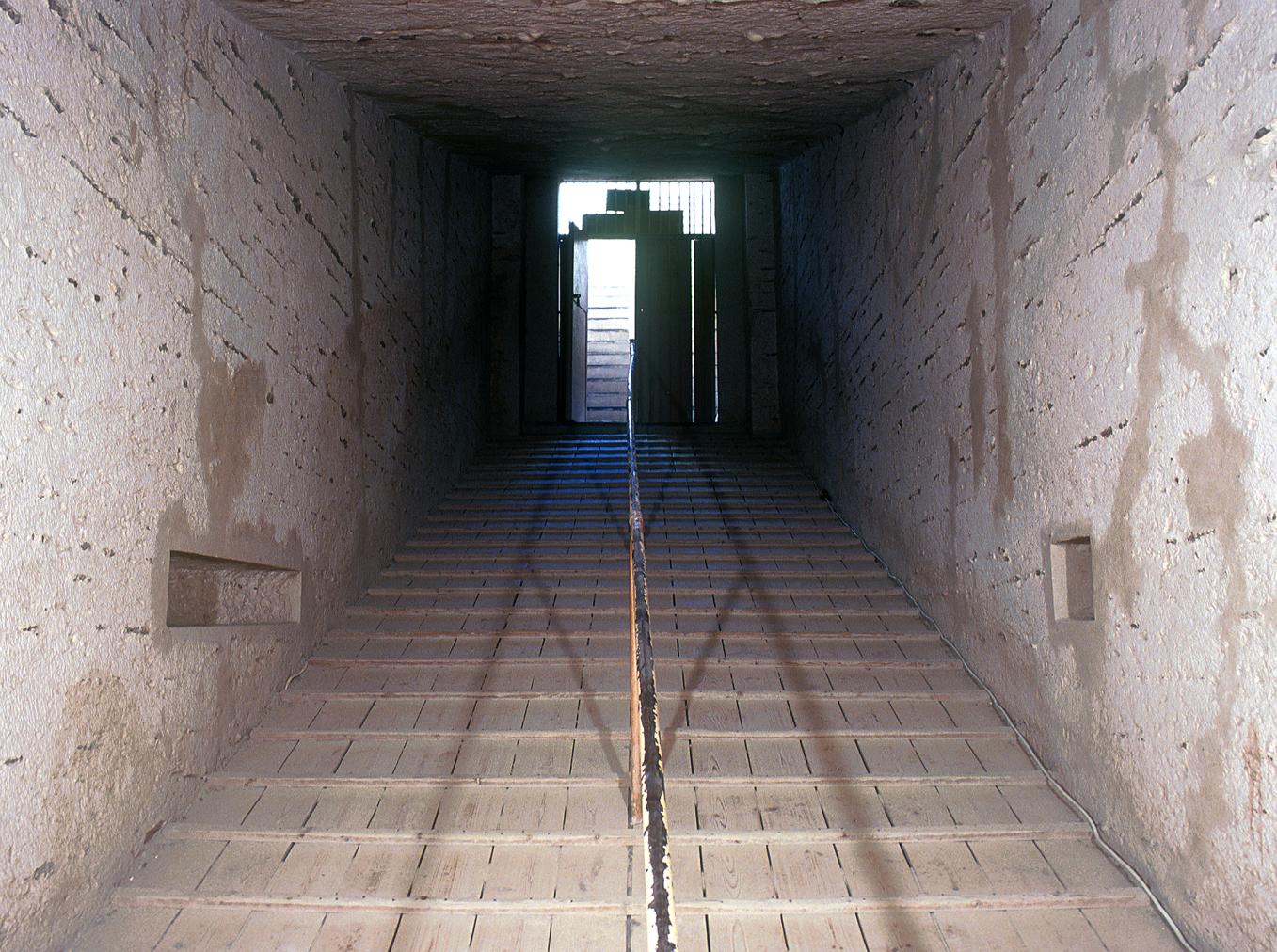
Beam holes in side walls.
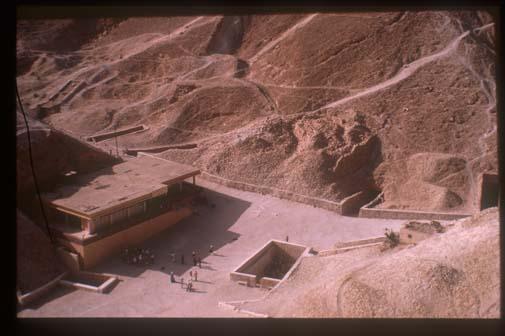
Old rest house, KV 18, KV 17, KV 16, KV 55, KV 62, KV 9, KV 10 and KV 11.
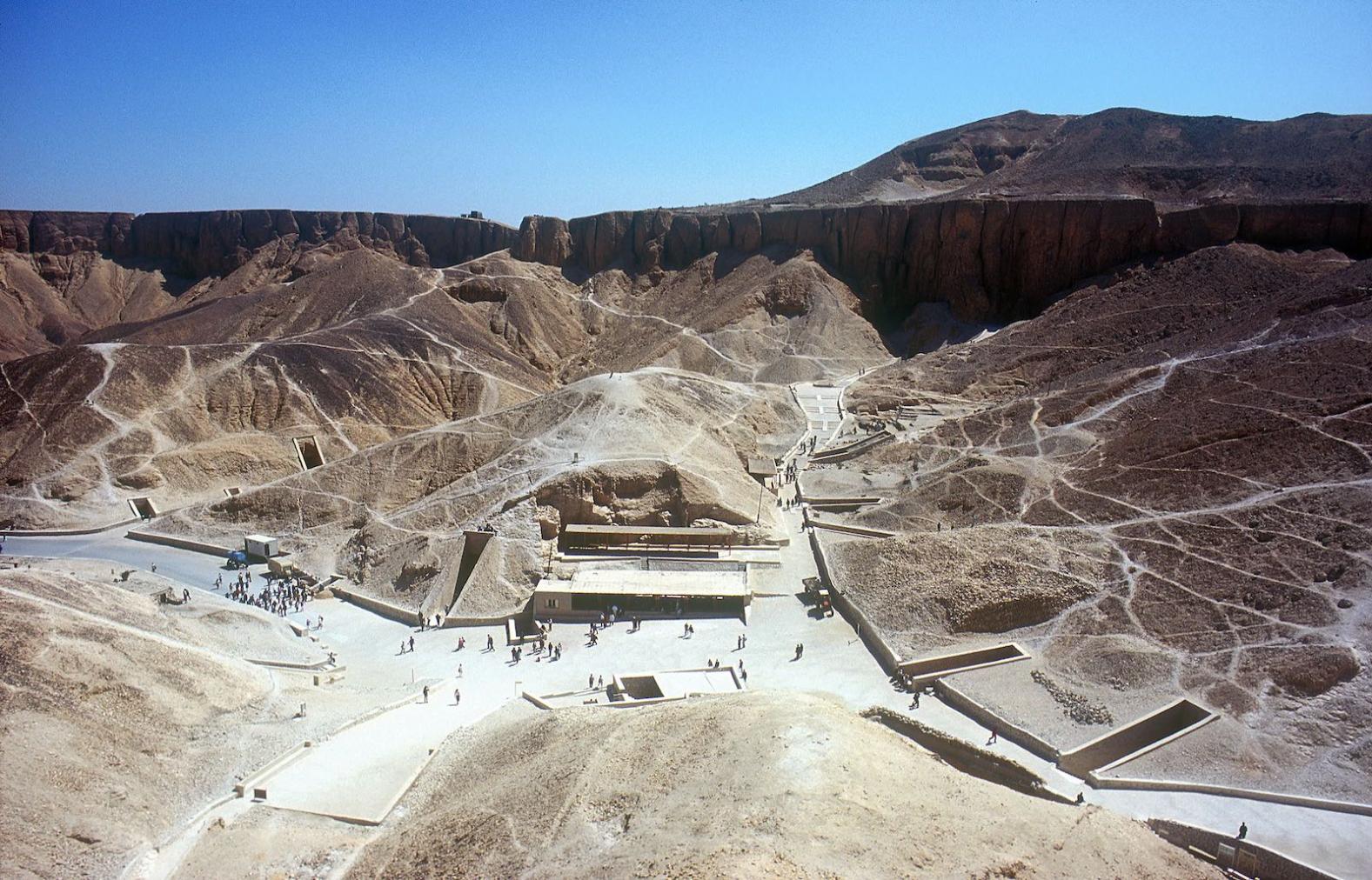
Valley of the Kings, panoramic view from cliffs above KV 09, looking southeast. Visible are entrances to KV 03, KV 07, KV 04, KV 05, KV 06, KV 55, KV 62, KV 18, KV 17, KV 16, KV 10, KV 11, KV 57, and toursit shelter.
Atum and Neit escorting [Rameses I] (reconstruction)
Kneeling winged Isis on head of sarcophagus.
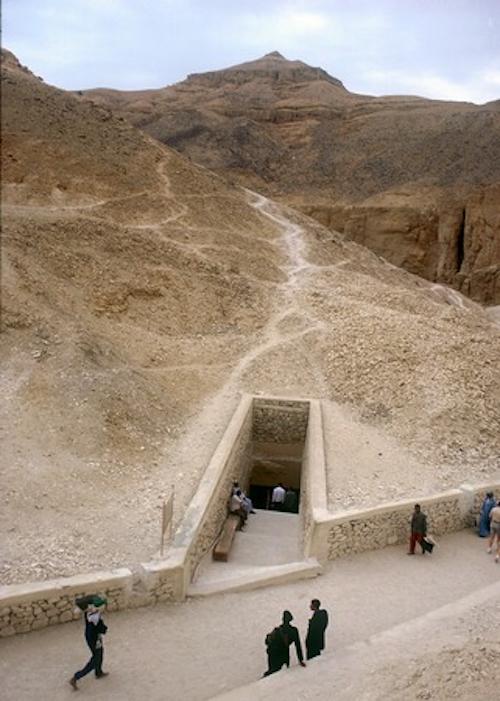
Tomb entrance.
Book of Gates, third division (P)/fourth hour (H), middle and lower registers, scenes 19 and 20.
Book of Gates, second division (P)/third hour (H), middle register: Bark of Ra.
Book of Gates, third division (P)/fourth hour (H), middle register: Osiris in shrine attended by ram-headed Anubis and uraeus (KV16)
Kheker frieze; Osiris with Iwnmutef priest with Horus [leading Rameses I].
Rameses I escorted by Horus, Atum and Neith [before Osiris].
Kheker frieze; Book of Gates, second division (P)/third hour (H), middle register, scene 11: Bark of the Earth.
Book of Gates, third division (P)/fourth hour (H), middle and lower registers, scenes 19 and 20.
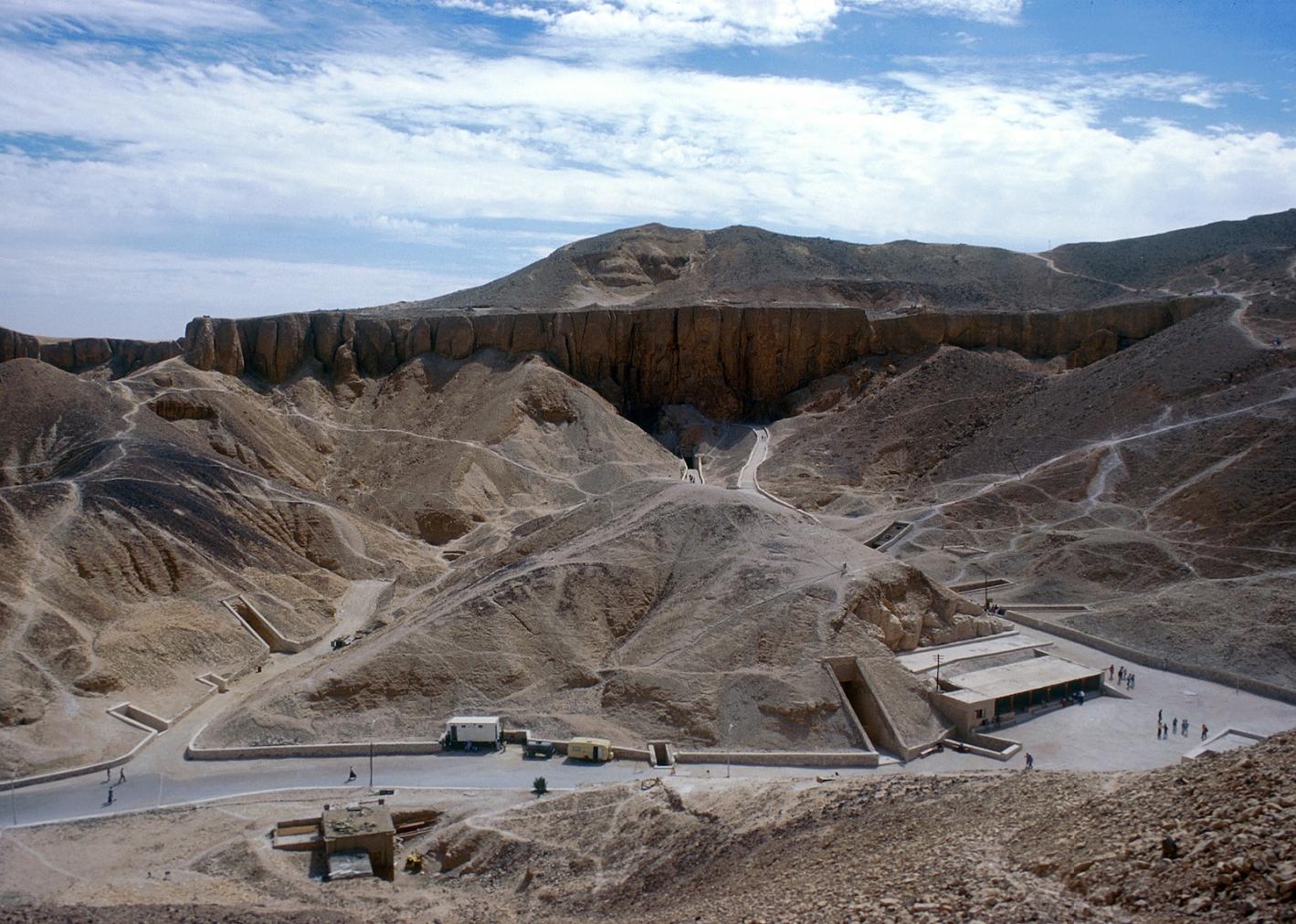
Tomb entrances and tourist shelter.
Osiris and Iwnmutef priest approached by Horus leading Rameses I.
Book of Gates, second division (P)/third hour (H), middle and lower registers.
Book of Gates, second division (P)/third hour (H), lower register, scene 14.
Kheker frieze; Book of Gates, second division(P)/third hour (H), middle and lower registers, scenes 12 and 14.
Imsety, Anubis, Duamutef, Thoth, winged Isis on the sarcophagus of Rameses I.
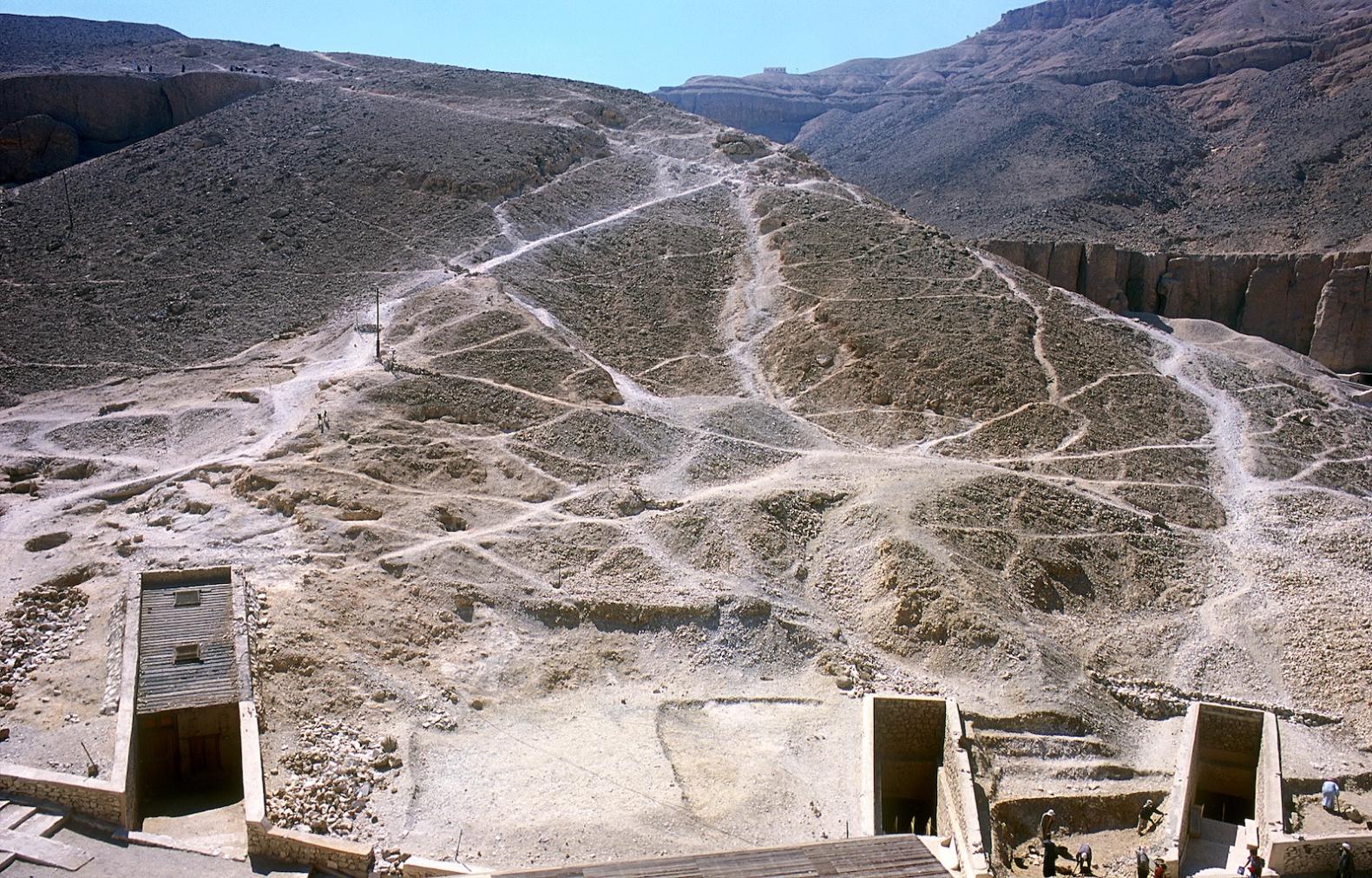
Tomb entrances with partial clearance by University of Basel expedition and American Research Center in Egypt flood control project.
Trace of eye panel, but other painted decoration lost.
Painted decoration lost.
Painted decoration mostly lost, but with traces of Thoth and Qebehsenuef, one of the four sons of Horus.
Kneeling winged Isis.
Thoth holding up pillar of heaven.
Duamutef, one of the four sons of Horus.
Imsety, one of the four sons of Horus, and Anubis.
Imsety, one of the four sons of Horus.
Kneeling winged Nephthys.
Thoth holding pillar of heaven (reconstruction).
Rameses I offering meret chests to Atum-Ra-Kheperi and led before Osiris by Horus (reconstruction).
KV16 and KV17 tomb entrances.
Rameses I before the god Ptah and a djed-pillar (Burial chamber J, front wall, right part). Courtesy of Uni Dia Verlag; Uni Dia Image Nr. 35651.
View of the southern corner and Gate Ja - the king before the god Ptah and djed-pillar (front wall, right part). The king flanked by the gods Horus and Anubis (left wall, right part), Book of Gates, third division (P)/fourth hour (H), middle register, scenes 18 and 19 (left wall above Gate Ja). Courtesy of Uni Dia Verlag; Uni Dia Image Nr. 35652.
Book of Gates, third division (P)/fourth hour (H), middle and lower registers, scenes 19 and 20 - Burial chamber J, left wall. Courtesy of Uni Dia Verlag; Uni Dia Image Nr. 35653.
Detail of snake guarding river crossing in the hereafter; Book of Gates, third division (P)/fourth hour (H), middle and lower registers, scenes 19 and 20 - Burial chamber J, left wall. Courtesy of Uni Dia Verlag; Uni Dia Image Nr. 35654.
Rameses I with souls of Nekhen and Pe; consecrating meret-chests [before Atum-Ra-Kheperi] (Burial chamber J, rear wall (left part)) and side chamber Jb - Book of Gates third division (P)/fourth hour (H) rear (Southwest) wall. Courtesy of Uni Dia Verlag; Uni Dia Image Nr. 35655.
Book of Gates third division (P)/fourth hour (H), Side chamber Jb, rear (southwest) wall. Courtesy of Uni Dia Verlag; Uni Dia Image Nr. 35656.
Rameses I (with the souls of Nekhen and Pe) and consecrating meret-chests before the syncretic god Atum-Ra-Kheperi, Burial chamber J, rear wall (left part). Courtesy of Uni Dia Verlag; Uni Dia Image Nr. 35657.
The gods Atum-Ra-Kheperi and Osiris seated back to back (not visible here) with an Iwnmutef priest before the god Horus [leading Rameses I], Burial chamber J, rear wall (center part). Courtesy of Uni Dia Verlag; Uni Dia Image Nr. 35659.
Horus [leading Rameses I], Burial chamber J, rear wall (center part). Courtesy of Uni Dia Verlag; Uni Dia Image Nr. 35660.
Ramses I led by the goddess Neith in front of the god Osiris, Burial chamber J, rear wall (right part). Courtesy of Uni Dia Verlag; Uni Dia Image Nr. 35661.
View of the western corner of Burial chamber J. Courtesy of Uni Dia Verlag; Uni Dia Image Nr. 35662.
Book of Gates second division (P)/third hour (H), middle and lower registers, Burial chamber J, right (northwest) wall (left part). Courtesy of Uni Dia Verlag; Uni Dia Image Nr. 35663.
Book of Gates second division (P)/third hour (H), middle and lower registers, Burial chamber J, right (northwest) wall (center part). Courtesy of Uni Dia Verlag; Uni Dia Image Nr. 35664.
Book of Gates second division (P)/third hour (H), middle and lower registers, Burial chamber J, right (northwest) wall (center part). Courtesy of Uni Dia Verlag; Uni Dia Image Nr. 35665.
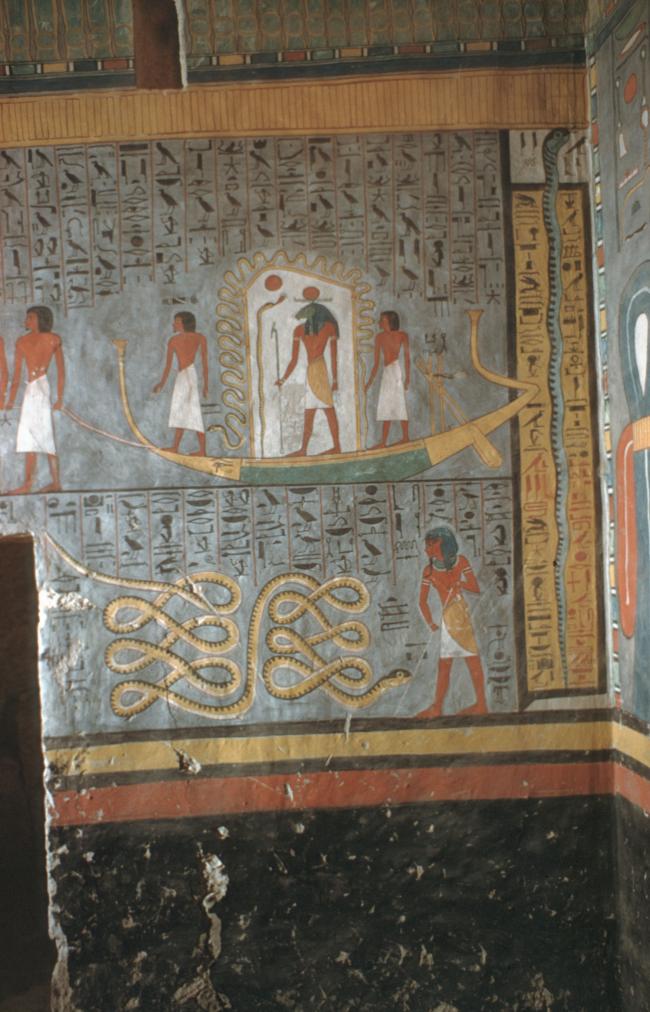
Detail of gods, Book of Gates second division (P)/third hour (H), middle and lower registers, Burial chamber J, right (northwest) wall (center part). Courtesy of Uni Dia Verlag; Uni Dia Image Nr. 35666.
Detail of the god Amun-Ra in the Book of Gates second division (P)/third hour (H), middle and lower registers, Burial chamber J, right (northwest) wall (right part) Courtesy of Uni Dia Verlag; Uni Dia Image Nr. 35668.
Detail of the god Atum defeating Apophis - Book of Gates second division (P)/third hour (H), middle and lower registers, Burial chamber J, right (northwest) wall (right part). Courtesy of Uni Dia Verlag; Uni Dia Image Nr. 35669.
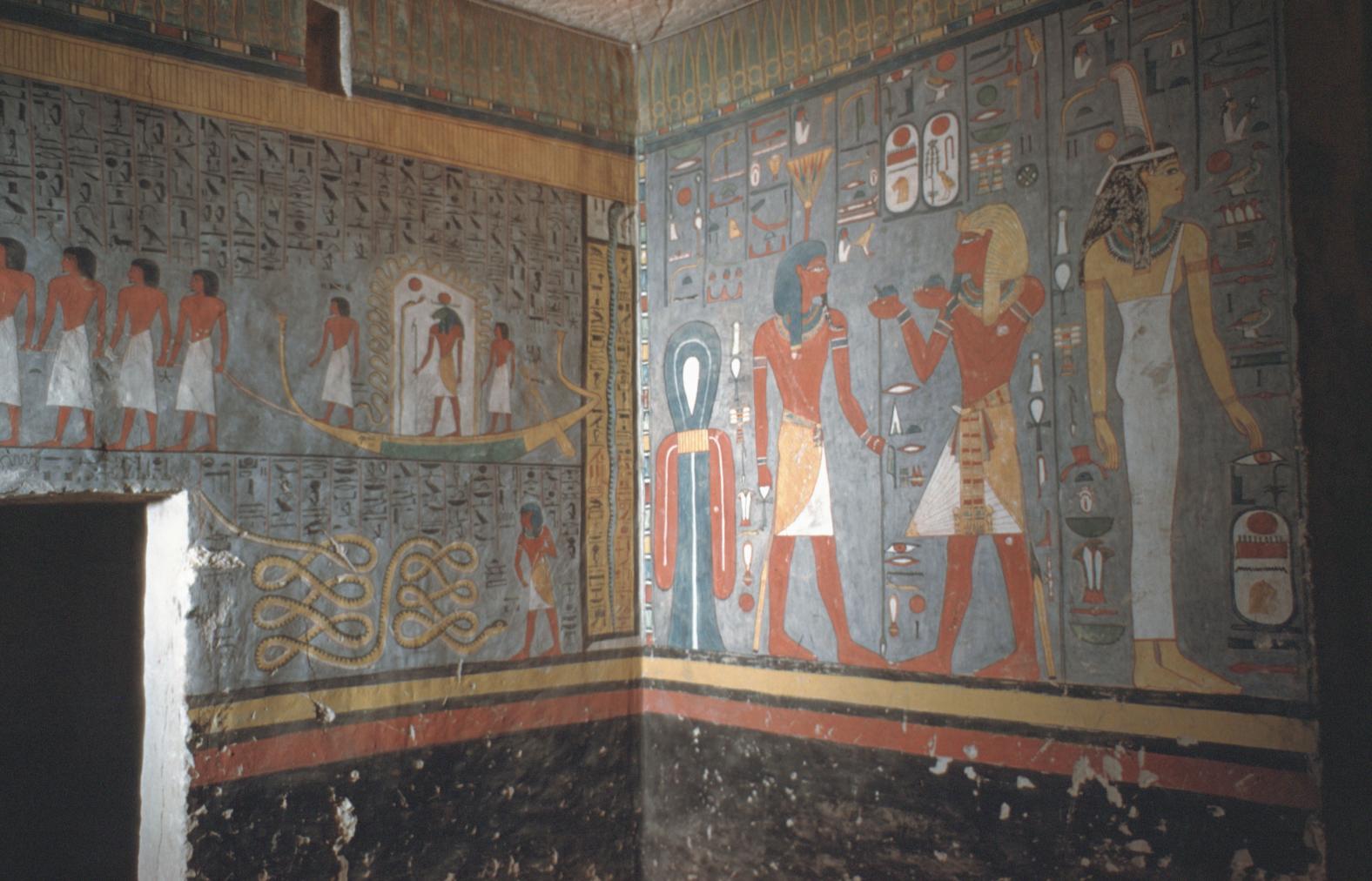
View of northern corner - Book of Gates second division (P)/third hour (H), middle and lower registers, Burial chamber J, right (northwest) wall (right part); Ramses I offering to the god Nefertum and tyet-knot (front wall, left part). Courtesy of Uni Dia Verlag; Uni Dia Image Nr. 35670.
The king offers to the god Nefertem beside a tyet-knot; the goddess Ma'at to the right (Burial Chamber J, front wall, left part). Courtesy of Uni Dia Verlag; Uni Dia Image Nr. 35671.
Bibliography
Porter, Bertha and Rosalind Moss. Topographical Bibliography of Ancient Egyptian Hieroglyphic Text, Reliefs, and Paintings. I, 2.The Theban Necropolis: Royal Tombs and Smaller Cemeteries. Oxford: Clarendon Press, 1964. Pp. 534-535.
Reeves, Carl Nicholas. Valley of the Kings: The Decline of a Royal Necropolis (= Studies in Egyptology). London: KPI, 1990. Pp. 91-92.
Robins, Gay. The Canon of Proportions in the Tomb of Ramesses I (KV 16). Göttingen Miszellen 68 (1983): 85-90.
Rossi, Corinna. The Identification of the Tomb Described on O. BM 8505. GöttMisz 187 (2001): 97-99.
Thomas, Elizabeth. The Royal Necropoleis of Thebes. Princeton: privately printed, 1966. Pp. 103-104.
Weeks, Kent R. Measurements of KV Royal Tomb Components. In: Richard H. Wilkinson and Kent R. Weeks (eds.). The Oxford Handbook of the Valley of the Kings. Oxford: Oxford University Press, 2016. Pp. 583-599.
Weeks, Kent R. (ed.). Atlas of the Valley of the Kings (=Publications of the Theban Mapping Project. Cairo: American University in Cairo, 1). Cairo: American University in Cairo Press, 2000. Map sheet 33.
Weeks, Kent R. The Treasures of Luxor and the Valley of the Kings. Vercelli: WhiteStar, 2005; Cairo: American University in Cairo Press, 2005. Available in English, Italian, Spanish, French, German and Chinese. Pp. 268-271.
Wilkinson, Richard H. and Carl Nicholas Reeves. The Complete Valley of the Kings. London: Thames and Hudson, 1996. Pp. 134-135.