

QV 44
Prince Khaemwaset


Entryway A
See entire tombThere is a tourist shelter to the right of the entrance and the short, slightly descending Ramp has modern retaining walls.

Entrance to QV44

Entrance to QV 44. Courtesy of Uni Dia Verlag; Uni Dia Image Nr. 36601.


Gate B
See entire tombThis gate provides access to the tomb. It was recut after the tomb was constructed and decorated as it was too narrow for the granite Sarcophagus. After the recutting, the gate was replastered and carved but was never painted. The gate now has a modern metal door with grill to prevent access once the site is closed and visiting hours have ended.
The decoration on the lower parts of the reveals and thicknesses are lost, presumably due to past flooding events. The only extant decoration remains on the right thickness and contains a fragmentary image of a winged kneeling Ma'at. There are post holes in the ceiling on either side of the doorway within the corridor for the original double wooden door.
Porter and Moss designation:
Corridor B
See entire tombThis corridor lies on axis with the tomb's entrance and has two side chambers, one to the southeast and one to the northwest. There is loss of plaster and relief on the lower parts of the walls, indicative of past flooding events. The ceiling is decorated with stars and a Kheker frieze runs along the upper parts of the walls. The walls are protected with glass barriers and lit by fluorescent lighting, while the floor is covered with a wooden walkway.
The scenes in this corridor center of the King, Rameses III, and the prince offering to various deities. As with the tombs of the other sons of Rameses III, the king is the dominant figure and interacts with the deities on behalf of his son.
Porter and Moss designation:

Rameses III before Shu in the tomb of Khaemwaset (QV44).

Rameses III in the tomb of Khaemwaset.

Vestibule and burial chamber of the tomb of Prince Khaemwaset (QV 44) after the removal of Late Period sarcophagi dating from the 25th to 26th Dynasties during Ernesto Schiaparelli's excavations. In the burial chamber, Prince Khaemwaset's granite sarcophagus is visible; however, its lower part (S. 5215) is missing. Italian Archaeological Expedition excavations. Courtesy of the Egyptian Museum in Turin.

Vestibule and burial chamber of the tomb of Prince Khaemwaset (QV 44) after the removal of Late Period sarcophagi dating from the 25th to 26th Dynasties during Ernesto Schiaparelli's excavations. In the burial chamber, Prince Khaemwaset's granite sarcophagus is visible; however, its lower part (S. 5215) is missing. Italian Archaeological Expedition excavations. Courtesy of the Egyptian Museum in Turin.

The god Ptah enshrined from the tomb of Prince Khaemwaset (QV 44) photographed during Ernesto Schiaparelli's excavations. Italian Archaeological Expedition excavations. Courtesy of the Egyptian Museum in Turin.

Thoth from the tomb of Prince Khaemwaset (QV 44) photographed during Ernesto Schiaparelli's excavations. Italian Archaeological Expedition excavations. Courtesy of the Egyptian Museum in Turin.

Rameses III who holds Anubis' hand from the tomb of Prince Khaemwaset (QV 44) photographed during Ernesto Schiaparelli's excavations. Italian Archaeological Expedition excavations. Courtesy of the Egyptian Museum in Turin.

Anubis holding Rameses III's hand from the tomb of Prince Khaemwaset (QV 44) photographed during Ernesto Schiaparelli's excavations. Italian Archaeological Expedition excavations. Courtesy of the Egyptian Museum in Turin.

Ra-Horakhty holding Rameses III's hand from the tomb of Prince Khaemwaset (QV 44) photographed during Ernesto Schiaparelli's excavations. Italian Archaeological Expedition excavations. Courtesy of the Egyptian Museum in Turin.

The tomb of Prince Khaemwaset (QV 44) photographed during Ernesto Schiaparelli's excavations that depicts the young prince (left), as well as his father Rameses III (right) in front of the god Geb. Italian Archaeological Expedition excavations. Courtesy of the Egyptian Museum in Turin.

The tomb of Prince Khaemwaset (QV 44) photographed during Ernesto Schiaparelli's excavations that depicts his father Rameses III who censes and libates an image of the god Geb. Italian Archaeological Expedition excavations. Courtesy of the Egyptian Museum in Turin.

The tomb of Prince Khaemwaset (QV 44) photographed during Ernesto Schiaparelli's excavations that depicts his father Rameses III who censes and libates in front of Geb. Italian Archaeological Expedition excavations. Courtesy of the Egyptian Museum in Turin.

The tomb of Prince Khaemwaset (QV 44) photographed during Ernesto Schiaparelli's excavations that depicts the young prince with a feathered fan. Italian Archaeological Expedition excavations. Courtesy of the Egyptian Museum in Turin.

The tomb of Prince Khaemwaset (QV 44) photographed during Ernesto Schiaparelli's excavations that depicts the young prince with a feathered fan. Italian Archaeological Expedition excavations. Courtesy of the Egyptian Museum in Turin.

The tomb of Prince Khaemwaset (QV 44) photographed during Ernesto Schiaparelli's excavations that depicts Rameses III censing in front of Atum. Italian Archaeological Expedition excavations. Courtesy of the Egyptian Museum in Turin.

General view of Corridor B from entrance

King (damaged) censing before Ptah in Shrine.

King censing (damaged)

Stars painted on ceiling

Ptah in Shrine, Rameses III and Prince offering to Thoth

Rameses III and Prince before Anubis and Rameses III greeted by Re-Horakhty

Prince and Ptah-Sokar

Rameses III censing before Geb, Rameses III and prince greeted by Shu, and Rameses III and Prince censing

Unidentified female deity (unpainted) (damaged)

Atum (unpainted)


Gate Ba
See entire tombThis gate is cut into the southeast wall of the corridor and provides access to a side chamber. The floor is cut slightly higher than that of the preceding corridor. There is a slot cut above the doorway, presumably for the placement of a wooden lintel. The gate is protected by glass barriers and lit with fluorescent lighting.
The lintel contains an image of a winged sun disk, the jambs have a dedication text of the tomb from the king to his son, and the thicknesses are decorated with images of Horus-Iwnmutef.
Porter and Moss designation:
Side chamber Ba
See entire tombThis side chamber lies to the southeast of the corridor. The walls are protected with glass barriers and lit by fluorescent lighting, while a wooden walkway was erected over the original floor. The plaster on the walls of this side chamber show signs of cracking, but there are no major losses.
Unusually, the prince is shown here interacting with deities directly without his father. He is, however, still shown with the side lock of youth. The major scene in this chamber is located on the southeast wall and consists of a double scene of Osiris seated with Isis adoring him on the right and Nephthys adoring him on the left. The side walls depict the prince offering to various deities.

Neith and Serqet

Isis and Nephthys

Prince before Four sons of Horus and Serqet

Double scene of Osiris seated and being adored by Nephthys on left and Isis on the right

Prince before Anubis and Imsety

Prince before Anubis, Four sons of Horus, and Neith


Gate Bb
See entire tombThis gate is cut into the northwest wall of the corridor and provides access to a side chamber. The floor is higher than that of the corridor. The walls are protected with glass barriers and lit by fluorescent lighting.
The lintel is decorated with a winged sun disk, the reveals with the titles of Rameses III, and the thicknesses with images of Horus-Iwnmutef.
Porter and Moss designation:

Winged sun disk

Dedication text of the tomb and titles of Rameses III

Dedication text and titles of Rameses III

Iwn-mutef priest

Iwn-mutef priest


Side chamber Bb
See entire tombThis side chamber lies to the northwest of the first corridor. There is evidence of cracking in the plaster of the walls and the ceiling has several small losses in painted plaster. The walls are protected by glass barriers and lit by fluorescent lighting, while the original floor is covered with a wooden walkway.
As with the previous side chamber, the prince is shown here interacting with the deities without the assistance of his father. He wears the side lock of youth. The main scene is situated on the northwest wall and consists of a double scene with Isis before Osiris seated and Nephthys before Ptah-Sokar seated. The side walls show the prince offering to the various deities.
Porter and Moss designation:

Isis and Nephthys

Prince in adoration before Imsety, Duamutef, Bak, and 'Horus in his Youth'

Double scene of Isis in adoration before Osiris and Nephthys in adoration before Osiris

Prince in adoration before Hapy, Qebehsenuef, dog-headed deity (Ennead of the Duat), and 'Horus in his Youth'


Gate C
See entire tombThis gate provides access to the burial chamber and lies on axis with the tomb's entrance. It was widened after the construction and decoration of the tomb in order to allow the granite Sarcophagus to pass. The jambs were then replastered and carved with relief but not painted. The jambs are protected with glass barriers and lit with fluorescent lighting. There are post holes in the ceiling on either side of the doorway in corridor C indicating that the doorway was closed with double wooden doors.
The lintel is decorated with a winged sun disk and the reveals with a unpainted relief of Nephthys on the left and Isis on the right.
Porter and Moss designation:

Gate C with winged sun disk on lintel

View of Gate C and Burial Chamber C

Isis (damaged) (unpainted)

Nephthys (damaged) (unpainted)

Lion-headed daemon with a knife at the tomb entrance (the shadow comes from the wire protection grill), Gate C. Courtesy of Uni Dia Verlag; Uni Dia Image Nr. 36603.


Burial chamber C
See entire tombThis corridor served as the burial chamber and lies on axis with the tomb's entrance. The ceiling is vaulted and there are two unfinished side chambers in the southeast and northwest walls. A pit was excavated into the floor as a Sarcophagus emplacement. The walls are protected with glass barriers and lit with fluorescent lighting, while the floor is protected by a wooden walkway.
The scenes in this chamber center on the Book of the Dead Spells 145-146 and depict the King, Rameses III, and the prince passing through the various gates of the underworld. As with the preceding corridor, the king is the dominant figure and interacts with the deities on the prince's behalf. The prince is shown with a side lock of youth. The sarcophagus lid of Khaemwaset was discovered in this chamber and is constructed out of red granite. It is now housed in the Egyptian Museum in Turin.
Chamber plan:
RectangularRelationship to main tomb axis:
ParallelChamber layout:
Flat floor, no pillarsFloor:
One levelCeiling:
Vaulted
Porter and Moss designation:
Vestibule and burial chamber of the tomb of Prince Khaemwaset (QV 44) after the removal of Late Period sarcophagi dating from the 25th to 26th Dynasties during Ernesto Schiaparelli's excavations. In the burial chamber, Prince Khaemwaset's granite sarcophagus is visible; however, its lower part (S. 5215) is missing. Italian Archaeological Expedition excavations. Courtesy of the Egyptian Museum in Turin.
Vestibule and burial chamber of the tomb of Prince Khaemwaset (QV 44) after the removal of Late Period sarcophagi dating from the 25th to 26th Dynasties during Ernesto Schiaparelli's excavations. In the burial chamber, Prince Khaemwaset's granite sarcophagus is visible; however, its lower part (S. 5215) is missing. Italian Archaeological Expedition excavations. Courtesy of the Egyptian Museum in Turin.
View of Gate C and Burial Chamber C

View of Burial chamber C

Prince as Iwnmutef priest

Prince as Iwnmutef priest (unfinished)

Book of the Dead, Spells 145-146

Unfinished side chamber

Book of the Dead Spell 145-146

Book of the Dead, Spells 145-46

Book of the Dead Spell 145-146

Unfinished side chamber

Book of the Dead Spell 145-146

Book of the Dead, Spells 145-46


Gate D
See entire tombThis gate provides access to a rear chamber and is on axis with the tomb's entrance. The jambs are protected by glass barriers and lit with fluorescent lighting.
The lintel contains a winged sun disk, the reveals are decorated with the titles of Rameses III, and the thicknesses have brightly colored Djed-pillars.
Porter and Moss designation:

View of Gate D with winged sun disk on lintel

Djed pillar

Djed Pillar

Lion-headed sphinx atop a shrine (shadow is from wire protection grill), Chamber D, front wall (right part). Courtesy of Uni Dia Verlag; Uni Dia Image Nr. 36604.


Chamber D
See entire tombThis chamber lies on axis with the tomb's entrance and has been termed the 'Room of Rebirth' due to the nature of the iconography. The walls are protected by glass barriers and lit with fluorescent lighting, while the floors are protected by wooden walkways.
The scenes center on the king offering to various deities associated with solarization and rebirth. He does so on behalf of the prince who is not depicted in this chamber. The main scene is depicted on the southwest wall and consists of a double scene of the king in adoration before Osiris, accompanied by Isis and Neit on the left and Nephthys and Serqet on the right.
Porter and Moss designation:

Osiris from the tomb of Khaemwaset.

The tomb of Prince Khaemwaset (QV 44) photographed during Ernesto Schiaparelli's excavations depicting a jackal and lion reclining atop chapels. Italian Archaeological Expedition excavations. Courtesy of the Egyptian Museum in Turin.

The tomb of Prince Khaemwaset (QV 44) photographed during Ernesto Schiaparelli's excavations depicting a jackal and lion reclining atop chapels. Italian Archaeological Expedition excavations. Courtesy of the Egyptian Museum in Turin.

The tomb of Prince Khaemwaset (QV 44) photographed during Ernesto Schiaparelli's excavations that depicts Rameses III offering to Thoth. Italian Archaeological Expedition excavations. Courtesy of the Egyptian Museum in Turin.

The tomb of Prince Khaemwaset (QV 44) photographed during Ernesto Schiaparelli's excavations that depicts Rameses III before Horsiese. Italian Archaeological Expedition excavations. Courtesy of the Egyptian Museum in Turin.

The tomb of Prince Khaemwaset (QV 44) photographed during Ernesto Schiaparelli's excavations that depicts Rameses III in adoration. Italian Archaeological Expedition excavations. Courtesy of the Egyptian Museum in Turin.

The tomb of Prince Khaemwaset (QV 44) photographed during Ernesto Schiaparelli's excavations. Isis (left) and Neith (right) before Osiris (and not visible here). Italian Archaeological Expedition excavations. Courtesy of the Egyptian Museum in Turin.

The tomb of Prince Khaemwaset (QV 44) photographed during Ernesto Schiaparelli's excavations. Nephthys (left) and Serqet (right) before Osiris (and not visible here). Italian Archaeological Expedition excavations. Courtesy of the Egyptian Museum in Turin.

The tomb of Prince Khaemwaset (QV 44) photographed during Ernesto Schiaparelli's excavations. Osiris facing the Nephthys and Serqet (not visible here). Italian Archaeological Expedition excavations. Courtesy of the Egyptian Museum in Turin.

The tomb of Prince Khaemwaset (QV 44) photographed during Ernesto Schiaparelli's excavations that depicts Rameses III in adoration. Italian Archaeological Expedition excavations. Courtesy of the Egyptian Museum in Turin.

The tomb of Prince Khaemwaset (QV 44) photographed during Ernesto Schiaparelli's excavations that depicts Rameses III censing and libating before Shepsi. Italian Archaeological Expedition excavations. Courtesy of the Egyptian Museum in Turin.

The tomb of Prince Khaemwaset (QV 44) photographed during Ernesto Schiaparelli's excavations that depicts Rameses III censing and libating before Horus (not visible here). Italian Archaeological Expedition excavations. Courtesy of the Egyptian Museum in Turin.

The tomb of Prince Khaemwaset (QV 44) photographed during Ernesto Schiaparelli's excavations. Heryma'at (left) is shown beside Neb-nerou (right). Italian Archaeological Expedition excavations. Courtesy of the Egyptian Museum in Turin.

The tomb of Prince Khaemwaset (QV 44) photographed during Ernesto Schiaparelli's excavations. Heryma'at (left) is shown beside Neb-nerou (right). Italian Archaeological Expedition excavations. Courtesy of the Egyptian Museum in Turin.

Jackal and lion atop chapels

Rameses III offering vases to Thoth, Rameses III offering vases to Horsiese, Rameses III in adoration

Isis and Neith before Osiris

Isis, Neith, Nephthys, and Serqet before double scene of Osiris

Rameses III in adoration, Rameses III censing before Shepsi and Horus, Rameses III censing and libating before Horus

Nebnerou and Hery-Ma'at


About
About
QV 44 is located at the end of the south branch of the main Wadi, where a number of the sons of Rameses Ill of the 20th Dynasty were buried. Unlike the majority of tombs along this branch, QV 44 is cut on a roughly east-west axis, largely perpendicular to the axes of preceding tombs, except for QV 43, whose axis it shares. Worth noting is the fact that side chamber (Ba) underlies Ramp (A) of QV 43, with approximately two meters of rock in between. QV 44 is a multi-chambered, corridor-type tomb that progresses along a straight axis from the entry ramp (A) to two subsequent corridor chambers (B, C) and a final square chamber (D). Two lateral chambers (Ba, Bb) flank the first corridor chamber (B) (one on each side) and two niches flank the sides of the second corridor chamber (C). The ceiling of corridor (C) has a slight barrel vault, indicating its intended use as the burial chamber. A second phase of construction appears to have been undertaken when the main chambers were finished. The doorways at the entrance, between corridors B and C, were widened to allow the large granite Sarcophagus to be brought into the tomb. These doorways were replastered and the decoration was carved, but they were never painted. It has been assumed that the two entryways carved on either side of chamber C had been planned as full side chambers, but were never finished.
QV 44 belongs to Prince Khaemwaset, a son of Rameses Ill. His mother may have been Rameses' great royal wife Tyti (QV 52). Khaemwaset (QV 44) should not be confused either with his famous predecessor, Khaemwaset, son of Rameses II, or with his half-brothers Rameses IX and XI, who both took the name Khaemwaset as well. Like the son of Rameses II, Khaemwaset was a priest of Ptah and probably spent his life at the temple in Memphis occupied by his religious duties. The remains of his Coffin are in Turin, while one of his Canopic jars is in the Egyptian Museum in Cairo. Otherwise, he is only mentioned as the eighth son on the prince list at Madinat Habu, where he is listed as deceased. A fragment of his coffin with an inscription of Rameses IV indicates that he did not die before his father, but during the reign of the latter. At some point in his life, he was the "king's first son of his body”, but he never took the throne.
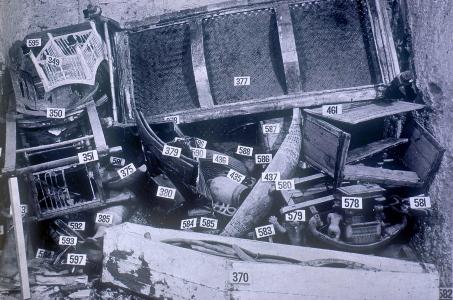
The tomb was discovered by Ernesto Schiaparelli in February 1903. At the time of discovery, the tomb was piled with mummies and wooden sarcophagi dated to the late 22nd-26th Dynasties, a period of substantial reuse of tombs. A dry masonry wall apparently sealed the entrance after these burials and, lacking evidence of Roman re-use, the entrance is assumed to have been lost and forgotten by that time. The tomb was re-opened and probably pillaged during the Coptic and Arab periods. Desert scavengers (perhaps hyenas) were noted by the Italian mission to have ravaged some of the mummified remains. The pit excavated in the floor of burial chamber C to receive the sarcophagus had been filled with sand since its discovery. Christian Leblanc has noted that a small amount of floodwater entered the tomb in November 1994.
Currently the tomb is open to visitation. Glass barriers, fluorescent lighting, and wooden flooring have been installed. Previously, low wooden barriers were used. A sturdy metal door seals and locks the tomb when the site is closed. After the 1994 flood, the modern ramp retaining walls were replaced.
Noteworthy features:
Unlike the majority of tombs along this branch, QV 44 is cut on a roughly east-west axis, largely perpendicular to the axes of preceding tombs, except for QV 43, whose axis it shares. Worth noting is the fact that side chamber Ba underlies Ramp A of QV 43, with approximately two meters of rock in between. A second phase of construction also appears to have been undertaken in QV 44 when the main chambers were finished. Gate B, and Gate C were widened to allow the large granite Sarcophagus to be brought into the tomb. These doorways were replastered and the decoration was carved, but they were never painted.
Site History
Tomb construction was begun between years 16 and 28 of Rameses Ill's reign in the 20th Dynasty, but was not finished until Rameses IV's reign when Khaemwaset's burial took place. There was intensive reuse in the Third Intermediate Period (late 22nd and 26th Dynasties) for a family burial of low-ranking elites who were temples workers. During the Coptic and Arab periods, possibly, the tomb was open and reused, but Lecuyot argues that there was no reuse after Third Intermediate Period.
Dating
This site was used during the following period(s):
Exploration
Conservation
Conservation History
According to the GCI-SCA, modern repair plasters were used to fill areas of loss throughout the tomb, slightly recessed below the level of the original decorated plaster. The paintings were treated again by the SCA between 1992-1994, though the scope of what was done during this period is unknown. The presence of different types of repair suggest several treatment phases. This can be seen on the ceiling of side chamber (Bb) where up to three different types of plaster repairs have been undertaken. This repeat treatment for localized areas of cracking and collapse of repair plaster on this ceiling in 1995 and again in 1996 indicates a possible ongoing problem or implies an ineffective treatment approach and inappropriate materials used to solve the problem. Paintings were last treated by the SCA in 2006, though again the scope of this treatment is unknown, but is assumed to be limited in nature. The paintings have also been cleaned. This appears to have resulted in some smearing of color and abrasion of fragile areas of paint, in particular blues and greens. However, generally the cleaning was not aggressively done and evidence of original varnish applications are still visible. There are also numerous injection holes, evidence of grouting, as well as drip marks, possibly indicating a surface consolidation treatment.
Site Condition
According to the GCI-SCA, the tomb rock is considered stable and there are no signs of severe fracturing or impending loss. However, assessment of the condition was difficult, given the extent of repair plaster that hid areas of previous rock loss. There are areas of cracking in the painted plaster that are possibly associated with underlying rock fissuring and/or instability of substantial areas of infill material. Some of these cracks are quite large and run across walls and ceiling; side chambers (Ba) and (Bb) in particular have significant cracking. However, none of these cracks appear to be endangering surrounding areas and there are relatively few areas of loss. The painted plaster also has smaller cracking throughout, most likely original drying cracks formed as the wet plaster dried. These cracks appear to be stable. The low ceiling of side chamber (Bb) also has a number of small losses in the painted plaster which suggest impact damage.
The survival of the decoration is excellent, but losses have occurred, though these are noticeably less than compared with QV 55 and QV 52. These include loss at the base of walls in the entrance and first corridor and other localized areas, though these are few in number. The blue paint is flaking in areas and there are losses of the paint layer related to the thickness and/or technique of the application of this particular pigment. There is evidence of past bat occupation of this tomb. Bat urine traces are present in side chamber (Ba). Scratch marks are also visible, possibly associated with bat activity. Substantial reuse of the tomb for burials may have resulted in some of the deterioration. Losses at the base of the walls toward the entrance of the tomb may indicate past flooding episodes. There are many areas where the painting still survives to floor level in the second corridor and in the rear chambers, indicating that flood waters may have only reached the first corridor.
Hieroglyphs
Prince Khaemwaset
 Sem-priest of 'Ptah South of his Wall', King's son, Khaemwaset
sm n ptH-rsw(i)-inb.f sA-nswt xa-m-wAst
Osiris from the tomb of Khaemwaset.
Rameses III before Shu in the tomb of Khaemwaset (QV44).
Rameses III in the tomb of Khaemwaset.

Excavating in front of the newly discovered tomb of Prince Khaemwaset (QV 44). Italian Archaeological Mission excavations. Courtesy of the Egyptian Museum in Turin.

At the end of the Valley of the Queens at the site of the still unknown (at the time) tomb of Prince Khaemwaset (QV 44) during Ernesto Schiaparelli's excavations. The tomb's discovery on February 15, 1903, would follow shortly after. Italian Archaeological Expedition excavations. Courtesy of the Egyptian Museum in Turin.

External view of the newly discovered tomb of Prince Khaemwaset (QV 44) during Ernesto Schiaparelli's excavations. At that time, the tomb of Sethherkhepshef (QV 43), to the left, had not yet been discovered. Italian Archaeological Expedition excavations. Courtesy of the Egyptian Museum in Turin.

Burial chamber of the tomb of Prince Khaemwaset (QV 44) at the time of its discovery on February 5, 1903, during Ernesto Schiaparelli's excavations. More than 40 Late Period wooden sarcophagi, dating from the 25th to 26th Dynasties, were found in the vestibule and derive from the tomb's later reuse. Italian Archaeological Expedition excavations. Courtesy of the Egyptian Museum in Turin.

Burial chamber of the tomb of Prince Khaemwaset (QV 44) at the time of its discovery on February 5, 1903, during Ernesto Schiaparelli's excavations. More than 40 Late Period wooden sarcophagi, dating from the 25th to 26th Dynasties, were found in the vestibule and derive from the tomb's later reuse. Italian Archaeological Expedition excavations. Courtesy of the Egyptian Museum in Turin.
Vestibule and burial chamber of the tomb of Prince Khaemwaset (QV 44) after the removal of Late Period sarcophagi dating from the 25th to 26th Dynasties during Ernesto Schiaparelli's excavations. In the burial chamber, Prince Khaemwaset's granite sarcophagus is visible; however, its lower part (S. 5215) is missing. Italian Archaeological Expedition excavations. Courtesy of the Egyptian Museum in Turin.
Vestibule and burial chamber of the tomb of Prince Khaemwaset (QV 44) after the removal of Late Period sarcophagi dating from the 25th to 26th Dynasties during Ernesto Schiaparelli's excavations. In the burial chamber, Prince Khaemwaset's granite sarcophagus is visible; however, its lower part (S. 5215) is missing. Italian Archaeological Expedition excavations. Courtesy of the Egyptian Museum in Turin.
The god Ptah enshrined from the tomb of Prince Khaemwaset (QV 44) photographed during Ernesto Schiaparelli's excavations. Italian Archaeological Expedition excavations. Courtesy of the Egyptian Museum in Turin.
Thoth from the tomb of Prince Khaemwaset (QV 44) photographed during Ernesto Schiaparelli's excavations. Italian Archaeological Expedition excavations. Courtesy of the Egyptian Museum in Turin.
Rameses III who holds Anubis' hand from the tomb of Prince Khaemwaset (QV 44) photographed during Ernesto Schiaparelli's excavations. Italian Archaeological Expedition excavations. Courtesy of the Egyptian Museum in Turin.
Anubis holding Rameses III's hand from the tomb of Prince Khaemwaset (QV 44) photographed during Ernesto Schiaparelli's excavations. Italian Archaeological Expedition excavations. Courtesy of the Egyptian Museum in Turin.
Ra-Horakhty holding Rameses III's hand from the tomb of Prince Khaemwaset (QV 44) photographed during Ernesto Schiaparelli's excavations. Italian Archaeological Expedition excavations. Courtesy of the Egyptian Museum in Turin.
The tomb of Prince Khaemwaset (QV 44) photographed during Ernesto Schiaparelli's excavations that depicts the young prince (left), as well as his father Rameses III (right) in front of the god Geb. Italian Archaeological Expedition excavations. Courtesy of the Egyptian Museum in Turin.
The tomb of Prince Khaemwaset (QV 44) photographed during Ernesto Schiaparelli's excavations that depicts his father Rameses III who censes and libates an image of the god Geb. Italian Archaeological Expedition excavations. Courtesy of the Egyptian Museum in Turin.
The tomb of Prince Khaemwaset (QV 44) photographed during Ernesto Schiaparelli's excavations that depicts his father Rameses III who censes and libates in front of Geb. Italian Archaeological Expedition excavations. Courtesy of the Egyptian Museum in Turin.
The tomb of Prince Khaemwaset (QV 44) photographed during Ernesto Schiaparelli's excavations that depicts the young prince with a feathered fan. Italian Archaeological Expedition excavations. Courtesy of the Egyptian Museum in Turin.
The tomb of Prince Khaemwaset (QV 44) photographed during Ernesto Schiaparelli's excavations that depicts the young prince with a feathered fan. Italian Archaeological Expedition excavations. Courtesy of the Egyptian Museum in Turin.
The tomb of Prince Khaemwaset (QV 44) photographed during Ernesto Schiaparelli's excavations that depicts Rameses III censing in front of Atum. Italian Archaeological Expedition excavations. Courtesy of the Egyptian Museum in Turin.
The tomb of Prince Khaemwaset (QV 44) photographed during Ernesto Schiaparelli's excavations depicting a jackal and lion reclining atop chapels. Italian Archaeological Expedition excavations. Courtesy of the Egyptian Museum in Turin.
The tomb of Prince Khaemwaset (QV 44) photographed during Ernesto Schiaparelli's excavations depicting a jackal and lion reclining atop chapels. Italian Archaeological Expedition excavations. Courtesy of the Egyptian Museum in Turin.
The tomb of Prince Khaemwaset (QV 44) photographed during Ernesto Schiaparelli's excavations that depicts Rameses III offering to Thoth. Italian Archaeological Expedition excavations. Courtesy of the Egyptian Museum in Turin.
The tomb of Prince Khaemwaset (QV 44) photographed during Ernesto Schiaparelli's excavations that depicts Rameses III before Horsiese. Italian Archaeological Expedition excavations. Courtesy of the Egyptian Museum in Turin.
The tomb of Prince Khaemwaset (QV 44) photographed during Ernesto Schiaparelli's excavations that depicts Rameses III in adoration. Italian Archaeological Expedition excavations. Courtesy of the Egyptian Museum in Turin.
The tomb of Prince Khaemwaset (QV 44) photographed during Ernesto Schiaparelli's excavations. Isis (left) and Neith (right) before Osiris (and not visible here). Italian Archaeological Expedition excavations. Courtesy of the Egyptian Museum in Turin.
The tomb of Prince Khaemwaset (QV 44) photographed during Ernesto Schiaparelli's excavations. Nephthys (left) and Serqet (right) before Osiris (and not visible here). Italian Archaeological Expedition excavations. Courtesy of the Egyptian Museum in Turin.
The tomb of Prince Khaemwaset (QV 44) photographed during Ernesto Schiaparelli's excavations. Osiris facing the Nephthys and Serqet (not visible here). Italian Archaeological Expedition excavations. Courtesy of the Egyptian Museum in Turin.
The tomb of Prince Khaemwaset (QV 44) photographed during Ernesto Schiaparelli's excavations that depicts Rameses III in adoration. Italian Archaeological Expedition excavations. Courtesy of the Egyptian Museum in Turin.
The tomb of Prince Khaemwaset (QV 44) photographed during Ernesto Schiaparelli's excavations that depicts Rameses III censing and libating before Shepsi. Italian Archaeological Expedition excavations. Courtesy of the Egyptian Museum in Turin.
The tomb of Prince Khaemwaset (QV 44) photographed during Ernesto Schiaparelli's excavations that depicts Rameses III censing and libating before Horus (not visible here). Italian Archaeological Expedition excavations. Courtesy of the Egyptian Museum in Turin.
The tomb of Prince Khaemwaset (QV 44) photographed during Ernesto Schiaparelli's excavations. Heryma'at (left) is shown beside Neb-nerou (right). Italian Archaeological Expedition excavations. Courtesy of the Egyptian Museum in Turin.
The tomb of Prince Khaemwaset (QV 44) photographed during Ernesto Schiaparelli's excavations. Heryma'at (left) is shown beside Neb-nerou (right). Italian Archaeological Expedition excavations. Courtesy of the Egyptian Museum in Turin.

At the end of the Valley of the Queens at the site of the still unknown (at the time) tomb of Prince Khaemwaset (QV 44) during Ernesto Schiaparelli's excavations. The tomb's discovery on February 15, 1903, would follow shortly after. Italian Archaeological Expedition excavations. Courtesy of the Egyptian Museum in Turin.

View up Southern branch of the wadi leading to QV45, QV44, QV43, QV42, QV41, QV40, QV39, QV38, QV37, QV36, and QV34. QV49 and QV50 in foreground.

View up Southern branch of the wadi leading to QV45, QV44, QV43, QV42, QV41, QV40, QV39, QV38, QV37, QV36, and QV34. QV49 and QV50 in foreground.

Entrances to QV47 and QV46 in foreground with QV44 and QV45 in background.

Entrance to QV47

Retaining walls of QV36, QV38, QV40, QV41, QV42, and entrances to QV43 and QV44 with visitors shelter.

Entrance to QV44 with visitors shelter and QV45 on the right

New signage in front of QV44

Entrance to QV44 with visitors shelter

New signage in front of QV44 and entrance to QV45 in the background.
Entrance to QV44

Signage in visitors shelter at QV44

View of entrances to QV42 and QV43 from QV44 visitors shelter.

Visitors shelter at QV44

view of the main wadi from QV44

Entrances to QV44 with visitors shelter and QV45

QV49 and QV50 in the foreground with the northern and southern branches of the main wadi in the background.

View of the southern branch of the main wadi

Entrances to QV30, QV31, QV32, QV33, with entrances to QV44 and QV45 in the background

End of the southern branch of the wadi with entrances to QV40, QV41, QV42, QV43, and QV44

Entrance to QV44 with visitors shelter and entrance to QV45 on the right

Entrance to QV45 on the right and QV44 with visitors shelter on the left

Winged Ma'at (unpainted)

Winged Ma'at (unpainted) (detail)
General view of Corridor B from entrance
King (damaged) censing before Ptah in Shrine.
King censing (damaged)
Stars painted on ceiling
Ptah in Shrine, Rameses III and Prince offering to Thoth
Rameses III and Prince before Anubis and Rameses III greeted by Re-Horakhty
Prince and Ptah-Sokar
Rameses III censing before Geb, Rameses III and prince greeted by Shu, and Rameses III and Prince censing

Winged sun disk

View of Gate Ba
Winged sun disk
Dedication text of the tomb and titles of Rameses III
Dedication text and titles of Rameses III
Unidentified female deity (unpainted) (damaged)
Atum (unpainted)
Neith and Serqet
Isis and Nephthys
Prince before Four sons of Horus and Serqet
Double scene of Osiris seated and being adored by Nephthys on left and Isis on the right
Prince before Anubis and Imsety
Prince before Anubis, Four sons of Horus, and Neith
Iwn-mutef priest
Iwn-mutef priest
Isis and Nephthys
Prince in adoration before Imsety, Duamutef, Bak, and 'Horus in his Youth'
Double scene of Isis in adoration before Osiris and Nephthys in adoration before Osiris
Prince in adoration before Hapy, Qebehsenuef, dog-headed deity (Ennead of the Duat), and 'Horus in his Youth'
Gate C with winged sun disk on lintel
View of Gate C and Burial Chamber C
Isis (damaged) (unpainted)
Nephthys (damaged) (unpainted)
View of Burial chamber C
Prince as Iwnmutef priest
Prince as Iwnmutef priest (unfinished)
Book of the Dead, Spells 145-146
Unfinished side chamber
Book of the Dead Spell 145-146
Book of the Dead, Spells 145-46
Book of the Dead Spell 145-146
Unfinished side chamber
Book of the Dead Spell 145-146
Book of the Dead, Spells 145-46
View of Gate D with winged sun disk on lintel
Djed pillar
Djed Pillar
Jackal and lion atop chapels
Rameses III offering vases to Thoth, Rameses III offering vases to Horsiese, Rameses III in adoration
Isis and Neith before Osiris
Isis, Neith, Nephthys, and Serqet before double scene of Osiris
Rameses III in adoration, Rameses III censing before Shepsi and Horus, Rameses III censing and libating before Horus
Nebnerou and Hery-Ma'at

Transporting the sarcophagi found in the tombs of Princes Khaemwaset (QV 44) and Sethherkhepshef (QV 43) from Schiaparelli's camp in the Valley of the Queens towards the Nile River. Italian Archaeological Expedition excavations. Courtesy of the Egyptian Museum in Turin.

Transporting the sarcophagi found in the tombs of Princes Khaemwaset (QV 44) and Sethherkhepshef (QV 43) from Schiaparelli's camp in the Valley of the Queens towards the Nile River. Italian Archaeological Expedition excavations. Courtesy of the Egyptian Museum in Turin.

View of the back of the Valley of the Queens photographed during Schiaparelli's excavations. From right to left are the entrances to an unfinished tomb (QV 45), the tomb of Prince Khaemwaset (QV 44), as well as the tomb of Prince Sethherkhepshef (QV 43). A commemorative plaque for the Italian Expedition's discoveries is visible followed by the barely visible shaft to the tomb of Princess Ahmose (QV 47) Italian Archaeological Expedition excavations. Courtesy of the Egyptian Museum in Turin.

View of the back of the Valley of the Queens photographed during Schiaparelli's excavations. From right to left are the entrances to an unfinished tomb (QV 45), the tomb of Prince Khaemwaset (QV 44), as well as the tomb of Prince Sethherkhepshef (QV 43). A commemorative plaque for the Italian Expedition's discoveries is visible followed by the barely visible shaft to the tomb of Princess Ahmose (QV 47) Italian Archaeological Expedition excavations. Courtesy of the Egyptian Museum in Turin.

View of Schiaparelli's camp near the Valley of the Queens shortly after the discovery of several sarcophagi in the tombs of Princes Khaemwaset (QV 44) and Sethherkhepshef (QV 43). Italian Archaeological Expedition excavations. Courtesy of the Egyptian Museum in Turin.

Red granite sarcophagus lid of Khaemwaset. Courtesy of the Egyptian Museum in Turin (S.5215).

Inner coffin of Mentuirdis found either in QV 43 or QV 44. Courtesy of the Egyptian Museum in Turin (S.5219).

Inner coffin of Mentuirdis found in QV 44. Courtesy of the Egyptian Museum in Turin (S.5219).

Inner coffin of Mentuirdis found in QV 44. Courtesy of the Egyptian Museum in Turin (S.5219).

Inner coffin of Mentuirdis found in QV 44. Courtesy of the Egyptian Museum in Turin (S.5219).

Inner coffin of Mentuirdis found in QV 44. Courtesy of the Egyptian Museum in Turin (S.5219).

Inner coffin of Mentuirdis found in QV 44. Courtesy of the Egyptian Museum in Turin (S.5219).

Inner coffin of Mentuirdis found in QV 44. Courtesy of the Egyptian Museum in Turin (S.5219).

Middle coffin of Mentuirdis found in QV 44. Courtesy of the Egyptian Museum in Turin (S.5220).

Middle coffin of Mentuirdis found in QV 44. Courtesy of the Egyptian Museum in Turin (S.5220).

Middle coffin of Mentuirdis found in QV 44. Courtesy of the Egyptian Museum in Turin (S.5220).

Middle coffin of Mentuirdis found in QV 44. Courtesy of the Egyptian Museum in Turin (S.5220).

Middle coffin of Mentuirdis found in QV 44. Courtesy of the Egyptian Museum in Turin (S.5220).

Wooden box of the coffin of Mentuirdis found in QV 44. Courtesy of the Egyptian Museum in Turin (S.5221).

Wooden coffin of Harwa (A) found either in QV 43 or QV 44. Courtesy of the Egyptian Museum in Turin (S.5226/1 a-b).

Wooden coffin of Harwa (A) found either in QV 43 or QV 44. Courtesy of the Egyptian Museum in Turin (S.5226/1 a-b).

Mummy of Harwa (A) found either in QV 43 or QV 44. Courtesy of the Egyptian Museum in Turin (S.5226/2).

"Scarf" of the mummy of Harwa (A) found either in QV 43 or QV 44. Courtesy of the Egyptian Museum in Turin (S.5226/3).

Faience and plant fiber funerary net from the mummy of Harwa (A) found either in QV 43 or QV 44. Courtesy of the Egyptian Museum in Turin (S.5226/4 a-b).

Coffin of Nesymendjam found either in QV 43 or QV 44. Courtesy of the Egyptian Museum in Turin (S.5227).

Mummy of Nesymendjam found either in QV 43 or QV 44. Courtesy of the Egyptian Museum in Turin (S.5227/02).

Coffin of Hor found either in QV 43 or QV 44. Courtesy of the Egyptian Museum in Turin (S.5228).

Coffin of Harwa (B) found either in QV 43 or QV 44. Courtesy of the Egyptian Museum in Turin (S.5229/a-b).

Coffin of Harwa (B) found either in QV 43 or QV 44. Courtesy of the Egyptian Museum in Turin (S.5229/a-b).

Lid of the coffin of Tadiaset-taheket found either in QV 43 or QV 44. Courtesy of the Egyptian Museum in Turin (S.5244).

Lid of the coffin of Iuefdi found either in QV 43 or QV 44. Courtesy of the Egyptian Museum in Turin (S.5253).

Wooden stela dedicated by Hor, son of Wakamontu, to the deities Isis, Nephthys, Re-Horakhty, and Osiris found either in QV 43 or QV 44. Courtesy of the Egyptian Museum in Turin (S.5267).
Entrance to QV 44. Courtesy of Uni Dia Verlag; Uni Dia Image Nr. 36601.

The king censes before the god Geb, Corridor B, right wall (left part). Courtesy of Uni Dia Verlag; Uni Dia Image Nr. 36602.
Lion-headed daemon with a knife at the tomb entrance (the shadow comes from the wire protection grill), Gate C. Courtesy of Uni Dia Verlag; Uni Dia Image Nr. 36603.
Lion-headed sphinx atop a shrine (shadow is from wire protection grill), Chamber D, front wall (right part). Courtesy of Uni Dia Verlag; Uni Dia Image Nr. 36604.


Articles

Decorating the Tombs
Funerary Equipment
Bibliography
Grist, Jehon. The Identity of the Ramesside Queen Tyti. The Journal of Egyptian Archaeology, 71 (1985): 71-81.
Hassanein, Fathy, Monique Nelson and Guy Lecuyot. La tombe du prince Khaemouaset [VdR no 44]. (= Collection scientifique: Vallée des Reines: vol. 72. Cairo: Supreme Council of Antiquities, 1997.
Hassanein, Fathy. Étude comparative de quatre tombes de princes, fils de Ramsès III, de la Vallée des Reines. PhD diss., Lyon: Université Lumière de Lyon-II, 1978.
Hassanein, Fathy. Le probléme historique du prince Seth-h.er-khopchef, fils de Ramsès III: à propos de la tombe no. 43 de la Vallée des Reines. In: Syliva Schoske (ed.), Akten des vierten Internationalen Ägyptologen Kongresses, 4, 63-66. (= Studien zur Altägyptischen Kultur, 1. Hamburg: Buske, 1991.
Kitchen, Kenneth A. Ramesses VII and the Twentieth Dynasty. The Journal of Egyptian Archaeology 58 (1972): 182-94.
Leblanc, Christian, and Alberto Siliotti. Nefertari e la valle delle regine. 2nd ed. Florence: Giunti, 2002.
Leblanc, Christian. Une nouvelle analyse de la double théorie des princes du temple de Ramsès III: à Medinet Habou. Memnonia, 12/13 (2001-2002): 191-218.
Lecuyot, Guy. Une nécropole de Thèbes-Ouest à l'époque romaine et copte: la Vallée des Reines. Kyphi, 2 (1999): 33-61.
Nelson, Monique and Marcel Kurz. Tombes des princes de la Vallée des Reines. Amon-(her)-khepchef (no. 55), Khaemouaset (no. 44), Seth-her-khepchef (no. 43) et pareherounemef (no. 42) avec 107 diapositives. Paris: Corea, 2005.
