

Wadi D-1
Menhet, Menwi & Merti
Cosmetic equipment of Menhet, Menwi, and Merti inscribed with the cartouche of Thutmes III (Metropolitan Museum of Art, 26.8.36a, b; 26.8.35a, b; 26.8.38a, b; 26.8.31a, b)


Entryway A
See entire tombThe entryway was excavated down into the platform that forms the cleft floor (some 10 m above the valley floor). It is well hidden and not visible from the valley. The entryway has poorly cut Steps and the walls are highly fractured and undecorated.

View of entrance to Wadi D-1

View of cleft and tomb entrance.


Corridor B
See entire tombThis long, unevenly cut corridor lies on axis with the tomb's entrance and is orientated southeast-northwest. There are remains of a doorway on the northwestern side, and a sill on the southeastern side that may have formed part of the gate separating the corridor from the burial chamber. The walls in this corridor are highly fractured, unplastered, and undecorated.
Burial chamber C
See entire tombThis vaulted burial chamber lies perpendicular to the tomb’s original axis and is orientated northeast-southwest. Large pieces of limestone have fallen from the ceiling, and the walls and ceiling are highly fractured and have been blackened by smoke from robbers’ fires and bats.
Chamber plan:
RectangularRelationship to main tomb axis:
PerpendicularChamber layout:
Flat floor, no pillarsFloor:
One levelCeiling:
Vaulted
About
About
Wadi D-1 is located in a water-worn cleft of a cliff at the head of Carter’s Wadi D. The tomb is situated deep at the back of the cleft and was excavated down into the platform that forms the cleft floor (some 10 m above the valley floor). It is therefore well hidden and not visible from the valley. The entryway (A) consists of poorly cut Steps leading down into a long, unevenly cut descending corridor (B). This corridor opens into the northern corner of a vaulted burial chamber (C) that lies perpendicular to the tomb’s original axis. According to Christine Lilyquist, the tomb’s plan is consistent with the chronologically close tombs of Wadi C-1, believed to belong to Neferure, and Wadi A-1, belonging to Hatshepsut as Great Royal Wife. All three tombs turn to the right from the descending corridor. Elizabeth Thomas also noted that the lack of decoration is a typical feature for tombs assigned to queens of the 18th Dynasty.
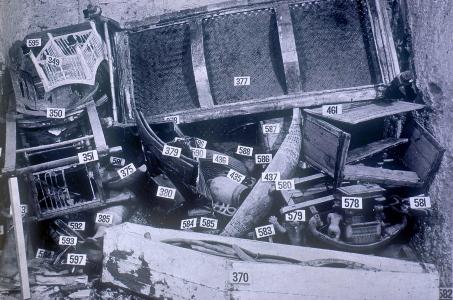
Wadi D-1 was discovered by locals from the West Bank in 1916. Word quickly spread through Luxor that the tomb was filled with gold objects and jewelry that were indicative of royalty. Approximately 1 month later, the Antiquities service excavated the tomb. While they did uncover further objects (now in Cairo Museum), a large portion of the tomb’s contents had already been removed by tomb robbers in the month prior and sold to antiquities dealers. Howard Carter, who excavated and studied the tomb shortly after the antiquities service’s excavation had concluded, spent several years thereafter attempting to locate the stolen objects on the antiquities market. A large portion thereof is now part of the Egyptian collection at the Metropolitan Museum of Art, New York.
The contents of the tomb, including Canopic jars, a large assortment of gold jewelry, and a gold diadem inlayed with semi-precious stones, indicate that the tomb belonged to three wives of Thutmes III. Both his Cartouche, as well as Hatshepsut’s name and titles as queen are present on a number of stone vessels, broad collars, and a mirror. Hieroglyphic inscriptions on the canopic jars name the three women - Menhet, Menwi, and Merti - and state that they held the title Hmt-nswt “King’s wife”. Most scholars agree that the names are not of Egyptian origin and that the three wives were foreign, although the exact area of origin is still debated.
While Menhet, Menwi, and Merti do not appear anywhere else in the archaeological record and are not mentioned alongside the other wives of Thutmes III, the fact that they carried the title “King’s wife”, were buried with lavish gifts, and were given a tomb typical of 18th Dynasty queens is indicative of their royal status.
Noteworthy features:
The tomb belonged to the three foreign wives of Thutmes III, Menhet, Menwi, and Merti, and is typical of 18th Dynasty queen’s tombs. It was filled with lavish royal gifts, including a large collection of gold jewelry inlaid with semi-precious stones, gold leaf and silver mirrors, and an assortment of beautiful stone cosmetic vessels.
Site History
According to Christine Lilyquist, Wadi D-1 was most probably constructed and filled with funerary equipment prior to Hatshepsut’s proscription (no earlier than year 42 of Thutmes III’s reign). This is due to the fact that the pottery discovered in the tomb favors an early 18th Dynasty date, as well as the fact that a number of stone vessels and scarabs from the tomb contain the name and titles of Hatshepsut.
After the burial of the Menhet, Menwi, and Merti, the tomb lay undisturbed until August 1916, when it was discovered by locals from the West Bank and robbed of the majority of its contents.
Dating
This site was used during the following period(s):
Exploration
Conservation
Site Condition
Due to its position at the base of a water worn cleft, the tomb suffered substantial flooding damage. Water coming from the plateau would empty into the cleft before flowing down into the Wadi, bringing debris that deposited in the tomb corridor. Furthermore, humidity from rain water entering the corridor and water seepage through the bed of rock above the tomb caused large chunks of limestone to fall from the ceiling of the burial chamber. Parts of the burial chamber ceiling have also been blackened by smoke from robbers’ fires and bats.
Due to its distant location and dangerous entry, the tomb is not open for public visitation.
Hieroglyphs
Queen Menhet
 The King's wife, Menhet
Hmt-nswt mnhtA
Queen Menwi
 The King's wife, Menwi
Hmt-nswt mnw-wAi
Queen Merti
 The King's wife, Merti
Hmt-nswt mrti

Cosmetic equipment of Menhet, Menwi, and Merti inscribed with the cartouche of Thutmes III (Metropolitan Museum of Art, 26.8.36a, b; 26.8.35a, b; 26.8.38a, b; 26.8.31a, b)

Gold sheet sandals from the funerary equipment belonging to one of three foreign wives of Thutmes III. They are decorated with details intended to imitate the decoration on leather sandals (MMA 26.8.146a, b)

Cuff Bracelets Decorated with Cats (MMA 26.8.121a).

Mirror with Handle in the Form of a Hathor Emblem. The handle of this mirror was originally made of wood (now restored) covered with gold foil (MMA 26.8.97).

Heart Scarab of Merti (MMA 26.8.145).

Mirror with Hathor Emblem Handle (MMA 26.8.98).

Heart Scarab of Menwi (MMA 26.8.91).

Amphora of Canaanite shape (MMA 18.8.19).

Libation Vessel of Menwi (MMA 18.8.21a, b).

Two-Handled Ointment Jar (MMA 18.8.18).

Piriform Stone Jar (MMA 18.8.17a).

Canopic Jar of Menwi (MMA 18.8.9a, b).

Piriform jug with cartouche of Thutmose III (MMA 26.8.16a).

Paired set of gold finger and toe stalls (MMA 26.8.154-158).

Armlet (MMA 26.8.140).

Oitment jar (MMA 26.8.33a, b).

Piriform jug with cartouche of Thutmose III (MMA 26.8.13).

Pair of Ribbed Penannular Earrings (MMA 26.8.92a, b).

String of lentoid beads (MMA 26.8.69a).

Three Strings of Beads (MMA 26.8.63a).

Melon Beads on Gold Wire (MMA 26.8.115).

Sweret Bead on Wire (MMA 26.8.114).

Gold folded cloth amulet (MMA 26.8.108).

Cuff Bracelet with Lion Cub Amulets (MMA 26.8.123a–g).

Large Krater with Strap Handles (MMA 26.8.2).

Canopic Jar of Merti (MMA 18.8.6a, b).

Canopic Jar of Merti (MMA 18.8.7a, b).

Girdle with Fish-Shaped Beads (MMA 26.8.61a).

Ointment jug with rope pattern (MMA 26.8.18).

Vulture pectoral, probably depicting the goddess Nekhbet (MMA 26.8.105).

Alabaster and gold goblet with the cartouche of Thutmes III (MMA 26.7.1434).

Drinking cup, probably imported from western Asia (MMA 26.7.1175).

Broad Collar with king's name is inscribed on the backs of the falcon-headed terminals (MMA 26.8.59a).

Hinged Cuff Bracelet (MMA 26.8.127).

A set of cosmetic jars highlighted with gold foil and inscribed with the cartouche of Thutmes III (MMA 26.8.29a, b–26.8.39).

Burnished gold, carnelian, and glass hinged bracelets inscribed with the cartouches and epithets of Thutmes III (MMA 26.8.129-130).

Girdle with gold and lapis wallet-shaped beads (MMA 26.8.60).

Broad collar of Nefer Amulets (MMA 26.8.135a).

Broad collar with falcon-head terminals (MMA 26.8.102).

Canopic Jar of Menwi (MMA 18.8.12a, b).

Wide-necked jar and lid with gold foil naming Thutmes III (MMA 26.8.34a, b).

Spherical Jar Inscribed with Hatshepsut's Titles as Queen (MMA 18.8.15).

Canopic jar inscribed with the name Menhet (MMA 18.8.3a, b).

Gold inlaid diadem with a pair of gazelle heads (MMA 26.8.99).

Heart Amulet of Menhet. The ends of the gold wire are shaped like birds' heads (MMA 26.8.144).

Lotiform chalice with gold foil. The sides are engraved with the cartouche of Thutmes III and a pattern of lotus petals (MMA 23.9).

Golden scarab finger ring with the names of Thutmes III and Hatshepsut (MMA 26.7.764).

Disk made of two sheets of gold, one concave and the other decorated with feathers or palm fronds (MMA 26.8.117bb).

Middle Kingdom pendant in the shape of an uraeus (MMA 26.8.81).

End of wadi D with ladder leading to Wadi D-1. Entrance to Wadi D-4 is in bottom right hand corner

View of burial chamber of Wadi D-1.
View of entrance to Wadi D-1
View of cleft and tomb entrance.

Entrance corridor to the burial chamber.


Articles
Funerary Equipment
